Showing posts with label 101 books. Show all posts

Thursday, 26 May 2022

101 books

Many years ago I made myself a '101 Books' challenge. I totally failed to complete it but the list sits there to taunt me. I recently read a review of 'Who was changed and who was dead' by Barbara Comyns and since it was on the list, I got it from the library. It reminded me most of 'Cold Comfort Farm', something of the rural atmosphere, and the slightly surreal characters, including the dominating elderly relative. The book starts with a flood, which gets the village all up in arms, and then people start dying, in random and unseemly ways, causing some measure of mass hysteria, all of which is observed rather bemusedly by Emma and Hattie and Dennis. It engaged me very much with the portrait of this somewhat secluded community and how it copes with disaster. 
Here is the grandmother, plotting, but confined by the fact that she has vowed never again to set foot on land she does not own, so she has to take her enjoyment in the situation as best she can:

"The old lady picked some beeswax out of her teeth as she pondered ways of putting her son in his place and brightened up a little when she decided to put the maids on to spring-cleaning his room. He couldn't sit up there in haughty isolation under those conditions. She chuckled to herself and felt happier. But if only she had been free to wander in the village and hear the screams coming out of cottage windows and perhaps even help nurse one of the unfortunate afflicted. She would dearly love to see someone who believed they were being pursued by monsters. So far there had only been five cases, but there would be more; she was confident there would be more. One of the maids might become a victim, or even Old Ives. The thought of Old Ives being devoured by imaginary monsters cheered her up considerably, and she trotted off to the potting shed to see if he looked at all queer; but she found him looking very well, sorting out some seeds he had been drying. She wasn't very pleased with the way he looked at her and asked how she was feeling." (p.87-88)

The other library book is '100 Prized Poems - Twenty-five years of the Forward Books', a celebration of works that have been published by Forward and won their poetry prizes. (If you have a few minutes, go and read this, (explanation here of what the poet, Nicole Sealey is writing about) the winner last year of the single poem prize). It has been some bedtime reading over the last few weeks, with many surprises and thought provoking moments, a few familiar names too. I give you this, War Poetry by Kate Clanchy. I loved the description of the broken nest, but also it feels somehow appropriate to the current world situation:

The class has dropped its books. The janitor's
disturbed some wasps, broomed the nest
straight off the roof. It lies outside, exotic
as a fallen planet, a burst city of the poor;
its newsprint halls, its ashen, tiny rooms
all open to the air. The insects' buzz
is low-key as a smart machine. They group,
regroup, in stacks and coils, advance
and cross like pulsing points on radar screens.

And though the boys have shaven heads
and football strips, and would, they swear,
enlist at once, given half a chance,
march down Owen's darkening lanes
to join the lads and stuff the Boche - 
they don't rush out to pike the nest,
or lap the yard with grapeshot faces.
They watch the wasps through glass,
silently, abashed, the way we all watch war.

Stay safe. Be kind. 

Sunday, 13 August 2017

Wrinkled

A Wrinkle in Time by Madeleine L'Engle. This is even more of a quickie than the other two today. Jill Fisher started reading this book aloud at an EO gathering years ago and I have been curious about it ever since, so I put it on my 101 books list. I was somewhat disappointed by it. Maybe if I had been reading it to the kids I would have enjoyed it more but although it was quite well written it lacked any subtlety in the story and the references to god put me off. I feel disappointed by my disappointment, because I wanted to like it, she is  much admired children's author. I think Philip Pullman has spoiled me.

Tuesday, 1 August 2017

Sorry Doris

On my parents bookshelf when I was a teenager was the book 'The Four-Gated City: Book Five of Children of Violence' by Doris Lessing. I was curious about this book title for years, but they didn't seem to own parts one to four, so in the end I bought them myself when I was a student. I had a bit of a Doris Lessing phase for some years and consider myself a great admirer. Mum said I could keep her copy of 'The Golden Notebook' because she didn't care for Doris much any more. I have started to read it twice, I'm sorry but this one is not for me.

Sunday, 4 June 2017

Nolite te Bastardes Carborundorum

I probably read 'The Handmaid's Tale' by Margaret Atwood thirty years ago; recent reading of her other books has provoked the desire to reread it, so we decided to have a little Margaret Atwood book group with some friends and get together to chat about the book.
I had very vague memories of the book so it was almost like reading it again for the first time. The Handmaid's Tale is set in some not necessarily very distant future where falling birthrates and a right wing fundamentalist regime has led to a new world order where women have no rights and those that are found to have viable ovaries are conscripted as child bearers for the government elite. We are thrust directly into this new reality, some vague explanations come later. Here Offred meets her partner on their daily shopping trip:

"'Blessed be the fruit,' she says to me, the accepted greeting among us.
'May the Lord open,' I answer, the accepted response. We turn and walk together past the large houses, towards the central part of town. We aren't allowed to go there except in twos. This is supposed to be for our protection, though the notion is absurd: we are well protected already. The truth is that she is my spy, as I am hers. If either of us slips through the net because of something that happens on one of our daily walks, the other will be accountable.
This woman has been my partner for two weeks. I don't know what happened to the one before. On a certain day she simply wasn't there any more, and this one was there in her place. It isn't the sort of thing you ask questions about, because the answers are not usually answers you want to know. Anyway there wouldn't be an answer." (p.29)

We gradually get some background to the events leading to this new theocracy, a violent revolution by christian fundamentalists. Offred gives some information about her past life, and hints at the loss of her husband and child. She does not know what has become of them, but she clings to the old memories and hope, it feels like a sign that her spirit is not broken:

"Any day now there may be a message from him. It will come in the most unexpected way, from the least likely person, someone I would never have suspected. Under my plate, on the dinner tray? Slipped into my hand as I reach the tokens across the counter in All Flesh?
The message will say that I must have patience: sooner or later he will get me out, we will find her, wherever they've put her. She'll remember us and we will be all three of us together. Meanwhile I must endure, keep myself safe for later. What has happened to me, what's happening to me now won't make any difference to him, he loves me anyway, he knows it isn't my fault. The message will say this also. It's this message, which may never arrive, that keeps me alive. I believe in the message.
The things I believe can't all be true, though one of them must be. But I believe in all of them, all three versions of Luke, at one and the same time. This contradictory way of believing seems to me, right now, the only way I can believe anything. Whatever the truth is, I will be ready for it.
This is also a belief of mine. This also may be untrue." (p.115-6)

But life has become almost too focussed on hopes and beliefs; the women know nothing. Moira, a friend from her former life, escapes from the Handmaid training centre, and becomes another beacon of hope for the women, but as she acknowledges, they are already accustomed to their new life and afraid of what rebellion could mean:

"The story passed among us that night, in the semi-darkness, under our breath, from bed to bed.
Moira was out there somewhere. She was at large, ordeal. What would she do? The thought of what she would do expanded till it filled the room. At any moment there might be a shattering explosion, the glass of the windows would fall inwards, the doors would swing open ... Moira had power now, she'd been set loose, she'd set herself loose. She was now a loose woman.
I think we found this frightening.
Moira was like an elevator with open sides. She made us dizzy. Already we were losing the taste for freedom, already we were finding these walls secure. In the upper reaches of the atmosphere you'd come apart, you'd vaporise, there would be no pressure holding you together.
Nevertheless Moira was our fantasy. We hugged her to us, she was with us in secret, a giggle; she was lava beneath the crust of daily life. In the light of Moira, the Aunts were less fearsome and more absurd. Their power had a flaw in it. They could be shanghaied in toilets. The audacity was what we liked.
We expected her to be dragged in at any minute, as she had been before. We could not imagine what they might do to her this time.It would be very bad, whatever it was. 
But nothing happened. Moira didn't reappear. She hasn't yet." (p.143)

Offred begins to have these strange, unorthodox meetings with the Commander. They play scrabble. And then he gives her an old copy of Vogue, and I had the best laugh of the book, it shows that along with her other intentions Margaret Atwood certainly does not lack a sense of humour:

"But why show it to me? I said, and then let stupid. What could he possibly say? That he was amusing himself, at my expense? For he must have known how painful it was for me, to be reminded of the former time.
I wasn't prepared for what he actually did say. Who else could I show it to? he said, and there it was again, that sadness.
Should I go further? I thought. I don't want to push him, too far, too fast. I knew I was dispensable. Nevertheless I said, too softly, How about your Wife?
He seemed to think about that. No, he said. she would't understand. Anyway, she won't talk to me much any more. We don't seem to have much in common these days.
So there it was, out in the open: his wife didn't understand him.
That's what I was there for, then. The same old thing. It was too banal to be true." (p.166)

This is how it happens, how the world might be turned upside down:

"It was after the catastrophe, when they shot the President and machine-gunned the Congress and the army declared a state of emergency. They blamed it on the Islamic fanatics, at the time.
Keep calm, they said on the television. Everything is under control.
I was stunned. Everyone was, I know that. It was hard to believe. The entire government gone like that. How did they get in, how did it happen?
That was when they suspended the Constitution. They said it would be temporary. There wasn't even any rioting in the streets. People stayed home at night, watching television, looking for some direction. There wasn't even an enemy you could put your finger one.
Look out, said Moira to me, over the phone. Here it comes.
Here what comes? I said.
You wait, she said. They've been building up to this. It's you and me up against the wall, baby. She was quoting some expression of my mother's, but she wasn't intending to be funny." (p.182-3)

And this, maybe this, is how the men would feel about it (after the women lose their jobs):

"We still have each other, I said. It was true. Then why did I sound, even to myself, so indifferent?
He kissed me then, as if now I'd said that, things could get back to normal. But something had shifted, some balance. I felt shrunken, so that when he put his arms around me, gathering me up, I was small as a doll. I felt love going forward without me.
He doesn't mind this, I thought. He doesn't mind at all. Maybe he even likes it. We are not each other's any more. Instead, I am his.
Unworthy, unjust, untrue. But that is what happened.
So Luke: what I want to ask you now, what I need to know is, Was I right? Because we never talked about it. By the time I could have done that, I was afraid to. I couldn't afford to lose you." (p.191-2)

It is not until Moira reappears that I think Offred realises how important a symbol of resistance she had become; you can feel her courage sinking, her ability to continue, there is no longer an idea of escape:

"'So here I am. They even give you face cream. You should figure out some way of getting here. You'd have three or four good years before your snatch wears our and they send you to the boneyard. the food's not bad and there's drink and drugs, if you want it, and we only work nights.'
'Moira,' I say. 'you don''t mean that.' She is frightening me now, because what I hear in her voice is indifference, a lack of volition. Have they really done it to her then, taken something away - what? - that used to be so central to her? But how can I expect her to go on, with my idea of her courage, live it through, act it out, when I myself do not?
I don't want her to be like me, give in, go along, save her skin. That is what it comes down to. I want gallantry from her, swashbuckling heroism, single-handed combat. Something I lack." (p.261)

Amongst the utter horror of her experience she finds hope is some unexpected places, and Atwood gives us something to cling on to at the end, but as she has said, all experiences in the story are from real life, they are all things that have happened, or are happening to women in the world today. Out there, in the real world, there is so much still to be accomplished.
We had a lovely evening munching crackers and hummus and talking round in circles, and getting off the subject. We did use some of the suggested questions from this discussion guide, they seemed less schooly than many of the links I found. Plans are afoot for another book.

Tuesday, 4 April 2017

acquiescence and compromise

I am not sure if the emotional intensity of Elizabeth Smart's 'By Grand Central Station I Sat Down and Wept' was spoiled by reading it three pages at a time with my breakfast. This is definitely poetry, for all that it appears to have chapters and some minor narrative progress. The book is an internal monologue charting the highs and lows of the early years of her love affair with poet George Barker. It seems the most surreal of ideas to fall in love with someone's writing and for that to become a real tangible attachment to the person. We don't learn anything about George from the book, but his Wikipedia page says he had fifteen children with an unmentioned number of women, including Elizabeth and his two wives, and the two descriptive words 'catholic' and 'bohemian' seems somewhat contradictory. But the book is not about him, it is about love itself, and the power it has over those possessed by it. Prepare for a small cascade of quotations.

Her thoughts on their first few days together:

"So we drive along the Californian coast singing together, and I entirely renounce him for only her peace of mind. The wild road winds round ledges manufactured from the mountains and cliffs. The Pacific in blue spasms reaches all its superlatives.
Who do I not jump off this cliff where I lie sickened by the moon? I know these days are offering me only murder for my future. It is not just the creeping fingers of the cold that dissuade me from action, and allow me to accept the hypocritical hope that there may be some solution. Like Macbeth, I keep remembering that I am their host. So it is tomorrow's breakfast rather than the future's blood that dictates fatal forbearance. Nature, perpetual whore, distracts with the immediate. Shifty-eyed with this fallacy, I plough back to my bed, up through the tickling grass." (p.18)

After the first time they make love:

"Gently the wood sorrel and the dove explained the confirmation and guided my return. When I came out of the woods onto the hill, I had pine needles in my hair for a bridalwreath, and the sea and the sky and the gold hills smiled benignly. Jupiter has been with Leda, I thought, and now nothing can avert the Trojan Wars." (p.25)

Contemplating the feelings of Barker's wife Jessica:

"But the gentle flowers, able to die unceremoniously, remind me of her grief whose tears drown all ghosts, and though I swing in torture from the windiest hill, more angels weep for her whose devastated love runs into all the oceans of the world.
What did she cherish as her symbol, and how did she protect herself from panic when her ship pursued the month's-old storm, and she fought the cancer which was her knowing grief for her lost child? I have broken her heart like a robin's egg. Its wreck reaches her finite horizon." (p.35)

When they are arrested (for crossing the state line for immoral purposes):

"But you care about justice, inspector, or you wouldn't be where you are?
I don't make the laws, he said, it isn't up to me, I have no authority. He smiled, but he was afraid of his smile and went away with a thin-lipped man and read the letters we had written.
They're only literary letters, I said, about things we both liked.
But you're a Communist? he said.
No.
But you've taken part in Communist activities?
No.
You have friends who are Communists?
Not more than other sorts.
He repented his smile and was severe in result. The thin-lipped man was livid with hate of our lineaments of gratified desire. He sneaked through the streets at dusk to warn the hotel.
The two policemen who had arrested us and brought us over the deserts together on a bench, like minor schoolboys, washed and brushed and well-behaved, to return to their wives and calm households and their suppers, while we hurtled through confusion into tragedy because of their caprice on the Arizona border." (p.50-1)

On the disapproval of her mother:

"Then my mother's clutch held me every way, with claws of biology and pity and hysterical hypnotism, and made me long for my annihilation. Can even Freud explain the terror of that clutch, the inescapability of its greed for authority, and why it was stronger than the North East wind, memory, reason, or Pre-Cambrian rock?" (p.66)

On being apart:

"Philosophy, like lichens, takes centuries to grow and is always ignored in the Book of Instructions. If you can't Take It, Get Out.
I can't take it, so I lie on the hotel bed dissolving into chemicals whose adventure will pursue time to her extinguishment, without the slightest influence from these few years when I held them together in human passion." (p.84)

Weeping at Grand Central Station:

"But what except morphine can weave bearable nets around the tigershark that tears my mind to shreds, seeking escape on every impossible side? The senses deliver the unbearable into sleep, and it ceases, except that it appears gruesomely at the edges of my dreams, making ghastly signals which wear away peace, but which I cannot understand.
The pain was unbearable, but I did not want it to end: it had operate grandeur. It lit up Grand Central Station like a Judgement Day. It was more iron-muscled than Samson in his moment of revelation. It might have shown me all Dante's dream. But there was no way to endure." (p.103-4)

It is like a greek tragedy, such melodrama, I found myself lurching between sympathising and wanting to tell her to pull herself together. If she was your best friend you would warn her that she was wasting her life on him. I loved the fact that she relishes every moment of what she is experiencing, the good and the bad, almost basking in the heat of the emotions; as she says in the quote above, she does not want it to end, like exquisite misery. I think I was more taken with the miserable passages than the besotted ones, maybe I'm just old and cynical now. As I said you get nothing about George, so I was left to wonder what it was that she loved about him, the book does not even tell you that, it is as if the love is all inside her head and has little to do with the human being he is. I think it would be better read in one sitting, and at just over 100 pages it would only be an afternoon. This book was written during the war and was relative unknown for many years. She went back to creative writing much later in her life after rising her children alone, she sounds like a fascinating woman and certainly someone to read more of.

Thursday, 16 February 2017

Brave New World

'Brave New World' by Aldous Huxley is such an iconic book, one of many to imagine an alternative reality, but rereading it it feels dated and almost quaint; some parts have fantastic futuristic technology and other parts are stuck firmly in the 1930s. Set several hundred years into the future it gives us a world where God has been replaced with Ford, but only in that babies are now created on a production line rather than via the traditional method. The first few chapters detail this process for the reader, so they understand how the manipulation of human life has become the basis for a new pre-determined social caste system that dictated how the whole of society is organised. The developing foetuses are enhanced or 'poisoned' to differing degrees and then conditioned as children (raised by the state of course) to accept their place and to be unquestioning participants in the life they are allocated. 

" 'Stability,' said the Controller, 'stability. No civilization without social stability. No social stability without individual stability.' His voice was a trumpet. Listening they felt larger, warmer.
The machine turns, turns and must keep turning - for ever. It is death if it stands still. A thousand million scrabbled the crust of the earth. The wheels began to turn. In a hundred and fifty years there were two thousand millions. Stop all the wheels. In a hundred and fifty weeks there are once again only a thousand million; a thousand thousand thousand men and women have starved to death.
Wheels must turn steadily, but cannot turn unattended. There must be men to tend them, men as steady as the wheels upon their axles, sane men, obedient men, stable in contentment." (p.44)

"Before Bernard could answer, the lift came to a standstill.
'Roof!' called a creaking voice.
The lift man was a small simian creature, dressed in the black tunic of an Epsilon-Minus Semi-Moron.
'Roof!'
He flung open the gates. The warm glory of afternoon sunlight made him start and blink his eyes. 'Oh, roof!' he repeated in a voice of rapture. He was as though suddenly and joyfully awakened from a  dark annihilating stupor. 'Roof!'
He smiled up with a kind of doggily expectant adoration into the faces of his passengers. Talking and laughing together, they stepped out into the light. The lift man looked after them." (p.56)

Bernard Marx (a bit of an outsider) and Lenina Crowne take a trip together to the Reservation, a place outside Civilization, to see how the 'savages' live. There they meet Linda, a woman from civilization, abandoned pregnant and forced to live and raise her baby as an outcast. Bernard arranges to bring Linda and her now grown son John back to civilization. John, having been neglected by his alcoholic mother, has a view of life and morality formed by a weird combination of living amongst the Indians and by reading the Complete Works of Shakespeare (the only book available to him) and he experiences the delights of civilization with increasing horror. He becomes a minor celebrity with people vying with each other for invites to meet him, but lacking the childhood conditioning that would enable him to fit in it is obvious things are not going to work out well. 

The morality of quasi-compulsory sexual promiscuity is an extension of the lack of any real bonds between people, they have no family bonds of course and they are discouraged from having ongoing relationships. What is most disturbing about the book is the way that social control is achieved through a passive, coddled, drugged and entertained population; there is no violence or repression, everyone just does what is expected of them because they do not have the ability to think otherwise, even those at the top of the hierarchy. In fact, it is not merely in his precognition of test tube babies that Huxley is so accurate, but also the advent of virtual reality, mass consumerism and a disposable culture. I was wrong, it is not quaint. The more I think about and reread odd pages the more disturbing it becomes. In a way the story of John's experiences are a distraction from the story of the society, the undercurrent of which is the real purpose of the book. Here, I love the wonderful juxtaposition of the idyllic children's garden with the political message: 

"Outside, in the garden, it was playtime. Naked in the warm June sunshine, six or seven hundred little boys and girls were running with shrill yells over the lawns, or playing ball games, or squatting silently in twos and threes among the flowering shrubs. The roses were in bloom, two nightingales soliloquised in the boskage, a cuckoo was just going out of tune among the lime trees. The air was drowsy with the murmur of bees and helicopters.
The Director and his students stood for a short time watching a game of Centrifugal Bumble-puppy. Twenty children were grouped in a circle round a chrome-steel tower. A ball thrown up so as to land on the platform at the top of the tower rolled down into the interior, fell on a rapidly revolving disk, was hurled through one of other of the numerous apertures pierced in the cylindrical casing, and had to be caught.
'Strange,' mused the Director, as they turned away, 'strange to think that even in Our Ford's day most games were played without more apparatus than a ball or two and a few sticks and perhaps a bit of netting. Imagine the folly of allowing people to play elaborate games which do nothing whatever to increase consumption. It's madness. Nowadays the Controllers won't approve of any new game unless it can be shown that it requires at least as much apparatus as the most complicated of existing games.'" (p.35)

An interesting reread, and it would be fascinating to know what Huxley might make of the 21st century world.

Thursday, 5 January 2017

One flew east, one flew west ...

'One flew over the cuckoo's nest' is such an iconic film that the book by Ken Kesey might seem superfluous, but I found that they compliment and enhance each other. The story in the book is narrated by the Chief who is believed by staff and inmates to be deaf and dumb, but who has simply adapted to a world that has ignored him. Into the regular and secure environment of their institution lands McMurphy, who's one aim, right from the start, seems to be to stir things up. The tight ship is run by Nurse Ratched who controls every waking moment of the men's lives, and the Chief recounts what becomes a battle of wills between Mack and the Big Nurse. This book is all about the atmosphere of the mental institution, stifling and monotonous, but also the divorce that happens for the inmates between reality and the life they are experiencing. The Chief, who's presence on the ward is not explained, suffers from delusions and hallucinations, bad dreams, and an extreme paranoia, and throughout the book it is his thoughts and experiences we are pulled in to. It can be quite scary:

"The least black boy and one of the bigger ones catch me before I get ten steps out of the mop closet, and drag me back to the shaving room. I don't fight or make any noise. If you yell it's just tougher on you. I hold back the yelling. I hold back till they get to my temples. I'm not sure it's one of those substitute machines and not a shaver till it gets to my temples; then I can't hold back. It's not a will power thing any more when they get to my temples. It's a ... button, pushed, says Air Raid Air Raid, turns me on so loud it's like no sound, everybody yelling at me hands over their ears from behind a glass wall, facing working around in talk circles but no sounds from the mouths. My sound soaks up all the other sound. They start the fog machine again and it's snowing cold and white all over me like skim milk, so thick I might even be able to hide in it if they didn't have a hold on me. I can't see six inches in front of me through the fog and the only thing I can hear over the wail I'm making is the Big Nurse whoop and charge up the hall while she crashes patients outta her way with that wicker bag. I hear her coming but I still can't hush my hollering. I holler till she gets there. They hold me down while she jams wicker bag and all into my mouth and shoves it down with the mop handle." (p.7)

McMurphy's presence is unsettling for the inmates as much as for Nurse Ratched; their cosy little world is being upset and they are just as worried about changes to their routine. For the Chief however it comes as a revelation, slowly he begins to see things more clearly and to want to change things. Here is his description of the change that McMurphy brings:

"Sweeping the dorm soon's it's empty, I'm after dis mice under his bed when I get a smell of something that makes me realise for the first time since I been in this hospital that this big dorm full of beds, sleeps forty grown men, has always been sticky with a thousand other smells - smells of germicide, zinc ointment, and foot power, smell of piss and sour old-man manure, of Pablum and eyewash, of musty shorts and socks musty even when they're fresh back from the laundry, the stiff odour of starch in the linen, the acid stench of morning mouths, the banana smell of machine oil, and sometimes the smell of singed hair - but never before now, before he came in, the man smell of dust and dirt from the open fields, and sweat, and work." (p.96)

There is an up-side to his sense of being removed and unnoticed; here the Chief describes going into a painting:

"I push my broom up face to face with a great big picture Public Relations bought in one time when it was fogged so thick I didn't see him. The picture is a guy fly-fishing somewhere in the mountains, looks like the Ochocos near Paineville - snow on the peaks showing over the pines, long white aspen trunks lining the stream, sheep sorrel growing in sour green patches. The guy is flicking his fly in a pool behind a rock. It's no place for a fly, it's a place for a single egg on a number-six hook - he'd do better to drift the fly over those riffles downstream.
There's a path running down through the aspen, and I push my broom down the path aways and sit down on a rock and look back out through the frame at the visiting doctor talking with the residents. I can see him stabbing some point in the palm of his hand with his finger, but I can't hear what he says because of the crash of the cold, frothy stream coming down out of the rocks. I can smell the snow in the wind where it blows down off the peaks. I can see mole burrows humping along under the grass and buffalo weed. It's a real nice place to stretch your legs and take it easy." (p.120)

The tale unfolds as McMurphy tries to take the others out of their comfort zone, not appreciating the potential consequences of his high jinks and despite warnings about how the 'Combine' will not be beaten. There is no hope for McMurphy, but there is, in the end, for the Chief. If you love the film I would highly recommend you give the novel a chance, it has a different perspective and added depth to the characters.

Friday, 16 December 2016

The Well of Loneliness

'The Well of Loneliness' by Radclyffe Hall.
This fascinating Brainpickings article outlines the ins and outs of the obscenity trials, both here and in the US, that made this book and its author cultural icons of the 20th century. I nearly gave up on it during the early chapters as it is deathly dull, as a young child she is just confused and made bereft by the loss of her beloved father, but once Stephen begins to confront rather than hide from the difference she knows marks her out it became more interesting. The book charts the life of a young woman as she comes to understand her sexuality and gender identity, from her childhood crush on a young housemaid, through an intense friendship with a married woman, to an enduring love affair with a young woman she meets during the First World War. Her unease with all things female is evident from a young age and her inability to conform the social expectations weighs heavily on her as the years pass. Born into the wealth she is somewhat protected from the consequences of what would have been a catastrophic ostracising by her social class; her inheritance provides for her and when events takes her to Paris she has the means to establish a new life for herself. I expected the move to Paris to provide her with a bohemian enclave of support and friendship but it is a rather small and sorry little group that she becomes part of, all of them equally on the run from disapproval. She longs wistfully for home and her childhood throughout the book and never confronts her mother over her cruel rejection. She looks at herself and sees only oddness, never learning to relish and celebrate her unconventionality, constantly, it seems, wishing she were more normal and acceptable. 

I think that what I liked about the book is that it is just the story of a woman trying to make her way in the world, trying to make her mark and trying to protect the person she loves. The style is very dated and somewhat repetitive, long descriptions of Stephen's inner thoughts that go over the same subjects time and again. She is a very strong and likeable character, and in fact most of the other people in the story are somewhat shallow and underdeveloped; the book is about Stephen, the other players just people the background of her life. I think the book of course is very much of its time and the gender roles (and social class divides) that it describes are so much more rigid than nowadays. Here are two contrasting quotes on how Stephen relates to women and men:

"There she would stand with her strong arms folded, and her face somewhat strained in an effort of attention. While despising these girls, she yet longed to be like them - yes, indeed, at such moments she longed to be like them. It would suddenly strike her that they seemed very happy, very secure of themselves as they gossiped together. There was something so secure in their feminine conclaves, a secure sense of oneness, of mutual understanding; each in turn understood the other's ambitions. They might have their jealousies, their quarrels even, but always she discerned underneath, that sense of oneness." (p.74)

"Could Stephen have met men on equal terms, she would always have chosen them as her companions; she preferred them because of their blunt, one outlook, and with men she had much in common - sport for instance. But men found her too clever if she ventured to expand, and too dull if she suddenly subsided into shyness. In addition to this there was something about her that antagonised slightly, an unconscious presumption. shy though she might be, they sensed this presumption; it annoyed them, it made them feel on the defensive. she was handsome but much too large and unyielding both in body and mind, and they liked clinging women. They were oak-trees, preferring the feminine ivy. It might cling rather close, it might finally strangle, it frequently did, and yet they preferred it, and this being so, they resented Stephen, suspecting something of an acorn about her." (p.74-5)

It is very much a cry for tolerance and acceptance of homosexuality and gender fluidity, and the thing that the book does well is to allow the reader to feel the depth of her sorrow and vulnerability over being shunned by society. I am not sure I would recommend it other than for its curiosity value, but it began a conversation that continues to this day and the story has an enduring relevance simply because there is still so far to go towards the tolerance she yearned for.

Friday, 18 November 2016

Bridge Building

Neil Postman wrote a book called 'Teaching as a Subversive Activity' that was a significant influence on me when my children were home educated. I bought 'Building a Bridge to the 18th Century' several years ago and it has been waiting patiently on the list. The book is about the ideas of the 18th century and how they laid the foundation for the modern world and 20th century thinking, and what they still have to offer us in terms of the future: "I do not mean - mind you- technological ideas, like going to the moon, airplanes and antibiotics. We have no shortage of those ideas. I am referring to the ideas of which we can say they have advanced our understanding of ourselves, enlarged our definition of humanness." (p.13-14)

"The eighteenth century is the century of Goethe, Voltaire, Rousseau, Diderot, Kant, Hume, Gibbon, Pestalozzi, and Adam Smith. It is the century of Thomas Paine, Jefferson, Adams, and Franklin. In the eighteenth century we developed our ideas of inductive science, about religious and political freedom, about popular education, about rational commerce, and about the nation-state. In the eighteenth century, we also invented the idea of progress, and, you may be surprised to know, our modern idea of happiness. It was in the eighteenth century that reason began to triumph over superstition. And, inspired by Newton, who was elected president of the Royal Society at the beginning of the century, writers, musicians, and artists conceived of the universe as orderly, rational, and comprehensible." (p.17-18)

I read it over several months so have not ended up with a coherent picture of his message, so am going to give you a selection of quotes that I noted as I read. He examines ideas surrounding progress, the use of language to understand ideas:

"We struggle as best we can to connect our words with the world of non-words. Or, at least, to use words that will resonate with the experiences of those whom we address. But one worries, nonetheless, that a generation of young people may become entangled in an academic fashion that will increase their difficulties in solving real problems - indeed, in facing them. Which is why, rather than reading Derrida, they ought to read Diderot, or Voltaire, Rousseau, Swift, Madison, Condorcet, or many of the writers of the Enlightenment period who believed that, for all of the difficulties in mastering language, it is possible to say what you mean, to mean what you say, and to be silent when you have nothing to say. They believed that it is possible to use language to say things about the world that are true - true, meaning they are testable and verifiable, that there is evidence for believing. Their belief in truth included statements about history and about social life, although they knew that such statements were less authoritative than those of a scientific nature. They believed in the capacity of lucid language to help them know when they had spoken truly or falsely. Above all, they believed that the purpose of language is to communicate ideas to oneself and to others. Why, at this point in history, so many Western philosophers are teaching that language is nothing but a snare and a delusion, that it serves only to falsify and obscure, is mysterious to me." (p.80-81)

the place of information and narrative within our culture:

"The problem addressed in the nineteenth century was how to get more information to more people, faster, and in more diverse forms. For 150 years, humanity has worked with stunning ingenuity to solve this problem. The good news is we have. The bad news is that, in solving it, we have created another problem, never before experienced: information glut, information as garbage, information divorced from purpose and even meaning. As a consequence, there prevails amongst us what Langdon Winner calls 'mythinformation' - no lisp intended. It is an almost religious conviction that at the roots of our difficulties - social, political, ecological, psychological - is the fact that we do not have enough information." (p.89)

"Those who speak enthusiastically about the great volume of statements about the world available on the Internet do not usually address how we may distinguish the true from the false. By it's nature, the Internet can have no interest in such a distinction. It is not a 'truth' medium; it is an information medium." (p.92)

"I define knowledge as organised information - information that is embedded in some context; information that has a purpose, that leads one to seek further information in order to understand something about the world. Without organised information, we may know something of the world, but very little about it. When one has knowledge, one knows how to make sense of information, know how to relate information to one's life, and, especially, knows when information is irrelevant.
It is fairly obvious that some newspaper editors are aware of the distinction between information and knowledge, but not nearly enough of them. There are newspapers whose editors do not yet grasp that in a technological world, information is a problems, not a solution. They will tell us things we already know about and will give little or no space to providing a sense of context or coherence." (p.93)

and the role of education and childhood:

"In the Protestant view, the child is an unformed person who, through literacy, education, reason, self-control and shame, may be made into a civilised adult. In the Romantic view, it is not the unformed child but the deformed adult who is the problem. The child possesses as his or her birthright capacities for candour, understanding, curiosity, and spontaneity that are deadened by literacy, education, reason, self-control, and shame." (p.121)

"The whole idea of schooling, now, is to prepare the young for competent entry into the economic life of the community so that they well continue to be devoted consumers." (p.126)

Including an interesting suggestion for the improvement of scientific education:

"The story told by creationists is also a theory. That a theory has its origins in a religious metaphor or belief is irrelevant. Not only was Newton a religious mystic but his conception of the universe as a kind of mechanical clock constructed and set in motion by God us about as religious an idea as you can find. What is relevant is the question, To what extent does a theory meet scientific criteria of validity? The dispute between evolutionists and creation scientists offers textbook writers and teachers a wonderful opportunity to provide students with insights into the philosophy and methods of science. After all, what students really need to know is not whether this or that theory is to be believed, but how scientists judge the merit of a theory. Suppose students were taught the criteria of scientific theory evaluation and then were asked to apply these criteria to the two theories in question. Wouldn't such a task qualify as authentic science education?" (p.168)

It is a hard book to pin down because he covers so many ideas, and often assumes rather a lot of knowledge on the part of his readers, though the book is all the better for that, there is nothing worse than academics dumbing down their thinking. I think it lacked some kind of conclusion, just ending with several appendices of quotations from a wide variety of writers from Lord Byron to George Orwell, and an essay on why television is ruining childhood. This book, reflecting on the impact the current technological revolution is having on our society, was published in 1999 and was Postman's final book, and I can't help but wonder what he might have made of where we are now.

Sunday, 9 October 2016

Literary failures and successes

I have admitted defeat (for the time being) with Gravity's Rainbow by Thomas Pynchon. I picked it up in the library on the spur of the moment and struggled with it for a fortnight, but it is impenetrable. Even though there is a wiki specifically designed to lead you through the finer points of the novel I decided that this is just not the right time for me to tackle something that needs an explanation of what is happening in each paragraph. Maybe when I have a year with nothing better to do, or when the arthritis has removed my ability to do anything other than read, or perhaps I'll get one of my grandchildren to read it to me as I lie on my deathbed. Anyway, I'm sure I'll give it another go at some point. 

On the plus side the Manchester Literature Festival is now well under way. I went to my first event last month however, one of the preview events, that saw my wonderful Professor Harari visiting to promote his new book. I did his Coursera course, 'A Brief History of Human Kind' three years ago (unfortunately it no longer seems to be available) and I was so excited to discover he was going to be coming to the festival. His new book, Homo Deus, is an examination of where the human race might be headed next.
I was a little starstruck when I went to get him to sign his book and managed to mumble something barely intelligible about how much I had enjoyed the course, but it was really lovely to see him in person, and he was just like he seemed in the online lectures. 
Last night I did my second event; the most wonderful Lemn Sissay was performing as part of the 8th annual Black and Asian Writers Conference organised by Cultureword at the Contact Theatre. I confess I had not heard any of his poetry previously but knew of him after he was elected Chancellor of Manchester University last year. He approached me in the foyer when he arrived, because I was wearing a MLF volunteer t-shirt, and asked about books for sale, and he was very distressed to find that, due to some very poor communication, there were none. The event, nevertheless, was a roaring success, sold out, and he was so funny and engaging and chatted on during the question and answer session way past the official finish time. 
His new collection is called 'Gold from the Stone'.
I will just give you this poem, called 'Some things I like', which is quite a good example of his style and delivery, though this video is from a couple of years ago. 

Wednesday, 5 October 2016

Viddy those malenky droogs - Banned Books Week

Banned Books Week was last week and it managed to take me all week to read 'A Clockwork Orange' by Anthony Burgess, it being the third time I have tried to read this book. I finished the last few pages this morning with my cup of tea and was well pissed off I can tell you. Have you read it? What the hell! I searched for some reviews and came across the information that the final 21st chapter was, under pressure from the American publishers, omitted from the original publication, and this version was the basis for the film (I have seen the film but too long ago to recall the ending.) Burgess, however, later in life, reasserted his original plan for the story and now most copies will include the final 'redemptive' chapter. It is wrong, so very very wrong. I am not sure I have disagreed with an author about his own book like this before. There is no redemption for Alex, there is no way he is going to 'grow out of' his profoundly violent, anti-social behaviour, it's just not on the cards for him. 

I decided not to look up a Nadsat dictionary and just went with reading and guessing from context the meaning of the words. The creation of this new way of talking I think is probably the most interesting aspect of the book. The reader is forced to think hard about how we get meaning from language and what words are, and about the way, for some social groups, the way they talk is an important part of their identity and social cohesion (I mean in terms of accent and dialect rather than separate languages). It takes some getting used to but by the end it was totally normal. While some argue that Burgess is writing about a dysfunctional society, I thought that the society, though in some measure reflecting the violence of the gang, was really quite normal. Alex, however, was a psychopath, not merely a wayward youth, and if the book is about whether you can change someone's moral framework, the answer has to be no, if they don't have one in the first place. He utterly lacks empathy or a sense that anyone else is an autonomous human being with rights and emotions of their own. He is impulsive and uncontrolled, thinking only of his own pleasurable experiences and seeks out victims for his violent urges. They are not random events caused by anger or frustration but planned and carefully executed to cause the most extreme trauma. His contempt for women in particular is obvious. He initiates, participates and also observes and gets pleasure from all three. There is no explanation for his behaviour, another thing that makes him seem psychopathic, that there is no reason, he just does it. His reaction to prison, the Ludovico experiment and his subsequent release from prison are all based on how to minimise his own suffering and inconvenience; there is never any change in his attitude towards others, they are always just things that might or might not provide him with amusement. I wondered whether his enjoyment and admiration for classical music was supposed to be some kind of redeeming feature, and there were moments when I felt some sympathy for him, but on reflection maybe that was because he felt so so sorry for himself. This suddenly reminded me of 'Lolita', and the 'unreliable narrator' issue, because Alex is telling us this story, and although he is completely honest about the violence he commits, what you are reading is his excitement at the events, which manages to undermine your own reaction to the description. I wonder if this is why the book, and the film, have sometimes been accused of glamourising violence, because it is Alex's view we have of each incident, so it is almost as if the reader/viewer is almost forced to adopt his 'moral' code. So when I reached the end and he muses about the idea of getting married and having a son it was just completely wrong. This is a boy who has no real relationships with other human beings, not even his parents, you cannot envisage him forming a loving bond with anyone, he is incapable of it. He seems to think he is becoming bored by the ultra-violence and is growing up, but you can't see him getting a nice settled job and being a reliable member of society. 

In my browsing I came across Daniel at The Gemsbok who has a brilliant analysis of why Clockwork Orange is better without the last chapter, and some interesting quotes from Burgess about the book. It is strange to think of a writer disparaging his own most well known work, though it makes me curious to read something else he has written and I may have to seek out some advice at the International Anthony Burgess Foundation where the Manchester Literature Festival holds many of its events. I am not sure what else to say about the book, something this well known does not need further description. The issue of whether someone is still 'human' if their ability to make moral decisions has been taken away seems quite a minor feature of the book, and in fact I felt more that the way the politicians use Alex as a pawn in their game was showing how politicians use people's lives to justify their policies and that they are as amoral as Alex is in their use of other people for their own purposes.
Will finish with this quote, because you need to read it to believe quite how linguistically inventive this novel is. Here is Alex, being arrested after being abandoned by his gang at the house of the old cat lady:

" 'A real pleasure this is,' I heard another millicent goloss say as I was tolchocked very rough and skorry into the auto. 'Little Alex all to our own selves.' I creeched out:
'I'm blind. Bog bust and bleed you, you grahzny bastards.'
'Language, language,' like smecked a goloss, and then I got a like backhand tolchock with some ringy rooker or other full on the rot. I said:
'Bog murder you, you vonny stinking bratchnies. Where are there others? Where are my stinking traitorous droogs? One of my cursed grahzny bratties chained me on the glazzies. Get them before they get away. It was all their idea, brothers. They like forced me to do it. I'm innocent, Bog butcher you.' By this time they were all having like a good smeck at me with the heighth of like callousness, and they'd tolchocked me into the back of the auto, but I still kept on about these so-called droogs of men and the  I viddied it would be no good, because they'd all be back now in the snug of the Duke of New York forcing black and suds and double Scotchmen down the unprotesting gorloes of those stinking starry ptitsas and they saying: 'Thanks lads. God bless you, boys. Been here all the time you have, lads. Not been out of our sight you haven't.' " (p.53-4)

Monday, 29 August 2016

LMNOP

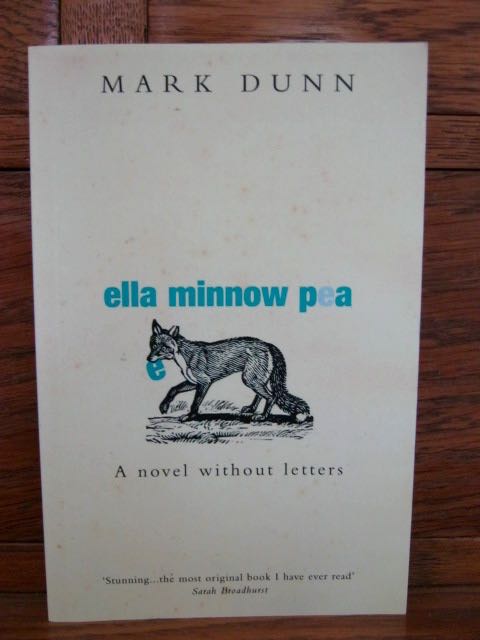
Monkey and I bought a few books in Waterstones the other day. 'Ella Minnow Pea' by Mark Dunn is on my 101 Books list and it was on one of their display tables, so I picked it up. As usual it is so long ago that I read about it, but it was worth the wait. Such a clever, original and entertaining book, described in the inside as "a progressively lipogrammatic epistolary fable".

When I left Poly I taught myself to type on my mum's manual typewriter by typing the phrase 'The quick brown fox jumps over the lazy dog' over and over. While I never got very good at using more than four or five fingers it did teach me the position of all the letters so I can type fairly rapidly without having to search. This story gives us Nevin Nollop, the imagined creator of this magical sentence, and a small independent island community (also called Nollop) off the coast of America that has come to venerate his memory. When one day one of the letters falls from the monument that bears the sentence the local council decide that it is Nevin himself speaking to them from beyond the grave and that this letter (Z) must be expunged from the lexicon (both oral and written) of the community. To begin with the reaction is almost bemusement, but the punishments are harsh and swift and the Law Enforcement Brigade ensures that the population are quickly cowed into submission. The description of the events takes the form of letters between Ella and Tassie, cousins trapped by poor road conditions on opposite sides of the island. As time passes the correspondence increases to include a wider variety of the island's occupants. In line with the gradually tumbling letters the correspondence also begins to take on a peculiar quality. You hardly notice the absence of the Z, and even the Q and the J, but when the D goes everyone begins to struggle. The protests are few and short-lived. People are exiled in ever increasing numbers as a small resistance movement struggles to contrive a 32 letter sentence of the 26 letters, to disprove the divinity of Nollop.


"Nollopton
Thurby, September 21
Throbbing Sister Mittie,
Still you are luckier to be in the village. Eighteen families were sent away this morning. Many of the members I knew. Losing the first three letters was relatively easy in comparison to this most recent banishment.
Slips of the tongue. Slips of the pen. All over town people hesitate, stammer, fumble for ways to express themselves, grip-grasping about for linguistic concoctions to serve the simplest of purposes. Receiving no easy purchase.
I go to the baker's. I point. We all point. We collapse upon our mattresses at the close of each evening, there to feel ... feel ... utterly, wholly diminished.
There. Now I happily enlist in the 'first offence club.' It feels exhilarating! You know I cannot allow you to be a member of any club to which I cannot belong. I will show a copy of this letter to one of our local authorities.
I will receive my official censure.
We shall be sister-true as always.
love,
Gwenette"
(p.75)

The book is described as a political allegory, charting the rise of a totalitarian state, but I found it to be much more about religious orthodoxy (and really the whole notion that if you give people arbitrary authority it is likely to get easily out of hand). The council claim an omniscient god-like status for their Nollop, they are like a priesthood, interpreting the signs and making these rules for the good of his followers. In a pronouncement issues by the High Council:

"7.The falling tiles can represent only one thing: a challenge - a summons to bettering out lot in the face of such deleterious complacency, and in the concomitant presence of false contentment and rank self-indulgence.
8. There is no room for alternative interpretations.
9. Interpretation of events in any other way represents heresy.
10. Heretics will be punished, as was, for example, Mr Nollop's saucy stenographer, who was cashiered for flippantly announcing to her employer the ease with which she could, herself, create such a sentence as his." (p.53)

Some people take the path of least resistance by ceasing to communicate and with desperation some of the remaining residents try to support and encourage each other. I had to partly just go with the slightly surreal and absurd scenario because my enjoyment in reading the book was the playing with language and words and the way the letter writers get around using the forbidden letters. New words are invented to represent the days of the week after the D falls, but these words themselves mutate over time as other letters become verboten. The odd foreign word sneaks in and then a vaguely twisted phonetic writing system emerges:


"Nollopton
Montae, Nophemger 12
To the Towgate Phamilee:
Please aspect my hartphelt simpathee at this time. Georgeanne past awae last night phrom let poisoning. She paintet her whole selph phrom het to toe with manee prettee, ornamental hews. She was so resplentent, almost ratiant in repose - the happee, appealing pigments an aesthetit reminter of her lophlee warm spirit.
She shoot loog smashing 4 the phooneral.
Her remains shoot arriph shortlee.
With all regrets,
Ella Minnow Pea"
(p.179)

I assume that, like myself, many readers spot the answer to the community's conundrum when it appears in one of the letters, and I laughed out loud as if the whole book had been one very long shaggy dog story; Mark Dunn manages to integrate into the story, in such a wonderfully convoluted way, the ability of one of the characters to write the sentence without it seeming out of place. The book made an interesting contrast to 'The Guernsey Literary and Potato Peel Pie Society' which I also loved but which focussed much more on the community of people being repressed and how they supported each other. So enjoyable, but then at the end I felt so thick for not spotting the obvious in the title. Now have to go and see if he has written anything else.

Saturday, 20 August 2016

Without a map

According to the amazon seller receipt I bought 'Without a Map' by Meredith Hall three years ago. I read it and felt sad. Sad for her, sad for her family, sad for her son and sad for a community that condemns and controls people's behaviour.  She has a baby at 16 and is shunned by her parents, ostracised by her community. She has no control or say; the baby is taken for adoption. In the book she tells us how she tries to make sense of all this, to find some meaning, to pull herself back together. It is heartbreaking. I just wanted to wrap her up and take care of her. She skates over a brief marriage that gives her two sons and then ends; she does not even give her husband's name or anything about their relationship. Considering how the rest of the book is so candid it left me feeling that there was something even worse about that period in her life, muted only by her love for her children. Maybe I am reading too much into it. 

The fact that she loves her father and mother so much is what makes it hard to read. She wants so much from them that they do not give her. I could not forgive them not matter that she seemed to. This quote is from a time before the baby. She is young and her newly remarried father takes his 'family' on regular visits to his mother, where they are obliged to pretend that nothing has changed:

"My father sits at the head of the table with his children and ex-wife and mother and grandmother all attending him. My mother pretends she is still his wife. We children pretend that we are still his children, that my father, their beloved Leslie, still comes home to us, that his new wife and stepchild so not exist. It is an audacious act for my father. I don't know why my mother goes along with it; she is in love with my father, and may find a strange comfort in being allowed to play wife again for an afternoon.
During these charades, I feel deep confusion. Whatever griefs and fears I am experiencing about my father's leaving do not seem to occur to him. He asks me, at ten or eleven years old, to put on an act for him, to pretend that I am still the happy girl from our earlier life. He tells us that he just wants his mother and grandmother to be happy. I know, though, even as a child, that my father will ask the unthinkable of me in order to smooth the way for himself. I learn in those tenuous afternoons, with the old mantel clock ticking, that my father is a weak man, and he will not protect me." (p.69-70)

And later, years later, this lingering feeling that she should have known what would happen, almost a sense of responsibility for her mother's rejection of her:

"Well, she can't live here. So abrupt, the end of having a mother. Within a few years, my mother and I will seem close again. I love her. But she will never again be my mother. Love and its failure.
My sister will say later, 'It was just the times.' But that is not true. There was something more, a secret, something I was missing, something I should have known, a capacity for this betrayal I should have sensed was coming. I could have prepared myself, kept my feet under me better, not spent a lifetime wondering how this could happen, and, always, wondering at my own lack of worth. I wish I had been able to see my mother - my two mothers - more clearly, to predict her capacity to judge so fiercely, to withdraw so abruptly her love and protection of me." (p.138)

What is most heartbreaking is that she never confronts them about it. She waits, patiently, for her mother to bring up what happened, to ask for forgiveness, to say she was wrong, but she never does and the relationship ends unresolved. Slowly and painfully Meredith builds something new for herself, a new family to love. She redeems her relationship with her adopted son and draws him in to her new family, but there is bitterness in the sweetness. A story that raised a lot of deeply submerged feelings for me, I almost wish I had not read it, but you cannot help by admire how hard it must have been to write.