Showing posts with label Booker prize. Show all posts

Friday, 2 January 2026

Looking Back and Forth

So we have rolled around to another year. There seems to be some consensus on good riddance to 2025. Routine life has plodded on with the highlight being my trip to Japan, but it now seems so long ago that I am barely sure it happened. Monkey is visiting in July this year so I can count down to the next time I see her. We chat on WhatsApp but it's not the same. I have restarted (for the third time) learning Japanese, but deliberately started before the new year so that it was definitely not a resolution. I need to go back to exercising but am going to consider my brain health first. And then financial health, which will involve not taking on anything else that will cost money; paying down the mortgage is going to be a priority.
So, books? I don't feel like I have read very much, and certainly far too many that were a bit meh. Having started well I have often not really liked the book club books, but I love the talking so have persevered with it and will continue to do so. Here is this year's list:
37 reviewed last year, though several abandoned part way and two to come from before Christmas, both wonderful (see one below). Highlight of the year has to the Emperor of Gladness, but also Orbital and Safekeep (below). More than I remembered that I did enjoy, maybe I was just being negative, it wasn't bad reading just neglectful reviewing.

'The Safekeep' by Yael Van Der Wouden was shortlisted for the Booker and won the Women's Fiction Prize in 2025, so was definitely on my radar. It starts a bit slow, with Isabel who lives a very small life in her childhood home, after her mother's death. Lots of snippets to come because it was so beautiful; coming back from dinner with her brother Hendrik :
"Home, when she arrived, welcomes her with relief. There you are, said the dim light in the kitchen, left on for comfort. I've waited up for you, said the rattle of the key in the door." (p.18)
After another family dinner her other brother Louis announces he is sending his current girlfriend Eva to stay with Isabel while he has to be away working. She resents the intrusion in her life but is so meek and submissive she just accepts it. The days, then weeks go past, the two young women tiptoeing around each other, Isabel resentful, Eva desperate to ingratiate herself. Isabel is obsessed with her possessions and the fear of someone stealing them, she goes around the house making an inventory, rechecking the spoons and ornaments. But Eva pushes back against her reserve until a tension exists between them. It starts really slow and builds:
"Up in her room Isabel sat at her dresser. There was a cloud of bugs by the open window, catching there setting sun, dancing up, down. In the mirror Isabel tried to see what Eva had seen. She pulled the strand from behind her ear, arranged it over her eye again. Pushed it back, hand slow, smoothing it back. She touched her cheek, the corner of her wide mouth.. Her fingers to her lips: she pushed two inside, over her tongue, the ridge of her teeth, and then a door slammed shut downstairs and Isabel got up and dried her fingers off on her skirt and swallowed three times. She could still taste her own skin. She rearranged herself, looked from the window to the wall to the bed." (p.58)
The next day Louis phones:
"Isabel put her forehead to the papered wall, looked in through the gap of the door hinge. Eva sat on the arm of the couch, phone to her ear. She had her hair up. Her dye job had missed the patch at the nape of her neck, and there was soft brown hair there, a few curls. The top buckle of her spine jutted pout above the collar of her blouse. Of her face, Isabel could only see the curve of her cheek, the shape of her smile." (p.63)
On the surface there is a formal awkward atmosphere between them, and then a horrible interlude where a local man who is basically harassing Isabel takes her on a date, because she is incapable of refusing him (and I became convinced he was going to rape her). Hendrik and his boyfriend Sebastian come and visit for a few days, and it breaks the tension between them, diverting their attention, but then Eva kisses her, and all hell lets loose.
"Isabel, too full to be teased, came to stand behind her. Wrapped her arms around her, pressed her face to Eva's neck and stayed there. Eva's laughter went quiet. She let herself be held a moment. She stroked Isabel's arms. She said, quiet, 'Who are you?' she said, 'Have you always been like this? Have you just been waiting to happen?'" (p.149)
Then, 
"'That's nice,' Eva swayed into her. Isabel turned her face this way, that. Eva let her. Isabel kept her with a hand to the small of her back. She put the wet towel to Eva's throat.
'Yeah,' Eva sighed, and shivered. Isabel held her there. A hand over coth over throat - held her there like that. Held her by the throat." (p.152)
and my mind leapt ahead anticipating huge crushing heartbreak and a terrible, terrible consequence. The intense passion of their relationship seemed to only allow for tragedy. But the story is so much more subtle than that. There is back story that emerges gradually, as we learn who Eva really is and how she came to be in Isabel's house. 
The first part of the story is tight with anticipation and the second half swamped with passion. Both women, so lost and alone, you want them to find and keep each other. 
I'll just finish with this last one, a quote from Eva's diary February 8 1961:
"She was staring at me. She stared in a way that I knew she would want to talk to me. I did not want that. She came to me just as I wanted to bike away and held my arm and said that I was Esther's girl. 'Aren't you? Aren't you Esther's girl? You are, I know it.' I couldn't say anything. It was like someone had put a stone in my mouth and now I could not speak. Who says my mother's name other than Malcha? No one says her name to me these days. She insisted on speaking to me. She wanted me to come have tea at a café at the corner. I thought, Oh, she has someone waiting there who will get me and send me to the Germans. That's what I thought! And then I thought: that can't happen anymore. Isn't that strange, how that works? You can think something that used to be true but isn't true anymore but still believe it in your bones." (p.196)
What a lovely book, intense and overwhelming. just what I needed to end the year.

Stay safe. Be kind.

Monday, 18 August 2025

Not Offloading much (day 19)

 
Having worked the entire of July without a break I finally got the day off on Friday ... and spent it cleaning the house. I got up early, cleaned Tomoya's room (very thoroughly, even dusted the bookshelves) then hoovered my office and down the landing, bumped the tall mirror that stands against the wall and shattered it into huge lethal pointy bits and equally dangerous tiny shards. After cleaning it up very thoroughly I moved on to clean the bathroom, then hoover my room, down the stairs, the hallway, living room and kitchen. I cleaned my lovely new front door and hoovered the porch (considering repainting the blue as not sure it goes well with the red).

Then I unblocked all the drains, including removing the kitchen U-bend, ran the hot water cleaning cycle on the washing machine and cleaned the filter. I put the hall rug to soak in the bath and washed the sofa cushion covers. Finally I cleaned out the worms and gave them new 'bedding'. In between I chatted to both Monkey and my sister, handed my telly off to Curry's to fix the DVD player, went to the library and the garden centre for a washing liquid refill, then to Dunk's for afternoon cuppa. So I was pretty smug and satisfied with the result by the end of the day and am free to ignore all domestic chores for a month.


Tish came across 'The Living Sea of Waking Dreams' by Richard Flanagan (Booker prize winner, but not this novel) and recommended it to me, which is nice because it's not something she's done before, we have quite different reading tastes. More weird shit. But in a different way. I ached for Anna's mother through the whole book, and had quite a chat with Monkey about the whole 'assisted dying' thing, which is linked in with this whole notion of keeping someone alive by force rather than allowing death to come naturally, (though not the same thing of course). Anna's mother Francie has multiple health problems and one son, Tommy, (with different kinds of problems) who lives nearby and cares for her. Her other son Terzo and her daughter Anna live further afield and prefer to just throw money at 'the problem'. When the doctor tentatively suggests that keeping her 'comfortable' is the best way to go Terzo goes apeshit and uses all his money and influence to get them to keep his mother hanging on by a thread, suffering. I hated him. Anna seems to then drift in to this dreamlike existence of sitting with her dying mother, almost as an excuse to escape her stressful life. And then the weird shit starts, and bits of her body start disappearing. And people don't seem to notice. I thought at first it was her imagination, but the body parts seem to be really gone. Then other people start losing body parts, including her son, who eventually becomes just a few fingers that continue to play video games in his darkened bedroom (see what I mean ... weird shit). 
And ... then there's the social media addiction and the horror of the destruction of the natural world, wildfires and ... and ...
The chat with Monkey also veered into the value of human life. How all human life is equal, but not. Valuable but also cheap and disposable. People are dying all the time. Huge amounts of money might be spent to save one person, like a child fallen into a well, or millionaires in a submarine that might or might not have exploded, but people drowning in the Channel or dying of starvation in Gaza are somehow not saveable. This book raised all those questions as the reader watches this rich man demand that his mother is kept alive at all costs. 

One of several quotes that often read more like someone's brain racing through thoughts, loved the word, Solastalgia:

"She googled vanishings. Nothing. She posted a penguin meme she couldn't hold her thoughts she couldn't read she clicked through smoke sending people crazy it triggers anxiety a professor said it's like war the enemy is attacking the city we don't know where the enemy is. The planet's life support system may collapse flat earth believers now number millions new words for a new age, reads a meme. Pyro-cumuloniumbus giant fire-generating clouds sixteen kilometres high creating more fire through lightening, ember attacks, wind, fire tornadoes. Omnicide. Solastalgia emotion induced by the loss of everything. What is the image for nothing? Where is a language she thought she didn't she tried Insta again it loaded. So much joy! Instagram, blessed Novocaine of the soul! Foodholidayssmilinggroupsshopping. She had to get off. She knew it. She had to get off." (p.103)

A very 21st century book, all the world's modern day problems encapsulated here. Sometimes I find the stories of tiny, tiny wins against the massive destruction more depressing than uplifting. But like the anti nuclear movement previously said, Protest and Survive.

Stay safe. Be kind. Don't be a fascist.

Monday, 26 May 2025

Sixth day: Completely, unjustly, darkly alone

I bought 'Orbital' by Samantha Harvey and sent it to Monkey, fully intending to pinch it back when I visited. Interestingly mum did not enjoy it at all, but Monkey and I both loved it. I love a book where nothing much happens. And floating around in space nothing much happens. Is it like being dead I wonder. I mean they are almost like Schrodinger's astronauts, there is a nasty crack in the space station so potentially they are kind of alive and dead at the same time, since nobody could save them if there is a breach.

This was quite a scientific book. Much research must have gone in to understanding the flight path and also the experience of the astronauts/cosmonauts. Six people are sealed in a tiny container rushing at thousands of miles an hour around the planet. And they just wake up and get on with their routine day. The book hops from one to another of the people, telling you what they are doing, what they are thinking, what they are eating, what they are talking about. I expected it to feel claustrophobic but they spend so much time looking out that it doesn't feel confined; it's almost as if they live in the whole of space. And I loved the fact that they never seemed to lose their sense of awe at what they are getting to experience. 

Queue the quotes, so much good writing in this book:

"At first on their missions they each miss their families, sometimes so much that it seems to scrape out their insides; now, out of necessity, they've come to see that their family is this one here, these others who know the things they know and see the things they see, with whom they need no word of explanation. When they get back how will they even begin to say what happened to them, who and what they were? They want no view except this view from the window of the solar arrays as they taper into emptiness. No rivets in the entirety of the world will do except these rivets around the window frames. They want padded gangways for the rest of their lives. This continuous hum." (p.12-13)

I love her long convoluted sentences. She has so much to say each time she starts one that she just keeps going:

"This planet that's been relegated out of the centre and into the sidelines - the thing that goes around rather than is gone around, except for by its knobble of moon. This thing that harbours we humans who polish the ever-larger lenses of our telescopes that tell us how ever-smaller we are. And we stand there gaping. And in time we come to see that not only are we on the sidelines of the universe but that it's a universe of sidelines, that there is no centre, just a giddy mass of waltzing things, and that perhaps the entirety of our understanding consists of an elaborate and ever-evolving knowledge of our extraneousness, a bashing away of mankind's ego by the instruments of scientific enquiry until it is, that ego, a shattered edifice that lets light through." (p.28)

Here Nell is on a spacewalk:

"She was outside for hours - almost seven, so she was told. You have no idea at all of the passing of time. You install or repair whatever you are tasked to install or repair; you photograph some of the hatches, the external tools, you do a litter pick of debris, plucking from space a few of those tens of thousands of remnants of jettisoned or exploded satellites and launch-vehicle stages and craft; wherever mankind goes it leaves some kind of destruction behind it, perhaps the nature of all life, to do this. Dusk steals upon you and the earth is a bruising of azure and purple and green, and you remove your sun visor and turn on your light and darkness brings out the stars and Asia passes by bejewelled and you work in your light-pool until the sun comes up once more behind you and burnishes an ocean you can't identify. Daylight spills blue on a snowy landmass moving into view and, against the black, the rim of the earth is a light bright mauve that brings a pain of elation to the gut. What might be the Gobi Desert rolls out beneath you while ground crews give soothing instructions and your partner leafs through the manual attached to the arm of his spacesuit and you can just about see his face through the sun visor, a tranquil oval of human face in the enormous anonymity of our landscape, and meanwhile the solar arrays drink the sun until dusk comes back and your partner is blackened by the sunset behind him and night creeps from the underside of the earth and engulfs it." (p.69-70)

Here Shaun and Pietro discuss a postcard. It is of a painting that, earlier in the book, we had learned was discussed in a class where Shaun and his wife first encountered each other. I liked this conversation because I like art, and I like how sometimes you have to really look. And so much of the book is just about looking. So much of science is just about looking. You have to look to understand, in both art and science. 

"Did someone send you a postcard? Pietro jokes, coming to the doorway of Shaun's quarters and nodding at the Las Meninas that's in free drift.
My wife, fifteen years ago, he says.
Pietro nods, and Shaun nips the postcard from its drift and hands it to him.
Read the back, Shaun says.
I wouldn't - 
No, go ahead.
What is the subject of the painting? his wife has written on the postcard's reverse. Who is looking at whom? the painter at the king and queen; the king and queen at themselves in a mirror; the viewer at the king and queen in the mirror; the viewer at the painter; the painter at the viewer, the viewer at the princes, the viewer at the ladies-in-waiting? Welcome to the labyrinth of mirror that is human life.
Is your wife always so obsessed with petty small-talk? Pietro asks.
And Shaun replies: I'm telling you, it's relentless.
Pietro stares for a while at the painting, and a while longer, then says, It's the dog.
Pardon?
To answer your wife's question, the subject of the painting is the dog.
He looks then - when Pietyro hands back the postcard, reaches across to squeeze the bony dome of Shaun's shoulder before diving away - at the dog in the foreground. He's never given it a second glance, but now he can't look at anything else. It has its eyes closed. In a painting that's all about looking and seeing, it's the only living thing in the scene that isn't looking anywhere, at anyone or anything. He sees now how large and handsome it is, and how prominent - and though it's dozing there's nothing slumped or dumb in that doze. Its paws are outstretched, its head erected and proud.
This can't be coincidental, he thinks, in so orchestrated and symbolic a scene, and it suddenly seems that Pietro is right, that he's understood the painting, or that his comment has made Shaun see a different painting altogether to the one he'd seen before. Now he doesn't see a painter or princess or dwarf or monarch, he sees a portrait of a dog. An animal surrounded by the strangeness of humans, all their odd cuffs and ruffles and silks and posturing, the mirrors and angles and viewpoints; all the ways they've tried not to be animals and how comical this is, when he looks at it now. And how the dog is the only thing in the painting that isn't slightly laughable or trapped within a matrix of vanities. The only thing in the painting that could be called vaguely free." (p104-105)
Las Meninas by Velazques
You could read this book in one sitting it is so short, in fact I might recommend it, for total absorption into their experience. And finally:

"Pietro doesn't dream. He has a rare night of deep and solid unthinking sleep. His breaths and heartbeats are smooth and few, his face resolves of its crease, his body a well of atom-self, an unworried sum of parts, as if he knows that outside the earth falls away in perpetual invention and leaves nothing more for him to do. Our lives here are inexpressible trivial and momentous at once, it seems he's about to wake up and say. Both repetitive and unprecedented. We matter greatly and not at all. To reach some pinnacle of human achievement only to discover that your achievements are next to nothing and that to understand this is the greatest achievement of any life, which itself is nothing, and also much more than everything. Some metal separates us from the void; death is so close. Life is everywhere, everywhere." (p.121)

Stay safe. Be kind. See you tomorrow.

Thursday, 4 April 2024

Lost Words (not an A to Z post)

I was excited to see 'Time Shelter' by Georgi Gospodinov on the International Booker shortlist having read 'Natural Novel' a few years ago. This book reminded me most strongly of Austerlitz as the main character tells a meandering story of his relationship with Gaustine. To begin with they recreate period specific spaces to help patients with Alzheimers, reproducing not just sights but sounds, smells and tastes from the past. The experiment works so well that other people want to try out the spaces. Then people, finding the present unbearable, start wanting to just live in the past permanently. The 'time shelters' are somewhere people feel safe. The whole things seems to snowball from there until, somewhat akin to Brexit, the countries of Europe take votes to decide what decade they would like to go back and live in. I have not captured anything about the book describing it like this. It is a book about memory and the role it plays for both individuals and society. 

From the beginning of the experiment:
"And so I traveled around, gathering up scents and afternoons, cataloging them. We need a precise and exhaustive description of which scent brings which memories back, what age it affects most strongly, which decade we could call forth with it. I described them in detail and sent my findings to Gaustine. In the clinic, scents could always be re-created when needed. Although some attempted to preserve the very molecules of a given scent, for Gaustine this was a waste of effort. It was much simpler and more authentic to toast a piece of bread or melt a bit of asphalt." (p.51)

Then at the end:
"First a few words disappeared. He turned it into a game, it was a long ago, they were still at the university. He told his wife and his friends those five or six disappearing words and when he needed one of them, they would prompt him - 'cornice,' 'mercantile,' 'rosemary,' 'confrontation'...
One day, perhaps because he had split up with his wife and had quit seeing his friends, and because the words were multiplying, he decided to write them down. At first a single piece of paper was sufficient, then both sides of a sheet of paper. Then another, and another ... Then he got himself a notebook. He called it A Brief Dictionary of the Forgotten. There was also a section for people's names. Gradually the number of sections increased - one for scents that reminded him of various things was added. Then one for sounds, he was going deaf on top of everything. (A doctor had told him that hearing loss and memory loss were related, they shared the same room in the brain.)
Finally yet another section appeared in the notebook, perhaps the most important of all - for that which had actually happened to him, so he could differentiate it from what he had read and from what he had invented.
Sooner or later everything would get mixed up - what had happened, what he had read, and what he had invented would jump up and switch places, until they gradually quieted down and faded away, but for now he was trying to hold the borders in place. Years later his ex-wife would line up for an autograph and he wouldn't be able to find her name in his head ..." (p.272-3)


'Greek Lessons' by Han Kang was similarly on my radar because of 'The Vegetarian' (from 2019). A nameless young woman is losing her son, and all her words, not forgotten but somehow trapped inside, unable to be spoken. She joins an evening class to learn Greek, making language an abstract thing that does not need to be spoken. The Greek teacher is losing his sight. Their lives are both empty but neither seems aware of their loneliness. Neither will admit to their weakness or ask for anything until circumstances force them together.

This is not those circumstances:
"There is a particular expression his face assumes when he addresses someone. His gaze humbly requests the other person's consent; there are occasionally times when something other than deference, something like an inexplicable, delicate sadness, haunts his look.
It was around thirty minutes before the lesson's start, and they were the only ones in the classroom. After taking her seat, she got out her textbook and writing things from her bag one by one, distractedly raised her head, and their eyes met. He stood up from his own chair, which was placed next to the lectern, and approached a desk that was a little distance from hers. After pulling out the chair and making space, he sat down facing the aisle. He raised both hands and lightly interlaced them in the air; it was just for a few moments, but she thought he was asking for a handshake. He was quiet for a while with his hands interlaced like that. As though he were making up his mind whether or not to address her and would let her know in due course. Not long afterwards there was the sound of footsteps in the corridor, and he stood up and went back to his place next to the lectern." (p.71-2)

I seem to have done a lot of very serious reading recently, and while it has been intellectually challenging it has not necessarily been enjoyable. So now I am reading 'The Long Earth' by Terry Pratchett and Stephen Baxter and enjoying it very much. I have also spent a lot of time doing puzzles and not reading, it is relaxing to the brain to focus on something abstract. I am waiting for the rain to stop so I can go outside and sort the yard. 
Stay safe. Be kind. Enjoy yourself.

Monday, 22 January 2024

A girl who turns heads

I'm really sorry to the people in the queue for this book (all 11 of them) but I had not finished and now it's with me in Torquay and will not be back in Manchester until Thursday. On the up side Claire is getting to read it too as I did finish reading it on the train.

'Eileen' by Ottessa Moshfegh was one of those books that you read in horrid fascination, willing someone to help, or for Eileen snap out of her self-obsession and look at what is happening. It is told by elderly Eileen, almost as if she is talking about someone else, she is so far removed from the events that she relates. Young Eileen lives with her alcoholic father in a dump of a house, neglected beyond reprieve since her mother died, and works in a children's detention centre, dealing with the daily realities of young boys who have fallen between every crack. She is consumed by self hatred, deprives herself of nourishment and is horrified by sex and the notion of being an adult woman, physically scrubbing herself clean of any sexual urges. Into her life arrives Rebecca, beautiful and elegant, and somehow out of place, and throughout the story we are told to anticipate her necessary and imminent departure from her home town because of the relationship with Rebecca. It is a book that is all build up, the tension ramped up over the chapters, while she draws a detailed picture of the sad, cold, empty life that Eileen leads, until the fateful denouement. 

"And back then - this was fifty years ago - I was a prude. Just look at me. I wore heavy wool skirts that fell past my knees, thick stockings. I always buttoned my jackets and blouses as high as they would go. I wasn't a girl who turned heads. But there was nothing really so wrong or terrible about my appearance. I was young and fine, average, I guess. But at the time I thought I was the worst - ugly, disgusting, unfit for the world. In such a state it seemed ridiculous to call attention to myself. I rarely wore jewellery, never perfume, and I didn't paint my nails. For a while I did wear a ring with a little ruby in it. It had been my mother's." (p.2)

In the story it is the end of days for young Eileen. Old Eileen knows that things will never be the same again, and you feel that, even though we are given only hints of the future, the events that Rebecca brings about transformed young Eileen's sense of herself and old Eileen lived a better and more meaningful life because if it. I don't want to give any spoilers, so there you are. I leave you with Eileen and the dead dog:

"One day I went out back to hang the laundry and found the dog belly-up in the uncut grass, tall and dried and dead in the bleaching sun. Perhaps God took the wrong soul, I thought in a freak moment of sentimentality, and I cried quietly, back pressed up against the house. I left the wet laundry in the basket, but draped a sopping pillowcase over Mona's body. It took a day for me to muster the courage to go back out there. By then the laundry had congealed and dried, and the sight of the dead dog when I lifted the pillowcase made me gag and spill the contents of my stomach - chicken, vermouth - into the dry dirt. It took me several hours to dig a sufficient hole with a trowel, push Mona in with my foot - I couldn't bring myself to touch her with my hands - and cover the body with the brittle earth. A week later, when my father kicked over the dog's dish of stale and smelly kibble, he simply said, 'Damn dog,' and so I threw the whole thing out, and told no one. A few days later my mother was dead, and I let the tears flow openly at last. It's a romantic story and it may not be accurate at this point since I've gone over it again and again for years whenever I've felt it necessary or useful to cry." (p.85-6)

Stay safe. Be kind. Enjoy the view.


Friday, 16 September 2022

Train books and some ...

This much procrastinated post will be a race through the books that I have read over the last two months because the pile is now so tall it teeters. 'Girl, Woman, Other' by Bernadine Evaristo won the Booker in 2019 and has been on the TBR list since then. It is a tangled tale of many women, their lives, and how the world changed around them and with them. It was very readable and the characters engaging but I was not bowled over by it, but what I did appreciate was that it managed to be political and thought provoking without being self-conscious with it. Here, Carole (and I kind of liked her lack of punctuation, it was stylistically interesting and informal):

"she's used to clients and new colleagues looking past her to the person they are clearly expecting to meet
she will stride up to the client, shake his hand firmly (yet femininely), while looking him warmly (yet confidently) in the eye and smiling innocently, and delivering her name unto him with perfectly clipped Received Pronunciation, showing off her pretty (thank-god-they're-not-too-thick) lips coated in a discreet shade of pink, baring her perfect teeth as he adjusts to the collision between reality and expectation, and tries not to show it while she assumes control of the situation and the conversation" (p.117)

A charity shop unread copy of 'Piranesi' by Susanna Clarke (which won the Women's Fiction Prize in 2021) was an utterly different kind of read. In a strange hidden world that consists entirely of vast rooms of statues lives Piranesi; he lives off fish and seaweed and things brought to him occasionally by the 'Other'. How does he come to be here, and who is this person who comes and goes? All will be revealed, as his own curiosity it piqued by strange occurrences that force him to rethink everything he thinks he remembers about his own life. A clever book and intriguing... but it reminded me so forcefully of something else I have read that uses a similar scenario, and I cannot remember what it is. Frustrating.

"The World (so far as I can tell) does not bear out the Other's claim that there are gaps in my memory.
While he was explaining it to me - and for some time afterwards - I did not know what to think. At several points I experienced a feeling akin to panic. Could it really be the case that I had forgotten whole conversations?
But as the day went on, I could find no evidence of memory loss to support the Other's claim. I busied Myself with my ordinary, everyday tasks. I mended one of my fishing nets and worked on my Catalogue of Statues. In the early evening I went to the Eighth Vestibule to fish in the Waters of the Lower Staircase. The Beams of the Declining Sun shone through the Windows of the Lower Halls, striking the Surface of the Waves and making ripples of golden Light flow across the Ceiling of the Staircase and over the Faces of the Statues. When night fell, I listened to the Song that the Moon and Stars were singing and I sang with them." (p70-71)

What a varied selection I realise I have read as I list them. Next up, 'Doggerland' by Ben Smith, set in a not-so-distant future where there is a lot of sea, and life seems to be controlled by a 'company', and the boy has been sent to work maintenance on an offshore windfarm (the title made me assume it was a reference to Dogger Bank in the shipping forecast), obliged to take on a job abandoned by his father. It is grim and meaningless and his only companion is the old man, who does little work and disappears regularly on mysterious fishing trips. It has much of the atmosphere of 'The Road'; the greyness, the claustrophobic atmosphere, the sense of hopeless helplessness and powerlessness, though there is less drama, the boy and the old man exist in a timeless vacuum. But the boy is obsessed with what happened to his father and the old man drops hints, but in reality has his own agenda to which the boy is irrelevant. And it manages something similar in that you root for the boy, you want him to win, he tempts you to hope for the future, and again, I'm warning you ... don't. 

"The old man's hand hovered over the tin on his left, then switched sides and picked upon from his right. He took a penknife from his pocket and scraped round the rim, clearing away the rust and dirt. He blew off the power residue, then got up, went to the sink and came back with the tin opener. He sat back down and fitted it to the top of the tin, jolting it around until the wheel bit into the lid.
The boy watched the old man closely. He was turning the handle too fast, so that the wheel kept slipping off the tin; and then he would mutter something, fit it back on and start again. There were streaks of power rust on the table and on his hands.
The old man turned the handle again but it didn't move. He tried to take the tin opener off but it stuck. 'Bloody thing's broken.'" (p.88)

'When we cease to understand the world' by Benjamin Labatut is a fictionalised version of the lives of a selection of the world's most astounding mathematical minds. Not traditionally fodder for a novel, but just go with it. Some I had heard of, Schrodinger, Neils Bohr, Heisenberg, some not, Grothendieck, Louis de Broglie, but what they had in common was their utter obsession with their subjects. The book sank periodically into descriptions of how they worked so hard they forgot to eat and sleep until it drove them out of their minds. I felt like I learned quite a lot from it, about physics and mathematics, and about the pursuit of esoteric knowledge.

"Most nights he fell prey to insomnia. In his delirium, his mood would establish strange connections that allowed him to achieve direct results, foregoing intermediate steps. He felt his brain split in two: each hemisphere worked on its own, without needing to communicate with the other, and as a result his matrices violated all the rules of ordinary algebra and obeyed the logic of dreams, where one thing can be many: he was capable of adding two quantities together and obtaining different answers depending on the order in which he proceeded. Three plus two was five, but two plus three might be ten. Too weary to question himself, he continued working until he had reached the final matrix. When he solved it, he left his bed and ran around his room sorting, 'Unobservable! Unimaginable! Unthinkable!' until the entire hotel was awakened. Frau Rosenthal entered in time to see him collapse on the floor and recoiled at the stench of his soiled pyjama bottoms. When she managed to calm him, she put him back to bed and ran off to fetch a doctor, paying no attention to his complaints, as he was passing in and out of his hallucinations." (Heisenberg, P.104)

I read most of this book on the train south and then abandoned it in favour of lighter reading that I found on a table in Claire's living room.
What I found most interesting about 'An Unequal Stillness' by Francesca Kay was the striking contrast between the life of her 'genius' artist and that of the scientists in the previous book. The men in Labatut's book were free to do nothing but pursue their obsession, real life barely seemed to exist for them, the practicalities of existence were provided by the women around them, but in this book Jennet must juggle her family and domestic responsibilities, snatching time for her real work where she can. I find myself annoyed by stories of women who pander to and continually forgive alcoholic husbands, but to be honest he was not that important to the story, she got on with things in spite of him. While I found the descriptions of her paintings rather annoying, because I was visualising them and wanted to see them, the writing was engaging and had some wonderful moments:

"Scouring out a cast-iron pot at the kitchen sink, Jennet stops to watch the reflection of a light above it glinting in the greasy water and her own hands submerged. Out of nowhere a wave of fear crashes over her and she is suddenly quite sure she will never lift her hands out of the water or unglue her feet from the floor. Only her wildly pounding heart is evidence of life. Otherwise she might as well be paralysed, like Lot's wife trapped in salt. Somewhere in the distance there is a baby crying, but Jennet cannot go to it. She cannot move at all. She must stand there forever with her hands beneath the water in the blackened pot."

'Ice Cream' is a book of short stories by the inimitable Helen Dunmore, read on the train on the way back north, in one sitting. Her writing is always so perfect, little vignettes of people's lives, capturing something that is essential to being human. Here, a lighthouse keeper's wife:

"The bed was too big when she lay alone in it. He was an off-shore lighthouseman and she knew that when she married him. If the lighthouse tender couldn't land to change the crew on relief day, Nancy might be waiting for him another week. Often the weather was bad when it came to changeover. He'd watch the wall of white foam crash against the glass and know he wasn't going to get off. But Nancy stood it. She had her little garden. She didn't flinch. She knew the fishing boats and would stand to watch them go out around the point, her skirts blown back against her legs, moulded to them by the wind. He was glad there was no one else to see her like that. She fed her garden with fish-meal and rotted-down seaweed, and when the salt-storms burnt off the leaves of her spinach and lettuces, she planted again. He would see her kneeling on the path, skirts bunched under her, tamping the seedlings in with her quick fingers." (p.56-57)

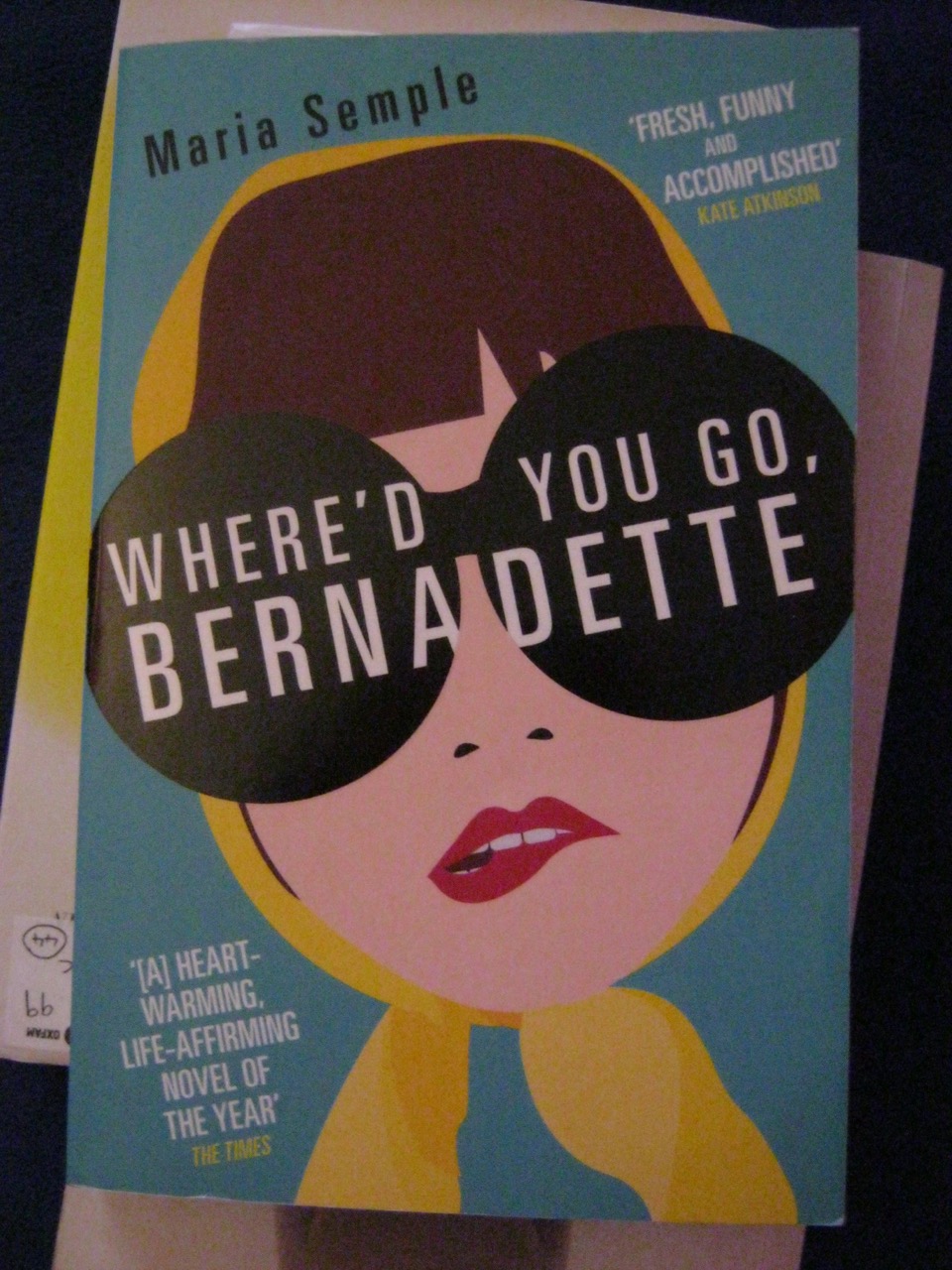
Then I came home and picked 'Where'd You Go Bernadette' by Maria Semple from the TBR pile in my room. You'd think I was sick of books about geniuses ... and yes, I think I am now. I have read lots of wonderful, well written and still engaging stories that are about ordinary people, living mostly unremarkable lives, but some writers just can't resist making their characters over-achievers, and I find them much less relatable. And this is a book with emails and hashtags and all manner of 21st century social media stuff, but I managed to get past that and just enjoy the mystery. So Bernadette is a genius who has plainly had a mental breakdown and her husband just seemed to have ignored it for a decade. That kind of trope annoys me to. Do people really just live so far up their own arse that they don't notice someone they love fall to pieces? (Turns out he is a bit of an arsehole so no surprise). So there was a lot to forgive in the book but I still managed to enjoy it, because she writes about the breakdown in a very real way and gets inside Bernadette's head so well, so we give her brownie points for that. Here, Bernadette's thoughts:

"What you've heard about the rain: it's all true. So you'd think it would be part of the fabric, especially among lifers. But every time it rains, and you have to interact with someone, here's what they'll say: 'Can you believe the weather?' And what you want to say, 'Actually, I can believe the weather. What I can't believe is that I'm actually have a conversation about the weather.' But I don't say that, you see, because that would be instigating a fight, something I try my best to avoid, with mixed results.
Getting into fights with people makes my heart race. Not getting into fights with people makes my heart race. Even sleeping makes my heart race! I'm lying in bed when the thumping arrives, like a foreign invader. It's a horrible dark mass, like the monolith in 2001, self-organised but completely unknowable, and it enters my body and releases adrenaline. Like a black hole, it sucks in any benign thoughts that might be scrolling across my brain and attaches visceral panic to them. for instance, during the day I might have mused, Hey, I should pack more fresh fruit in Bee's lunch. That night, with the arrival of The Thumper, it becomes I'VE GOT TO PACK MORE FRESH FRUIT IN BEE'S LUNCH!!! I can feel the irrationality and anxiety draining my store of energy like a battery-operated racer grinding away in the corner. This is energy I will need to get through the next day. But I lie in bed and watch it burn, and with it any hope of a productive tomorrow. There go the dishes, there goes the grocery store, there goes exercise, there goes bringing in the garbage cans. There goes basic human kindness. I wake up in a sweat so thorough I sleep with a pitcher of water by the bed or I might die of dehydration. (p.129-130)

So that was the pile, though I have already finished another, that I think might get more than two lines. All enjoyable in their own way and a nicely mixed bunch.
I left behind in Devon some unfinished business, but Claire managed to complete it ... and then take it back to the charity shop:
Oh yes, Monkey is home:
and we have been stepping over the suitcase in the living room for a week, but then we are experts at that, having lived with two bags of compost in the kitchen for a month (you stop noticing them after a while):

Stay safe. Be kind. Step around life's obstacles.

Wednesday, 30 March 2022

A Little Life

I have had 'A Little Life' by Hanya Yanagihara from the library twice; I had to send it back first time as I did not have time to get through 700 pages. It follows on quite nicely from my review of Lilian's Story in that it is the story of a little life. Although some small parts follow other characters the main focus of the book is Jude, and the group of friends around him. I both loved it and hated it. It made me cry but it infuriated me. I was angry because parts of it felt like torture porn. She takes this child and gives him the worst life, then bad things happen, then more cruelty, then he escapes, but finds more pain and cruelty, then he escapes again, and finds more pain and cruelty, and on ad nauseam. Why does nobody help him? And through his life, as his self-destructive behaviour deteriorates, none of the people who claim to love him truly help him. I was left wondering just how much pain it is acceptable to inflict on one character. The book becomes the worst parable of how childhood experiences never leave you and shape everything about how you see yourself and affect all your future relationships. And he suffers, and believes he deserves to suffer and envisions no end to his suffering. And then, when he is happy, the author smacks him down again and I cried out in protest (both because she did it and because she telegraphed it in a clichéd and lazy way that made me angry). 
I feel like this could become a rather critical review because there were so many aspects of the writing and story that I found annoying. It was repetitive. Tedious unnecessary lists of people who came to parties or Thanksgiving dinner. Repetitive descriptions of Jude's self harming. The timeline was unpredictable; sometimes small incidents being anecdotally inserted, sometimes extended bits of back story. Occasionally the story is narrated first person and I was left wondering who was being talked about. It was as if initially she was going to make it about all four of the friends and then changed her mind. And then there's the whole rich people thing. I wonder if writers do that because it allows the characters to self-obsess more. If your characters don't have to struggle to make a living, if they have a comfortable life, they have time to sit around and muse on the meaning of their existence. Also repetitive descriptions of their beautiful New York lofts (these people are not just rich, they are very rich). It also allows Jude to have endless very expensive medical treatment that normal people would be bankrupted by. There are more hours in Jude's day than a normal person. He would spent hours of his day swimming, or cutting himself and then recovering from it, and still manage to do the kind of work hours that corporate lawyers are expected to do. He works till midnight but still seems to have time to have dinner with people. And if you were really in the amount of pain he was in you would not be able to function, you would not be able to work, you would collapse from exhaustion. And his doctor friend would not see the level of self harm and not do something. It just would not have carried on like that. 
So I hated it, you must conclude. But no, it sucked me right in, mostly because I yearned for Jude to heal, to learn to trust people and accept love as real. And occasionally she did stuff like this, that was just quiet and understated; here Willem is wondering if he will 'make it' as an actor:
"But then the feeling would dissipate, and he would be left alone to scan the arts section of the paper, and read about other people who were doing the kinds of things he didn't even have the expansiveness, the arrogance of imagination to dream of, and in those hours the world would feel very large, and the lake very empty, and the night very black, and he would wish he were back in Wyoming, waiting at the end of the road for Hemming, where the only path he had to navigate was the one back to his parents' house, where the porch light washed the night with honey." (p.55)

Also this, it is so delicate. Jude has broken a mug made by Harold's (deceased) son, and his vulnerability is exposed so rawly here, and Harold's response is so touching:
"Harold went upstairs to his study with the mug in his hands, and he finished his cleaning in silence, the lovely day graying around him. When Julia came home, he waited for Harold to tell him how stupid and clumsy he'd been, but he didn't. That night at dinner, Harold was the same as he always was, but when he returned to Lispenard Street, he wrote Harold a real, proper letter, apologising properly, and sent it to him.
And a few days later, he got a reply, also in the form of a real letter, which he would keep for the rest of his life.
'Dear Jude,' Harold wrote, 'thank you for your beautiful (if unnecessary) note. I appreciate everything in it. You're right; that mug means a lot to me. But you mean more. So please stop torturing yourself.
'If I were a different kind of person, I might say that this whole incident is a metaphor for life in general: things get broken, and sometimes they get repaired, and in most cases, you realise that no matter what gets damaged, life rearranges itself to compensate for your loss, sometimes wonderfully.
'Actually - maybe I am that kind of person after all.
'Love, Harold.' " (p133-4)

Very shortly after Harold tells him about their son Jacob and how he experienced the loss of his son:
"And let me tell you two other things I learned. The first is that it doesn't matter how old that child is, or when or how he became yours. Once you decide to think of someone as your child, something changes, and everything you had previously enjoyed about them, everything you had previously felt for them, is preceded first by that fear. It's not biological: it's something extra-biological, less a determination to ensure the survival of one's genetic code, and more a desire to prove oneself inviolable to the universe's feints and challenges, to triumph over the things that want to destroy what's yours.
The second thing is this: when your child dies, you feel everything you'd expect to feel, feelings so well documented by so many others that I won't even bother to list them here, except to say that everything that's written about mourning is all the same, and it's all the same for a reason - because there is no real deviation from the text. Sometimes you feel more of one thing and less of another, and sometimes you feel them out of order, and sometimes you feel them for a longer time or a shorter time. But the sensations are always the same.
But here's what no one says - when it's your child, a part of you, a very tiny but nonetheless unignorable part of you, also feels relief. Because finally, the moment you have been expecting, been dreading, been preparing yourself for since the day you became a parent, has come.
Ah, you tell yourself, it's arrived. Here it is.
And after that, you have nothing to fear again." (p.163-4)

Jude's fear is focussed on himself and I came to feel that the book is an examination of that fear. After a childhood of abuse it is his ability to be in control of his body that is his only solace, and yet his fear and memories cause him to simply inflict more pain on it. He has only himself he can rely on, and even his own body, with all it s damage, often seems to be against him. His inability to trust and rely on others is at the core of the book. This passage is quite visceral, because you feel both his yearning and his revulsion for physical/emotional intimacy:
"But as self-conscious as he is about appearing normal, he doesn't want a relationship for propriety's sake: he wants it because he realises he is lonely. He is so lonely that he sometimes feels it physically, a sodden lump of dirty laundry pressing against his chest. He cannon unlearn the feeling. People make it sound so easy, as if the decision to want it is the most difficult part of the process. But he knows better: being in a relationship would mean exposing himself to someone, which he has never done to anyone but Andy: it would mean the confrontation of his own body, which he has not seen unclothed in at least a decade - even in the shower he doesn't look at himself. And it would mean having sex with someone, which he hasn't done since he was fifteen, and which he dreads so completely that the thought of it makes his stomach fill with something waxy and cold. When he first started seeing Andy, Andy would occasionally ask him if he was sexually active, until he finally told Andy that he would tell him when and if it ever happened, and until then, Andy could stop asking him. So Andy never asked again, and he has never had to volunteer the information. Not having sex: it was one of the best things about being an adult." (p.305)

And for contrast here is Willem talking about Jude:
"And yet he sometimes wondered if he could ever love anyone as much as he loved Jude. It was the fact of him, or course, but also the utter comfort of life with him, of having someone who had known him for so long and who could be relied upon to always take him as exactly who he was on that particular day. His work, his very life, was one of disguises and charades. Everything about him and his context was constantly changing: his hair, his body, where he slept that night. He often felt he was made of something liquid, something that was being continually poured from brightly-colored bottle to brightly-colored bottle, with a little being lost or left behind with each transfer. But his friendship with Jude made him feel that there was something real and immutable about who he was, that despite his life of guises, there was something elemental about him, something that Jude saw even when he could not, as if Jude's very witness of him made him real." (p.436-7)

And another scene, so sweet and touching, and yet, for all that, in the back of your mind you know all that you know about Jude you think that Jude is not experiencing this moment in the same way that the others are:
"Now he shakes his head to clear the memory. 'I'm going to go up and check on him,' he tells Harold and Julia, and then he hears the glass door slide open, and all three of them turn and look up the sloping hill to see Jude holding a tray of drinks, and all three of them stand to go help him. But there is a moment before they begin heading uphill and Jude begins walking toward them in which they all hold their positions, and it reminds him of a set, in which every scene can be redone, every mistake can be corrected, every sorrow reshot. And in that moment, they are on one edge of the frame, and Jude is on the other, but they are all smiling at one another, and the world seems to hold nothing but sweetness." (p574)

So traumatised is the main word I used when describing to Julie how I felt about this book. I feel like I am a positive person, and so read on, hoping with each page turn that something would break through the protective shell that Jude created around himself, that someone or some thing would reach in to him, that he would find a way to heal, that new experiences would reshape him. But that was not to be. Nasty, brutish and short is a well known description of human life. This book is titled a little life, as if Jude's existence was somehow insignificant, and I think to him he was. He was made to feel he didn't matter and nobody managed to change that for him.

Stay safe. Be kind. Remember you matter.

Monday, 28 March 2022

Holiday reading

(Another post sitting unfinished in the drafts, so I have to get it done so I can move on to the next one, which was most infuriating.)
'Lilian's Story' by Kate Grenville was in the charity shop pile (author previously reviewed here and here).  It follows Lil through life a ups and downs, from a childhood heavy with parental expectations to an adulthood of disappointment and an old age of couldn't-give-a-damn. I liked her because of her refusal to conform to society's expectations, but I pitied her because those expectations still managed to hang over her.
Here, an example of how she evokes the place they live (Australia) so vividly, something I loved about previous books, after their slightly deranged father has harangued her and her brother John at the dinner table:
"Some bird flew in and perched on the branch over our heads, blinking at us out of one eye, then the other. When the sun had slid behind the roof of Miss Gash's house and the sky began to turn pink, the bird flew away with a twitter and insects began to croak. Out of the lantana bush Miss Gash's tabby crept, stared at us with a paw raised, and crept on. John lay in his vomit and I watched pink dusk die into grey. Somewhere, streets away, someone was practicing the bugle, sending sad, random notes into the shallow pink sky like something lost." (p.86)

It is just a life, which she tries to create for herself, in spite of the world around her. This sums it up. She meets Jewel again, a woman from when she had been institutionalised, and she asks her about her regrets:
"She nodded seriously as I spoke, as if taking notes. I regretted almost nothing. There was a leather-bound copy of William that Father had given me long ago, before he knew that William was not just words. I regretted that, and it must have bubbled heavily, like a desperate drowning person, as he dropped it over the stern of the boat, but it had already been too late, I had already learned enough to keep me going. There were a few people I regretted not hitting. They might have thanked me for it in the end. I regretted not having said yes to F.J. Stroud, all those years ago. And of course I regretted the islands in the sun, the jungles, the gibber deserts, Niagara Falls, sleds drawn by reindeer, the feel of whale lifting my boat into the air under me. Naturally I regretted all that." (p.256)

I often find myself drawn in by books like this, that just follow a life. I don't need anything very much to happen. In fact some of the best books have very little happen in them. You just let yourself get attached to the person, wonder sometimes at their choices, but in the end a life is just a life, it matters whatever.


'No one is talking about this' by Patricia Lockwood was shortlisted for both the Booker and the Women's Ficton prizes last year. I started out not sure if I liked it; I almost gave up on it quite quickly thinking it was some kind of gimmicky 'internet generation' novel, but it turned out to be something else and I loved it. It is written in these weird disjointed paragraphs, that don't follow on from one another or flow like a story in any meaningful way. It could be described as stream-of-consciousness except it is third person. At times it feels like it is the woman writing, it is so immediate and intimate and often inside her head and her feelings, so it feels unsettling that it is third person. 

Here is an example of the early part, and why it made me cringe. I find that people who are obsessed with their 'online existence' think that it is real, when it's not. And the superficiality of it all makes me nauseous. ('This' refers to a post she had made that went 'viral'):
"This had raised her to a certain airy prominence. All round the world, she was invited to speak from what felt like a cloud bank, about the new communication, the new slipstream of information. She sat onstage next to men who were better known by their usernames and women who drew their eyebrows on so hard they looked insane, and tried to explain why it was objectively funnier to spell it sneazing. This did not feel like real life, exactly, but nowadays what did?" (p.13-14)

I liked this one because it is astute and perceptive, and witty:
"White people, who had the political education of potatoes - lumpy, unseasoned, and biased towards the Irish - were suddenly feeling compelled to speak out about injustice. This happened once every forty years on average, usually after a period when folk music became popular again. When folk music became popular again, it reminded people that they had ancestors, and then, after a considerable delay, that their ancestors had done bad things." (p.33-34)

I think what makes me bored by the internet is that people 'discover' stuff, but you know what, mostly it is not new stuff, it's stuff we already knew, it's just a new generation getting all excited about old stuff. But then I am an old fuddy-duddy who is confused when her kids are familiar with music that I listened to as a teenager. So this one too:
"Modern womanhood was more about rubbing snail mucus on your face than she had thought it would be. But it had always been something hadn't it? Taking drops of arsenic. Winding bandages around the feet. Polishing your teeth with lead. It was so easy to believe you freely chose the paints, polishes, and waist-trainers of your own time, while looking back with tremendous pity to the women of the past in their whalebones; that you took the longest strides your body was capable of, while women of the past limped forward on broken arches." (p.86)

So then her sister gets pregnant. And life changes. The baby has Proteus Syndrome, and her presence in their lives just takes over. And it is beautiful. Because you see the transformation of a person totally obsessed with herself into someone who comes to see someone else as the most important person on the planet. The style of the book remains the same; disjointed paragraphs, but they are telling someone else's story instead; it documents a tiny life in its entirety and established once and for all what really matters:
"On New Year's eve, she leaned over the baby with a glass of champagne and sang 'Bali Ha'i' right next to her ear and the baby's eyes flew wide, she went to the island. She sang 'Do Re Mi' and the baby followed up and down the stairs; she sang 'Over the Rainbow' and the rainbow went round. She sang 'If I Were a Bell' and that really did it; the baby pedalled her legs with excitement, she gripped her fingers with both hands, she cooed and cooed on the same pitch, she pushed the oxygen mask away and then clutched it to her face; if I were a bell I'd go ding dong ding dong ding.

Why not, she thought, and began to read the baby Marlon Brando's Wikipedia entry. Maybe it was the champagne, but it suddenly struck her as a democratic principle, that everyone should get to know about Marlon Brando: how he looked like a wet knife in a t-shirt, the cotton balls in each cheek when he talked, rumours of him wearing diapers on the set of Apocalypse Now. Nothing useful, but one of the fine spendthrift privileges of being alive - wasting a cubic inch of mind and memory on the vital statistics of Marlon Brando." (p.177-78)

Stay safe. Be kind. Enjoy the privilege of being alive.