Showing posts with label short stories. Show all posts

Friday, 10 October 2025

Scary Stories


I read 'Care of Wooden Floors' back in 2013 (go back and read that, I used to write proper reviews😐), and it was one of my best books of the year, probably *the best*. So 'The Anechoic Chamber' by Will Wiles is new out and I was excited to read it. While the stories are excellently clever, I don't like horror/ghost stories so some of them did not float my boat ... and they were not good for bedtime reading. I don't like being frightened, and there is a very fine line between disturbing and frightening.

While I did enjoy (just disturbing enough) the title story, and 'The Acknowledgements', that I started reading thinking it was the actual acknowledgments, the one that I enjoyed most was 'Moths', about a man sorting through family photographs after his father's death, an interesting tale of family dynamics with a hint of mystery:

"After Mum died four years ago, the photography tailed off. Everything tailed off. Had it been about her, all the time? He kept a photograph Blu-Tac'd inside the little bureau he used as a desk at home: Mum, in the mid 1970s, before any of us were born, sitting on a grassy slope with her knees up, a wide unguarded smile on her face, and a strand of brown hair blowing across her eyes, which are closed. Quite an 'arty' shot, now I think about it, but it was without a doubt Dad's favourite. By the mid 1990s, this exposure had faded quite badly, and Dad was able to find the correct negative and make a new print. That was an unanswerable vindication of his photo hoarding, and afterwards there was no question of him throwing anything away." (p.106)

Stay safe. Be kind. Don't forget it's Banned Books Week ... I did!

Friday, 16 September 2022

Train books and some ...

This much procrastinated post will be a race through the books that I have read over the last two months because the pile is now so tall it teeters. 'Girl, Woman, Other' by Bernadine Evaristo won the Booker in 2019 and has been on the TBR list since then. It is a tangled tale of many women, their lives, and how the world changed around them and with them. It was very readable and the characters engaging but I was not bowled over by it, but what I did appreciate was that it managed to be political and thought provoking without being self-conscious with it. Here, Carole (and I kind of liked her lack of punctuation, it was stylistically interesting and informal):

"she's used to clients and new colleagues looking past her to the person they are clearly expecting to meet
she will stride up to the client, shake his hand firmly (yet femininely), while looking him warmly (yet confidently) in the eye and smiling innocently, and delivering her name unto him with perfectly clipped Received Pronunciation, showing off her pretty (thank-god-they're-not-too-thick) lips coated in a discreet shade of pink, baring her perfect teeth as he adjusts to the collision between reality and expectation, and tries not to show it while she assumes control of the situation and the conversation" (p.117)

A charity shop unread copy of 'Piranesi' by Susanna Clarke (which won the Women's Fiction Prize in 2021) was an utterly different kind of read. In a strange hidden world that consists entirely of vast rooms of statues lives Piranesi; he lives off fish and seaweed and things brought to him occasionally by the 'Other'. How does he come to be here, and who is this person who comes and goes? All will be revealed, as his own curiosity it piqued by strange occurrences that force him to rethink everything he thinks he remembers about his own life. A clever book and intriguing... but it reminded me so forcefully of something else I have read that uses a similar scenario, and I cannot remember what it is. Frustrating.

"The World (so far as I can tell) does not bear out the Other's claim that there are gaps in my memory.
While he was explaining it to me - and for some time afterwards - I did not know what to think. At several points I experienced a feeling akin to panic. Could it really be the case that I had forgotten whole conversations?
But as the day went on, I could find no evidence of memory loss to support the Other's claim. I busied Myself with my ordinary, everyday tasks. I mended one of my fishing nets and worked on my Catalogue of Statues. In the early evening I went to the Eighth Vestibule to fish in the Waters of the Lower Staircase. The Beams of the Declining Sun shone through the Windows of the Lower Halls, striking the Surface of the Waves and making ripples of golden Light flow across the Ceiling of the Staircase and over the Faces of the Statues. When night fell, I listened to the Song that the Moon and Stars were singing and I sang with them." (p70-71)

What a varied selection I realise I have read as I list them. Next up, 'Doggerland' by Ben Smith, set in a not-so-distant future where there is a lot of sea, and life seems to be controlled by a 'company', and the boy has been sent to work maintenance on an offshore windfarm (the title made me assume it was a reference to Dogger Bank in the shipping forecast), obliged to take on a job abandoned by his father. It is grim and meaningless and his only companion is the old man, who does little work and disappears regularly on mysterious fishing trips. It has much of the atmosphere of 'The Road'; the greyness, the claustrophobic atmosphere, the sense of hopeless helplessness and powerlessness, though there is less drama, the boy and the old man exist in a timeless vacuum. But the boy is obsessed with what happened to his father and the old man drops hints, but in reality has his own agenda to which the boy is irrelevant. And it manages something similar in that you root for the boy, you want him to win, he tempts you to hope for the future, and again, I'm warning you ... don't. 

"The old man's hand hovered over the tin on his left, then switched sides and picked upon from his right. He took a penknife from his pocket and scraped round the rim, clearing away the rust and dirt. He blew off the power residue, then got up, went to the sink and came back with the tin opener. He sat back down and fitted it to the top of the tin, jolting it around until the wheel bit into the lid.
The boy watched the old man closely. He was turning the handle too fast, so that the wheel kept slipping off the tin; and then he would mutter something, fit it back on and start again. There were streaks of power rust on the table and on his hands.
The old man turned the handle again but it didn't move. He tried to take the tin opener off but it stuck. 'Bloody thing's broken.'" (p.88)

'When we cease to understand the world' by Benjamin Labatut is a fictionalised version of the lives of a selection of the world's most astounding mathematical minds. Not traditionally fodder for a novel, but just go with it. Some I had heard of, Schrodinger, Neils Bohr, Heisenberg, some not, Grothendieck, Louis de Broglie, but what they had in common was their utter obsession with their subjects. The book sank periodically into descriptions of how they worked so hard they forgot to eat and sleep until it drove them out of their minds. I felt like I learned quite a lot from it, about physics and mathematics, and about the pursuit of esoteric knowledge.

"Most nights he fell prey to insomnia. In his delirium, his mood would establish strange connections that allowed him to achieve direct results, foregoing intermediate steps. He felt his brain split in two: each hemisphere worked on its own, without needing to communicate with the other, and as a result his matrices violated all the rules of ordinary algebra and obeyed the logic of dreams, where one thing can be many: he was capable of adding two quantities together and obtaining different answers depending on the order in which he proceeded. Three plus two was five, but two plus three might be ten. Too weary to question himself, he continued working until he had reached the final matrix. When he solved it, he left his bed and ran around his room sorting, 'Unobservable! Unimaginable! Unthinkable!' until the entire hotel was awakened. Frau Rosenthal entered in time to see him collapse on the floor and recoiled at the stench of his soiled pyjama bottoms. When she managed to calm him, she put him back to bed and ran off to fetch a doctor, paying no attention to his complaints, as he was passing in and out of his hallucinations." (Heisenberg, P.104)

I read most of this book on the train south and then abandoned it in favour of lighter reading that I found on a table in Claire's living room.
What I found most interesting about 'An Unequal Stillness' by Francesca Kay was the striking contrast between the life of her 'genius' artist and that of the scientists in the previous book. The men in Labatut's book were free to do nothing but pursue their obsession, real life barely seemed to exist for them, the practicalities of existence were provided by the women around them, but in this book Jennet must juggle her family and domestic responsibilities, snatching time for her real work where she can. I find myself annoyed by stories of women who pander to and continually forgive alcoholic husbands, but to be honest he was not that important to the story, she got on with things in spite of him. While I found the descriptions of her paintings rather annoying, because I was visualising them and wanted to see them, the writing was engaging and had some wonderful moments:

"Scouring out a cast-iron pot at the kitchen sink, Jennet stops to watch the reflection of a light above it glinting in the greasy water and her own hands submerged. Out of nowhere a wave of fear crashes over her and she is suddenly quite sure she will never lift her hands out of the water or unglue her feet from the floor. Only her wildly pounding heart is evidence of life. Otherwise she might as well be paralysed, like Lot's wife trapped in salt. Somewhere in the distance there is a baby crying, but Jennet cannot go to it. She cannot move at all. She must stand there forever with her hands beneath the water in the blackened pot."

'Ice Cream' is a book of short stories by the inimitable Helen Dunmore, read on the train on the way back north, in one sitting. Her writing is always so perfect, little vignettes of people's lives, capturing something that is essential to being human. Here, a lighthouse keeper's wife:

"The bed was too big when she lay alone in it. He was an off-shore lighthouseman and she knew that when she married him. If the lighthouse tender couldn't land to change the crew on relief day, Nancy might be waiting for him another week. Often the weather was bad when it came to changeover. He'd watch the wall of white foam crash against the glass and know he wasn't going to get off. But Nancy stood it. She had her little garden. She didn't flinch. She knew the fishing boats and would stand to watch them go out around the point, her skirts blown back against her legs, moulded to them by the wind. He was glad there was no one else to see her like that. She fed her garden with fish-meal and rotted-down seaweed, and when the salt-storms burnt off the leaves of her spinach and lettuces, she planted again. He would see her kneeling on the path, skirts bunched under her, tamping the seedlings in with her quick fingers." (p.56-57)

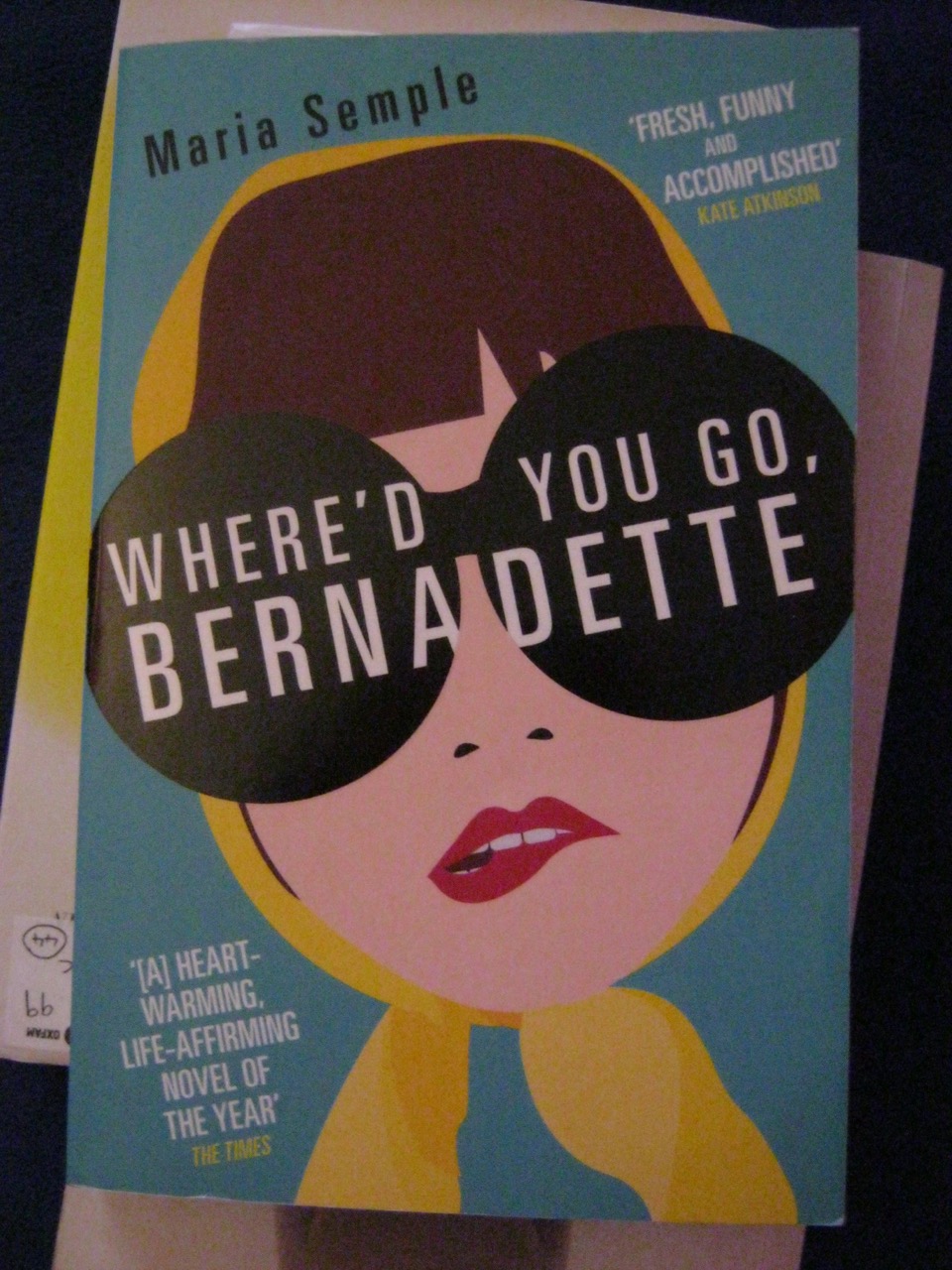
Then I came home and picked 'Where'd You Go Bernadette' by Maria Semple from the TBR pile in my room. You'd think I was sick of books about geniuses ... and yes, I think I am now. I have read lots of wonderful, well written and still engaging stories that are about ordinary people, living mostly unremarkable lives, but some writers just can't resist making their characters over-achievers, and I find them much less relatable. And this is a book with emails and hashtags and all manner of 21st century social media stuff, but I managed to get past that and just enjoy the mystery. So Bernadette is a genius who has plainly had a mental breakdown and her husband just seemed to have ignored it for a decade. That kind of trope annoys me to. Do people really just live so far up their own arse that they don't notice someone they love fall to pieces? (Turns out he is a bit of an arsehole so no surprise). So there was a lot to forgive in the book but I still managed to enjoy it, because she writes about the breakdown in a very real way and gets inside Bernadette's head so well, so we give her brownie points for that. Here, Bernadette's thoughts:

"What you've heard about the rain: it's all true. So you'd think it would be part of the fabric, especially among lifers. But every time it rains, and you have to interact with someone, here's what they'll say: 'Can you believe the weather?' And what you want to say, 'Actually, I can believe the weather. What I can't believe is that I'm actually have a conversation about the weather.' But I don't say that, you see, because that would be instigating a fight, something I try my best to avoid, with mixed results.
Getting into fights with people makes my heart race. Not getting into fights with people makes my heart race. Even sleeping makes my heart race! I'm lying in bed when the thumping arrives, like a foreign invader. It's a horrible dark mass, like the monolith in 2001, self-organised but completely unknowable, and it enters my body and releases adrenaline. Like a black hole, it sucks in any benign thoughts that might be scrolling across my brain and attaches visceral panic to them. for instance, during the day I might have mused, Hey, I should pack more fresh fruit in Bee's lunch. That night, with the arrival of The Thumper, it becomes I'VE GOT TO PACK MORE FRESH FRUIT IN BEE'S LUNCH!!! I can feel the irrationality and anxiety draining my store of energy like a battery-operated racer grinding away in the corner. This is energy I will need to get through the next day. But I lie in bed and watch it burn, and with it any hope of a productive tomorrow. There go the dishes, there goes the grocery store, there goes exercise, there goes bringing in the garbage cans. There goes basic human kindness. I wake up in a sweat so thorough I sleep with a pitcher of water by the bed or I might die of dehydration. (p.129-130)

So that was the pile, though I have already finished another, that I think might get more than two lines. All enjoyable in their own way and a nicely mixed bunch.
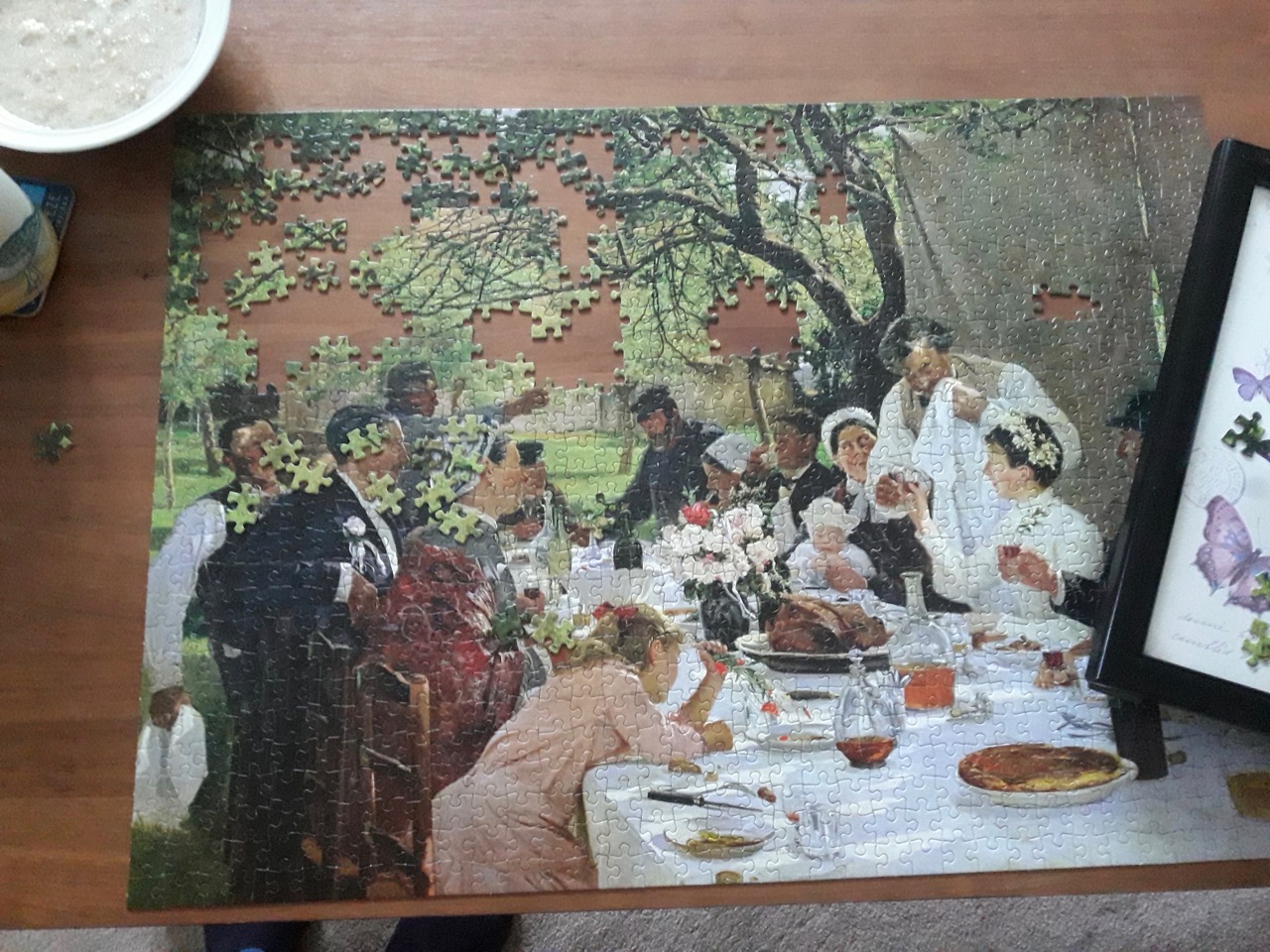
I left behind in Devon some unfinished business, but Claire managed to complete it ... and then take it back to the charity shop:
Oh yes, Monkey is home:
and we have been stepping over the suitcase in the living room for a week, but then we are experts at that, having lived with two bags of compost in the kitchen for a month (you stop noticing them after a while):

Stay safe. Be kind. Step around life's obstacles.

Tuesday, 13 April 2021

Instead of cake there was cheese


What should you do when you have been doing excessive internet purchasing ? ... why build a cat castle with all the packaging of course. And the cat even plays on it.
So I came home from work today, watered my seedlings, got changed and rode to the gym, did gym stuff, went to the shop for dinner, rode home, stretched, made a pot of tea, sat down and opened my computer, saw a message from the library to say they had three books for me to collect, jumped back on my bike and rode to the library (which is in the same place as the gym, fortunately only a few minutes bike ride), rode home, poured my cup of tea and finally got to relax.
As usual I can't recall why I have most of the books on my request list, since the library has been shut since December, though they all sound great, especially Ocean Vuong, who's poetry I read not very recently.
So, books to read, knitting to do, plants to water, what more is there to enjoy in life?
I very much enjoyed this short story, 'The Irish Wedding' by Elizabeth McCraken; I was attracted by an interview with her because I read 'The Giant's House' and 'An exact replica of a figment of my imagination' back in 2014 and loved them both, and am sure I will love her new story collection. I also very much enjoyed, Because, the poem of the week in the Grauniad.
Stay safe. Be kind, Stay human. Read a story, or a poem.

Tuesday, 1 September 2020

100 Days - 62nd : summer reading


Some members of the clan have been having an exciting time buying new houses in Devon with panoramic sea views and going on dappled sunlit bike rides with the oldies ...
some of us have just been going to work and coming home and not writing any book reviews.

This is a bad pile. I have had backlogs before but this is bad. From the top:
'The New York Trilogy' by Paul Auster. I read, and loved, 4321 back in 2017 but after I read the first two novellas, that were too alike in theme and character, I crawled to a halt on the third.
'Purple Hibiscus' by Chimamanda Ngozi Adichie was quite a hard read. I found I hated the controlling and violent parenting so much that I was just angry at the situation while I read; angry at the mother for not protecting her children, angry at the respect for religious people that allows such behaviour to go unchallenged. Have read several others by her that I enjoyed more, here, here and here.
'The Bluest Eye' by Toni Morrison is another one that made me angry, but for the grinding and inescapable poverty of their situation as much as for the people's behaviour. 
"The Discomfort of Evening' by Marieke Lucas Rijneveld has just won the International Booker Prize but I bought and read it some time ago. I don't want to say it was another book that made me angry but it was. What is it with people writing about stifling religiosity, anybody would think that all religion is controlling and stifling ... oh wait, it mostly is. It is a story of loss and people crumbing under it. When Matthies dies the parents just kind of fade away, leaving their remaining children to emotionally fend for themselves. I cared about them and wanted to wrap them up and reassure them, to reassure Jas that it was not her fault. I loved the relationship between Jas and Hanna, her younger sister was the saving grace of the story, which made the ending all the more traumatic. I got to the last page, the last line, and cried out in horror, but of course I should have seen it coming. The naive, optimistic part of me wanted to believe the love of her sister would pull her through, but it didn't. 
'The Stories of Eva Luna' by Isabel Allende was just a lovely collection of stories, some funny, some a little dark, all about the characters and their intriguing lives.
'Arboreal' edited by Adrian Cooper, subtitled, a collection of new woodland writing, was a lovely collection of people just writing about woods that they know and love. Some were very lyrical or childhood remembrances, others much more scientific or expounding on the ecological significance. The sheer variety kept it interesting throughout. Having experienced much tree joy this year what's not to love in a book all about the joy of trees.

'The Terrorist at my Table' by Imtiaz Dharker. I came across one of her poems in the Guardian back in April and very much enjoyed the rest of her collection (you can read several on her website). Unusually for a poetry book it was punctuated by her atmospheric line drawings. I lost the paper on which I listed my favourites. They managed to combine the personal and the political with just lovely evocative images and use of language. I have to pick this one, just because ... tea (I also love the one entitle Tissue). Maybe the literature festival will invite her some time.

The right way

You call this
tea?
Black brew, no sugar, raw milk?
Let me tell you how it should be.
Put the water in the pan. 
Add sugar, more than that,
more. Then boil it
till it becomes quite syrupy.
Now add the tea-leaves,
let them boil, to get
your money's worth from them.
This is when
my wife would put in
ginger, cinnamon, or seeds of cardamom.
You have none of those?
No matter, let me show you.
Put milk now. Boil again,
yes, boil. Let it rise,
turn down the heat.
Turn it up, let it rise again,
sizzling. Blow on it to keep it
bubbling just inside the rim.
This takes skill, and shows respect 
to both tea and guest.

Then take the cup
and strain it in. No,
don't drink yet,
I am showing you the way
we drink tea in my village.

Pour it in
to the saucer, blow.
Now drink. Don't shake, don't spill.
Don't laugh.
Good, no?

'Why I'm no longer talking to white people about race' by Reni Eddo-Lodge is a highly recommended and thought provoking look at the race situation in Britain. So much is being said in the news about race in America at the moment that you sometimes find British people being a bit smug, but you know what, we are as fucked up as they are. Our history is as fucked up, our economy and education systems are as fucked up, our criminal justice system is as fucked up. There is no area of life where people of colour do not get the short end of the stick. If that's not systemic I don't know what is. People complained the other day about an Argos advert with a black family in it, and you want to smack your head off a brick wall. You know what, don't be sorry, don't be defensive, don't say 'yes, but', just accept that this is the reality of our society and see what you can do to challenge it. Reading books is a good first step because it's important to know what you're up against. 

I borrowed the Gardening with Containers from Julie and have enjoyed browsing ideas and learning about plants and compost and all that jazz. I also found 'How to Garden' by Alan Titchmarsh in the charity shop which has been great for all sorts of basic stuff about growing plants. I am getting much joy from seeing things grow and want to do more
I know I have gone back to living inside my own life recently, well, since I bought the house really. It feels selfish. Going to the gym and caring about being fit feels selfish. I could have gone and joined with with some XR stuff in Manchester but I didn't want to. I feel like I am hiding, but you know what, I am not beating myself up about it, it's just what I need to do right now.
Stay safe. See you tomorrow.


Tuesday, 17 September 2019

I have been reading, honest

Life has been weird. We had a couple of months of hectic activity on the house and then I ran out of both money and energy. The bathroom is still in process, looking fab, but delayed somewhat by cutting the top off my thumb with the Stanley knife, and now waiting for a suitable day to redo the bath sealant.

The list of books unreviewed has been growing and I just wanted to make a record of them for posterity, or whatever:

Gingerbread by Helen Oyeyemi - a magical realist story of Perdita and Harriet and their strange provenance and the gingerbread with peculiar properties. (Realised looking at her website that I read Mr Fox too some time ago but did not like it.)

The House on Mango Street by Sandra Cisneros: vignettes from the life of a young girl Esperanza, considered a coming-of-age classic.

The Passenger by Lisa Lutz: thriller about a woman who changes her identity to escape her past; rather implausible much of the time and a predictable ending.

The Siege by Helen Dunmore: I love Helen Dunmore, many other of her books read and reviewed here. This one follows a family as they live through the siege of Leningrad during the Second World War, despite the extreme cold it is warm and life-affirming.

Fever Dream by Samata Schweblin: I read a list of recommendations of translated novels and requested a few from the library. Fever Dream is a scary and surreal story, it is about a mother's bond with her child, and the extremes they go to in the face of threat. Hard to describe and it left me disturbed.

All the Light We Cannot See by Anthony Doerr: Winner of the Pulitzer in 2015 this has been on the shelf for some time. I loved it as much as I anticipated. It is the story of Marie Laure, a blind french girl, and Werner, a young german boy, and the war that uproots their entire existence and leads them to a place where their lives brush gently up against each other. It is the kind of story that you can allow yourself to sink in and live it with the characters, beautifully drawn characters and meticulously historical, I wish there were more books like this in my life (and that I had the energy to do it justice).

Birds of America by Lorrie Moore: Have done a lot of late night insomnia reading of this short story collection. Have struggled with the stories being long enough to get thoroughly engaged and then feeling dropped as they end, and also the sense that they are about the same people in slightly different situations and times in their lives. She is so highly thought of but I feel a bit underwhelmed.

So quite a bit of variety, despite feeling like I have lost my mojo. The readathon is coming up in a few weeks so will try and recapture it.

Tuesday, 28 August 2018

Lots of books

This is cheating I know but I have gotten so far behind that today I give you a mass half-arsed review of books that I have read in the last few months but have languished on the 'To Be Reviewed' pile.

'The Making of Henry' by Howard Jacobson, was picked up in a charity shop because I enjoyed 'The Finkler Question' so much, but this one, written several years before was nothing like as good a read; too much navel-gazing and self-pity on the part of Henry and not enough of the other characters. Like Finkler it is very much just about the people and their relationships but I found Henry much less relatable or likeable, in fact it felt suspiciously self indulgent and playing to his readership profile; rather boring and shallow middle aged bloke is strangely very attractive to women, who fall over themselves to make him happy. Having said that I did enjoy the story and it had plenty of entertaining moments to make it worth the reading. This quote pretty much sums Henry up, but I am sure that many people, myself included, recognise this feeling:

"Something that had tormented Henry all his life, something he felt at school, at university, still feels today when he goes to a party, a conference, a concert, the theatre even: how well acquainted everybody but Henry is with everybody else. Leave aside coincidences of sympathy or interest, where do they actually meet, at what Henry-free time and in what Henry-free dimension do they make contact, dock, establish intimacy, and agree, without so much as mentioning Henry's name, to exclude him? Let Henry be the first person in the room, it will transpire as soon as the room fills that every single person there except Henry is on close terms with every other. does it happen when he goes to get himself a drink? Does it happen when he blinks? Or, as seems much more likely, was it all laid down long ago in anterior time? Was there another world before this one, a sort of metaphysical prep school, a preliminary universe, to which someone forgot to send Henry?" (p.67)

Tish, Monkey and I had a little spate of reading together. Both the girls use Terry Pratchett audiobooks to get themselves to sleep so they have become a firm family favourite. 'Monstrous Regiment' is the wonderful tale of a gang of trainee soldiers joining up to fight in some foreign skirmish. It gradually emerges that some of the lads are lasses, but by this time they have formed a strong bond, and using some pretty unconventional tactics they set about winning the war.

'Sourcery' has the entire Discworld disrupted by the arrival at Unseen University of Coin, the eighth son of an eighth son of an eighth son ... which makes him Sourcerer, and able to command magic at an existential level. But it's ok, Rincewind and the Luggage are on hand to save the day, with some assistance from Conina, daughter of the infamous Cohen the Barbarian. 

'Yesterday's Weather' by Anne Enright is the second book in the pile from a Booker Prize winner. It is a collection of short stories that I was reading back in March, so far too long ago for comment. Her writing is always lovely and understated, with perceptive observation of the human condition, what more can you ask for. This is from 'Little Sister', a young woman telling of her sister's demise: 

"We waited for ninety-one days. On Saturday that thirteenth of September there was the sound of a key in the door and a child walked in  - a sort of death-child. She was six and a half stone. Behind her was a guy carrying a suitcase. He said his name was Brian. He looked like he didn't know what to do.
We gave him a cup of tea, while Serena sat in the corner of the kitchen, glaring. As far as we could gather, she just turned up on his doorstep, and stayed. He was a nice guy. I don't know what he was doing with a girl just out of school, but then again, Serena always looked old for her age.
It is hard to remember what it was like in those days, but anorexia was just starting then, it was just getting trendy. We looked at her and thought she had cancer, we couldn't believe this was some sort of diet. Then trying to make her eat, the cooing and cajoling, the desperate silences as Serena looked at her plate and picked up one green bean. They say anorexics are bright girls who try too hard and get tipped over the brink, but Serena sauntered up to the brink. She looked over her shoulder at the rest of us, as we stood and called to her, and then she turned and jumped. It is not too much to say that she enjoyed her death. I don't think it's too much to say that." (p.162)

I bought Megan Beech's poetry collection 'When I Grow Up I Want to be Mary Beard' purely on the basis of the title, because who doesn't want to be Mary Beard; she's up for my third life because I plan to be Victoria Coren next time around. As is often the case poets who write for performance sometimes don't translate brilliantly to book form, and while I enjoyed reading her poems I do think they would come across much better live; if she makes it to the literature festival some time that will be a date for the diary.

"When I grow up I want to be Mary Beard.
A classy, classic, classicist,
intellectually revered.
Wickedly wonderful and wise
full to brim with life,
while explaining the way in which Caligula died,
on BBC prime time." 
And life goes on, and other books arrive to fill the gaps. This new shelf-full came partly from a charity shop trawl in Brighton with Claire and partly from work a couple of months ago, when I came across two bags of books left out in the hallway of a block of flats in Withington. 


Sunday, 8 January 2017

Shoe Fly Baby

'Shoe Fly Baby' is the Asham Award Prize short story collection edited by Kate Pullinger. I recommended a short story by Kate a while back in another anthology. I drifted though this book a little, kept coming back to half read stories with no recollection of what had been happening, I'm afraid that does not recommend it very highly, or maybe I am just in such a bad slump at the moment I was not concentrating. 
The one that struck me most was 'An angel in the garden' by Jane Maltby, about an elderly woman who's life is altered by a car crash at the bottom of her garden. She forms a bond with the family of the young man who is killed, while her own faculties go into rapid decline. It has a lovely metaphor of cryptic crossword clues running though the story, reflecting the confusion she increasingly experiences: 

"She kept finding bits, all over the place, even after they'd cleaned up. Not from the victim, of course not, that would be silly, although he went straight out through the windscreen and along the road, face down, they told her. She didn't look. Even when all the neighbours ran down their gardens to the road, and all the police cars with their lights were parked all over the grass, and it was even on the radio, the cars were queued up for that long.
The boy's car embraced the lamp-post deeply. That was the thought that struck her. It had sucked the post into its vitals. Glass and metal lay on the ground, and there were the bits that, weeks after the crash, she kept crunching over when she finally went down, to check the flowers. The body had come to rest perhaps twenty yards away, just on the boundary with her neighbours, who kept cats. Just inside the boundary. It was her accident, all right." (p.62)


Monday, 10 October 2016

10 X 10 X 10 Giveaway post

It has been creeping up slowly over the last couple of months, but finally I have reached my 1000th post! It feels like a huge milestone, who knew I had so much to say. I decided to celebrate the things that I have enjoyed about blogging with a 10 x 10 x 10 post. 
Up first are my ten most visited posts:

10: Cool Aid Dying with 1031 visits

9: Cooking and Sewing Post with 1114 visits
8: Carol Ann Duffy with 1124 visits
7: for the home educators HESFES : long self-indulgent holiday post with 1216 visits
6: for the reptile fans Tegu Walking with 1123 visits
5: for the Philip Pullman fans Midsummer's day with Will and Lyra with 1496 visits
4: Engelby by Sebastian Faulks with 1158 visits
3: Luscious Lemon Cake with 1565 visits
2: an early poetry post, visited by many students I think Margaret Atwood Poetry with 3247 visits
1: (not quite fair on Margaret Atwood but combining two as they go together) Lizard Cake and Lizard Cake Tutorial with a total of 4985 visits

Next I give you, with much torturous decision making, my ten favourite books of the 462 that are labelled at book reviews (alphabetical for I could never rank them one to ten):


Any Human Heart by William Boyd

Austerlitz by W.G. Sebald
Care of Wooden Floors by Will Wiles
Fugitive Pieces by Anne Michaels
The Goldfinch by Donna Tartt
The Lacuna by Barbara Kingsolver
The Luminaries by Eleanor Catton
The Road by Cormac McCarthy
The Wasp Factory by Iain Banks
Words from a Glass Bubble by Vanessa Gebbie

And the final ten posts are the ten that I love, either because they mark significant things that have happened over the last few years or just times when I wrote something important to me or that I was particularly pleased with:


Don't Apologise speaks for itself, I was angry, I should write like that more often.

Nostalgia ain't what it used to be is a brief post that celebrates 15 years of friendship with the Ridley Birks family. 
Two Deaths, Three Kisses and a Punchup was written in 2011 when I blogged for the Library Theatre's production of Hard Times
Monkey Quilt the Final Chapter is the result of over two years working on our beekeeper's quilt.
Favourite Moments gives the best bits from my visit to Costa Rica with my mum in 2014.
Dead Dog Poems is one of many many post written during my longstanding involvement with the Manchester Literature Festival, it was one of my favourite events.
What I Think is a course review of 'A Brief History of Humankind', of the many courses I have done with Coursera since 2013 it was the most interesting and engaging.
Night of Writing Dangerously: Monkey and I have participated in NaNoWriMo several times, and are planning to again this year.
Luggage: I have taken part in the Blogging from A to Z Challenge every year since 2012, several years I have done flash fictions, and this is one I particularly liked.
Blogger (a poem) that I wrote back in 2010


I hummed and hawed about what to do to celebrate, and thought that of course there should be a give-away. I know people visit when I post stuff and I hope you get some interest or enjoyment out of reading but I thought it might be nice to know who you all are. So here are three outrageously unique tote bags that I made for my short-lived Etsy shop, so maybe if people just say hi and leave their email contact/blog link and I will pick three people at random to send them to.
Red and Black flocked satin lined with white cotton.
Brown satin with gold spirals lined with pale pink satin.
Pink paisley satin lined with pale pink satin.


Saturday, 20 August 2016

The Boat

'The Boat' by Nam Le was recommended in many places and was certainly a brilliant collection of stories. It's always difficult to review a short story collection, this one particularly because of the range of subjects that he has written about, there does not seem to be any overarching theme or link between them. Le is Vietnamese by birth so the last story in the book, 'The Boat', almost seems obligatory; it is a claustrophobic tale of a refugee boat journey, though not told from personal experience since he was a baby when making the voyage himself. I thought it was interesting however because in the first story 'Love and Honour and Pity and Pride and Compassion and Sacrifice' he has the characters discuss the idea of 'ethnic lit':

"'It's hot,' a writing instructor told me at a bar. 'Ethnic literature's hot. And important too.'
A couple of visiting literary agents took a similar view: 'There's a lot of polished writing around,' one of them said. 'You have to ask yourself, what makes me stand out?' She tag-teamed to her colleague, who answered as though intoning a mantra, 'Your background and life experience.'
Other friends were more forthright: 'I'm sick of ethnic lit,' one said. 'It's full of descriptions of exotic food.' Or: 'You can't tell if the language is spare because the author intended it that way, or if he didn't have the vocab.'
I was told about a friend of a friend, a Harvard graduate from Washington D.C., who had posed in traditional Nigerian garb for his book-jacket photo. I pictured myself standing in a rice paddy, wearing a conical straw hat. Then I pictured my father in the same field, wearing his threadbare fatigues, young and hard-eyed." (p.9)

While this first one is narrated by a character named Nam Le he moves quickly away from any sense of the autobiographical with stories that go off in a wide variety of directions: an elderly man hoping to reconnect with his long-estranged daughter; a teenager struggling with his mother's illness and being threatened by a 'love rival'; a naive young woman travelling to Iran in search of a friend with political ambitions. Such excellent writing, with voices so distinct and authentic. Short stories are at their best I always feel when they immerse you in an unfamiliar time and place and allow you to connect with other human experience. In 'Hiroshima' a young girl tells us of life as an evacuee, longing to be back with her family, in the days and hours before the bomb falls:

"Do without until victory! I am under a ginkgo tree and behind it the sky is darker, the colour of dry dirt. I will walk and dry in the wind. The watercolours are gone. Taker's friend tried to eat the watercolours and was punished by Mrs Sasaki. I imagine the smell of potatoes, with spices. Butterburs and horsetails. It has been so long since the last Visiting Day. Yukio and Tomiko were angry because Mother did not follow the rules and brought me luxurious food: two pears, and rice with red beans, and sesame seeds with salt. Their mothers did not bring so much. I gave them sesame seeds to chew. Where is Big Sister? I ask. Sumi could not get a travel certificate, says Mother, even though she is eligible for evacuation. She tells you to work hard on the farms to help with the food shortage. Yes, I will. Sumi is a loyal subject, says Mother. In the day she is mobilised and at night she works at the munitions factory. I see her in the rain with her face shining. Father does not look at her. She tells you to remember the way of Bushido. Mother sleeps with her head on the summer clothes she brought for me. Now they are wet, and cold against my skin. The wind is loud. That night the room is full of darkness and whispering. Her hair smells of chrysanthemum and pine oil and as I sleep I try to keep the smell in my nose." (p.173-4)

So good, get a copy.

Tuesday, 1 March 2016

Belated and Weird

I get a lot of blog feeds by email these days, but I guess I visit the blogs less because instead of excited it makes me strangely anxious to add more books to the reading list. My parents turn 80 this year, which finally feels old, I have trouble thinking of them as old, and even more trouble thinking of myself as getting old. However I recently added up and found that at a rate of about 50 books a year, if I live to my early 80s I am only going to get through another 1500 books before I pop my clogs ... that's not very many and maybe I should be more careful which ones I choose. Ok, maybe once I retire I will have more time and will get through more books, but we are still not talking a huge number. 

Anyway, this morning, via Estella's Revenge, where Estella was talking about an ongoing challenge to 'Read My Own Damn Books', I found my way to Julianne at 'Outlandish Lit' who is running a 'Month-long Weirdathon' (and who doesn't love made up words), and I found myself quite agreeing with her definition of weird, so decided to join in. I have two books waiting in the wings that fit the bill: Tristano by Nanni Balestrini and How to be Both by Ali Smith (failed before but have my own copy now so will give it another go). 


I have just finished 'Stone Mattress' by Margaret Atwood, who would probably come quite high on many people's weird list. The first three stories connect Constance, Gavin and Jorrie, a fantasy realm and the peculiarities of old people, then we move on to something more like a fairy tale, then back to the real world with an unusual discovery in an auctioned storage lot. A couple more stories deal with the character's long standing issues that have very different outcomes: The Dead Hand Loves You is a story of the bond between four housemates and a very successful horror novel, and Stone Mattress has a woman encounter a man from her past in an unexpected place. I think my favourite was probably 'Torching the Dusties', where a new-age protest movement has taken against the elderly, and how an unlikely couple escape a nasty fate. Here Wilma and Tobias first notice the protestors:
" 'What is it?' Wilma asks now. 'Is it an ambulance?'
There haven't been sirens: she's sure of that, she still hears quite well. It's at times like this that her disability is most discouraging to her. She'd rather see for herself; she doesn't trust Tobias to interpret; she suspects him of holding things back. Protecting her, he'd call it. But she doesn't want to be protected in that way.
Perhaps in response to her frustration, a phalanx of little men forms up on the windowsill. No women this time, it's more like a march-past. The society of the tiny folk is socially conservative: they don't let women into their marches. Their clothing is still green, but a darker green, not so festive. Those in the front rows have practical metal helmets. In the ranks behind them the costumes are more ceremonial, with gold-hemmed capes and green fur hats. Will there be miniature horses later on in the parade? It's been known to happen.
Tobias doesn't answer at once. Then he says, 'Not an ambulance. Some sort of picketing. It looks organised.' " (p.271)


I have given up Facebook in the last few weeks; I mean I disabled my account rather than trying to stop visiting, which is pointless as they keep sending nagging emails if you try and cut down. As a result quite a lot of reading and knitting has happened. Monkey and I have also got through two seasons of Gilmour Girls, because I can't knit and read at the same time. This is my Bressay Dress from the book Fair Isle Style that Julie and I bought together some time ago. It is knitted in Debbie Bliss Fine Donegal with the fair isle design in Noro Taiyo. I love it so much I already have yarn to knit a second one. 
and there are leg warmers to match since I only used three of the five balls of yarn.
Oh yes, 'belated'. It was my seventh blogiversary a few weeks ago and I missed it for the second year running. 111 posts in the last year, which is way down, and the follower numbers went up and then down again, but I am quite philosophical since why would people visit when I have been such an irregular blogger in recent months. I can't promise to try harder, though I am reading 'The Name of the Rose' and hope to write a goodie on that.