Showing posts with label women's prize for fiction. Show all posts

Tuesday, 17 February 2026

What is real?

I have had Ruth Ozeki's 'The Book of Form and Emptiness' from the library before, it's long and I ended up returning it barely started, and for once I actually got around to borrowing it again. I confess it has been difficult. I read 'Tale for the Time Being' a decade ago, so I was determined to like this too. Like the previous book it also asks the question about reality. Benny and the Book take turns to tell us what is happening, and a lot is happening. I initially thought that Benny was experiencing something supernatural and was a bit suspicious of where the book was going, and I struggled watching Annabelle be overwhelmed and unable to have much agency in her life. The whole set up was quite frightening, how easily an apparently ordinary life can slip out from under you, and how much they had depended on Kenji, even though he seems to have been less than dependable. 

Kenji is killed in a stupid accident and Annabelle and Benny are left with grief and just each other. When object around him start talking to Benny he finds it annoying, to begin with. As the talk gets louder and more intrusive he has nowhere to escape it. He is sectioned the first time after the scissor incident and on the children's psyche ward he meets the Aleph. She has struggles of her own but she becomes someone who helps him make sense of things that are happening. 

"Is it odd to see a book within a book? It shouldn't be. Books like each other. We understand each other. You could even say we are all related, enjoy a kinship that stretches like a rhizomatic network beneath the human consciousness and knits the world of thought together. Think of us as a mycelium, a vast, unconscious fungal mat beneath the forest floor, and each book a fruiting body. Like mushrooms we are a collectivity. Our pronouns are we, our, us.

Because we're all connected, we communicate all the time - agreeing, disagreeing, gossiping about other books, name-dropping, and quoting each other - and we have our preferences and prejudices too. Of course, we do! Biases abound on library shelves. The scholarly tomes disparage the more commercial books. Literary novels look down on romance and pulp fiction, and there's an almost universal disregard for certain genres, like self-help." (p.94)

The Book as a character in the book is Benny's book. It is said we all have a book inside us, the story of our own life. Benny's book starts talking to him and as he spirals into his breakdown he feels that the book is the one in charge, the one making the bad things happen, and he wants to shut it out. The book tries to explain that it is just a narrator but Benny is struggling to see what is real. The other book that appears in the book is 'Tidy Magic', a decluttering self-help book written by a Japanese Buddhist monk.

While the book is about so many things, it centres on Benny's mental health crisis; we watch as he falls off the edge, it is vivid and frightening, and Annabelle is powerless to help him. He escapes school and finds a safe place in the local library that he visited as a child, reading voraciously and randomly to quiet the voices in his head. But then Annabelle has an accident trying to clear some of the accumulated junk from the house and things all fall further apart. The library becomes however a place where they both find help and a community of people who catch them before they hit the bottom. 

Sometimes a story does try to do too much, and there is a lot going on in this story; the sense of belonging and family, the disconnectedness of society, consumerism as a replacement for the lost connection, grief and friendship, and several references to the earthquake and tsunami of 2011 (that feature also in Tale for the Time Being). But it is all pulled together in this mother and son who need each other, but who cant weather their storm alone. 

Sometimes you get to the end of a book and are just glad to be there. 

Stay safe. Be kind.

Friday, 2 January 2026

Looking Back and Forth

So we have rolled around to another year. There seems to be some consensus on good riddance to 2025. Routine life has plodded on with the highlight being my trip to Japan, but it now seems so long ago that I am barely sure it happened. Monkey is visiting in July this year so I can count down to the next time I see her. We chat on WhatsApp but it's not the same. I have restarted (for the third time) learning Japanese, but deliberately started before the new year so that it was definitely not a resolution. I need to go back to exercising but am going to consider my brain health first. And then financial health, which will involve not taking on anything else that will cost money; paying down the mortgage is going to be a priority.
So, books? I don't feel like I have read very much, and certainly far too many that were a bit meh. Having started well I have often not really liked the book club books, but I love the talking so have persevered with it and will continue to do so. Here is this year's list:
37 reviewed last year, though several abandoned part way and two to come from before Christmas, both wonderful (see one below). Highlight of the year has to the Emperor of Gladness, but also Orbital and Safekeep (below). More than I remembered that I did enjoy, maybe I was just being negative, it wasn't bad reading just neglectful reviewing.

'The Safekeep' by Yael Van Der Wouden was shortlisted for the Booker and won the Women's Fiction Prize in 2025, so was definitely on my radar. It starts a bit slow, with Isabel who lives a very small life in her childhood home, after her mother's death. Lots of snippets to come because it was so beautiful; coming back from dinner with her brother Hendrik :
"Home, when she arrived, welcomes her with relief. There you are, said the dim light in the kitchen, left on for comfort. I've waited up for you, said the rattle of the key in the door." (p.18)
After another family dinner her other brother Louis announces he is sending his current girlfriend Eva to stay with Isabel while he has to be away working. She resents the intrusion in her life but is so meek and submissive she just accepts it. The days, then weeks go past, the two young women tiptoeing around each other, Isabel resentful, Eva desperate to ingratiate herself. Isabel is obsessed with her possessions and the fear of someone stealing them, she goes around the house making an inventory, rechecking the spoons and ornaments. But Eva pushes back against her reserve until a tension exists between them. It starts really slow and builds:
"Up in her room Isabel sat at her dresser. There was a cloud of bugs by the open window, catching there setting sun, dancing up, down. In the mirror Isabel tried to see what Eva had seen. She pulled the strand from behind her ear, arranged it over her eye again. Pushed it back, hand slow, smoothing it back. She touched her cheek, the corner of her wide mouth.. Her fingers to her lips: she pushed two inside, over her tongue, the ridge of her teeth, and then a door slammed shut downstairs and Isabel got up and dried her fingers off on her skirt and swallowed three times. She could still taste her own skin. She rearranged herself, looked from the window to the wall to the bed." (p.58)
The next day Louis phones:
"Isabel put her forehead to the papered wall, looked in through the gap of the door hinge. Eva sat on the arm of the couch, phone to her ear. She had her hair up. Her dye job had missed the patch at the nape of her neck, and there was soft brown hair there, a few curls. The top buckle of her spine jutted pout above the collar of her blouse. Of her face, Isabel could only see the curve of her cheek, the shape of her smile." (p.63)
On the surface there is a formal awkward atmosphere between them, and then a horrible interlude where a local man who is basically harassing Isabel takes her on a date, because she is incapable of refusing him (and I became convinced he was going to rape her). Hendrik and his boyfriend Sebastian come and visit for a few days, and it breaks the tension between them, diverting their attention, but then Eva kisses her, and all hell lets loose.
"Isabel, too full to be teased, came to stand behind her. Wrapped her arms around her, pressed her face to Eva's neck and stayed there. Eva's laughter went quiet. She let herself be held a moment. She stroked Isabel's arms. She said, quiet, 'Who are you?' she said, 'Have you always been like this? Have you just been waiting to happen?'" (p.149)
Then, 
"'That's nice,' Eva swayed into her. Isabel turned her face this way, that. Eva let her. Isabel kept her with a hand to the small of her back. She put the wet towel to Eva's throat.
'Yeah,' Eva sighed, and shivered. Isabel held her there. A hand over coth over throat - held her there like that. Held her by the throat." (p.152)
and my mind leapt ahead anticipating huge crushing heartbreak and a terrible, terrible consequence. The intense passion of their relationship seemed to only allow for tragedy. But the story is so much more subtle than that. There is back story that emerges gradually, as we learn who Eva really is and how she came to be in Isabel's house. 
The first part of the story is tight with anticipation and the second half swamped with passion. Both women, so lost and alone, you want them to find and keep each other. 
I'll just finish with this last one, a quote from Eva's diary February 8 1961:
"She was staring at me. She stared in a way that I knew she would want to talk to me. I did not want that. She came to me just as I wanted to bike away and held my arm and said that I was Esther's girl. 'Aren't you? Aren't you Esther's girl? You are, I know it.' I couldn't say anything. It was like someone had put a stone in my mouth and now I could not speak. Who says my mother's name other than Malcha? No one says her name to me these days. She insisted on speaking to me. She wanted me to come have tea at a café at the corner. I thought, Oh, she has someone waiting there who will get me and send me to the Germans. That's what I thought! And then I thought: that can't happen anymore. Isn't that strange, how that works? You can think something that used to be true but isn't true anymore but still believe it in your bones." (p.196)
What a lovely book, intense and overwhelming. just what I needed to end the year.

Stay safe. Be kind.

Tuesday, 22 July 2025

Fundamentally (unload 16)

Too much ISIS recently. 'Fundamentally' by Nussaibah Younis was a different take on the 'Isis bride' issue: the main character Nadia finds herself  in Iraq working with the UN to help return women formerly married to Isis soldiers to their home countries. It's as much about her, and the team of people around her, as about the women she is trying to help. The way she deals with the situation is far more about her own troubles and worldview, and considering the author has considerable inside knowledge of Iraq it felt rather depressing to think that people with so little real knowledge or experience might be sent into such a situation.

I am too tired to try and write about the book and it's in a long queue at the library, so there you go. Work is stressful and crappy and three more people phoned in sick today and nobody is really managing the situation. I mainly just want to go to sleep. Trying to read other less demanding books. Didn't like the book club book again ... oh well.

Stay safe. Be kind.

Sunday, 25 May 2025

5: Enter Ghost

I picked 'Enter Ghost' by Isabella Hammad from the Women's Fiction Prize shortlist from last year, and it sat waiting for quite a long time. It follows Sonia as she returns to her homeland of Palestine after a long time living in London, reconnecting with her sister and her country. It is set in 2017 and so very much predates the current violence but as I read you feel aware all the time of the tension between the residents of the West Bank and the occupying Israeli forces. Sonia is an actor and, lacking anything particular to spend her time on, she ends up joining a theatre group staging Hamlet in Arabic. Much of the story is taken up with the relationships within the group of actors and watching them rehearse. It was a serious read, lots of literary references, that would no doubt mean more to someone familiar with the play, I often felt I was missing something more subtle. It's very much a book about identity and sense of belonging. And yet also there is also an atmosphere of weary resignation amongst the Palestinians, of acceptance of the restrictions imposed on their lives and the pointlessness of resisting them.

Couple of long quotes, the first really struck me, an incident where they pull up at a checkpoint that bought home the tension of the whole situation:

"One foreign national with an Arab name, two Palestinian citizens of Israel and one West Bank resident with a temporary permit sit in a car with yellow Israeli plates approaching a checkpoint. The line is sluggish: the soldiers are investigating every vehicle, regardless of the number-plate colour. Near the windowless tower, a shabby Israeli flag roils on the wind, looking not at all like those forlorn fraying Palestinian flags that, once illegal but now par for the course, adorn electricity pylons across Ramallah, but rather somehow eternal and careless, a mark of the ragged outposts of empire. Part of the checkpoint itself is surrounded by scaffolding, and the red plastic webbing around the base has broken down, the stick supports in the corners pointing at odd angles. A tap on the driver's window: a slender soldier bends over wearing a very large green helmet like an upside-down basket. He has blond eyelashes. A typical rigmarole of identification cards and passports ensues, conducted in Hebrew with the driver. Then the soldier points at the youngest of the men, the West Bank resident, sitting in the back. Hebrew switches to Arabic. The soldier tells him to get out of the car.
'I have a permit,' says the young man.
'He has a permit,' repeats the woman driving.
Another soldier appears on the other side of the car. He opens the rear door and orders the young man out; the threat has materialised so quickly, unspoken, that if he does not comply they will force him out. Wael gets out. The soldiers escort him into the building at the checkpoint.
As they are passing through the doorway, the blond soldier taps him on the back of the head, and Wael's shoulders flinch into an automatic hunch. It is as though the scene is being played out on a roll of film, from which this frame onward has been bleached.
I was hardly aware of my body as I thrust my door open. I only knew my vision filled with white. And now I was outside, and the morning air was cool on my face and hands. Propelled by an alien force I marched over the uneven, untended terrain that preceded the checkpoint, the rubble and trash and random horizontal blocks of concrete, towards another soldier now standing to attention with his gun ready. Dimly conscious that Mariam and Ibrahim were shouting at me from the car windows, Come back, Sonia, come back, the crucial thought swooped through my mind that the soldier might suspect I had a knife, a suspicion I knew was grounds for shoot to kill, and although my ability to pass as a foreigner might offer me some protection I nevertheless dropped my pace and lifted my arms to make clear that my hands were empty. Rage was making me vibrate. Strangely, as I neared him, the soldier turned to one side, as if to ignore me, except that his hands were on his weapon and he looked ready to use it. He was young, probably eighteen or nineteen. Perhaps he didn't know how to respond to this situation, the approach of a possibly raving woman in white linen trousers and Converse sneakers. He spoke rapidly into his walkie-talkie. Oh god, what am I doing? I thought, and then said loudly in English: 'Where have you taken my son?' The voice came from somewhere other than my mouth, somewhere further away." (p. 153-154)

It is another feature of the book that she frequently finds herself observing, as if she is not part of the scene. And lots of theatre-y language and references, and some of the 'scenes' between the characters are written in the form of a play. It is designed to make you aware of the very fine dividing line between reality and performance; how much of the time we are all playing parts. Here they are seeing the outdoor set that has been constructed for the performance for the first time, having just heard the news that a cast member has received an interrogation order. Where earlier Sonia had been outraged and forthright, here she seems to have accepted that control over her actions is limited:

"Jenan and Wael returned to their positions to complete the dialogue. Both looked rattles, particularly Jenan, which was understandable: she'd just joined us, she was feeling out our dynamic, and now not only was a new dynamic hatching but a threat had materialised of interrogation, of danger. Of dissolution, even. As far as I was concerned, if the Israelis really made an effort to stop us it would not be worth the fight. We were mere human beings, there was only so much we could do. The only person who didn't look unnerved was Mariam, who stared at her actors as though with the force of her gaze she could make them more sturdy. I had a feeling I sometimes get when I drink too much coffee, which was that while standing still, watching Jenan and Wael, another more agitated Sonia was wriggling inside my skin, trying to get out. I was thirsty as well and I needed the loo, and in this state of physical discomfort something strange happened. My viewpoint switched, and as though I were in a dream and my perspective had been breached I moved like a surveillance drone and saw our project from above, situation fragilely in time and place, this summer, this side of the wall. Accompanying this vision was a fear, almost a premonition, that it was all foretold anyway, everything had been decided in advance, we were only acting parts that had been given to us, and now some inexorable machinery was being set in motion that would sooner or later throw our efforts out into the audience, dismantle our illusions, and leave us cowering before the faceless gods of Fate and State." (p.223-224)

Seriously thinking about making some fatet betenjan.

Stay safe. Be kind. See you tomorrow.

Saturday, 25 November 2023

The Power


'The Power' by Naomi Alderman won the Women's Fiction Prize in 2017. At one point I did a challenge to read all the winners but I have not kept it up in recent years and there are four that I have not read (but probably still will at some point). The Power is a pretty scary book. What might happen if women suddenly find they have the power to inflict pain on others ... will they behave just like men do? It turns out that power does corrupt. A young woman finds she can produce electricity from a mysterious skein organ across her collarbone, and with practice can target and control it. Soon more women can, and younger women can awaken the power in older women. There ensues a fight for control of the human race. Men try to cling to their millennia old position but you can see where it is all going to end. A new religion is born and wars begin. Some women just go mad with their new found freedom. The tale is told in retrospect ... somewhat I suddenly realise, like Handmaid's Tale, but by a man, who has researched and written a book about the period of transformation. His editor suggests he might want to use a woman's name, to add credibility to his narrative. That's all really. So much going on in the story, lots of strong women characters of course, but not lacking in men, and utterly gripping. Fantastical but also utterly believable.
Here Margot is a politician, and has had to pretend that she doesn't have the power. I love the notion of 'constant ease', the idea that having this new strength makes her feel safe.

"Late at night in a part of town that she knows has no surveillance cameras, Margot parks her car, gets out, puts her palm to a lamp post and gives it everything she's got. She just needs to know what she's got under the hood here; she wants to feel what it is. It feels as natural as anything she's ever done, as known and understood as the first time she had sex, as her body saying, Hey, I got this.
All the lights in the road go out: pop, pop, pop. Margot laughs out loud, there in the silent street. She'd be impeached if anyone found out, but then she'd be impeached anyway if anyone knew she could do it at all, so what's the margin? She guns the gas and drives off before the sirens start. She wondered what she'd have done if they'd caught her, and in the asking she knows she has enough left in her skein to stun a man, at least, maybe more - can feel the power sloshing across her collarbone and up and down her arms. The thought makes her laugh again. She finds she's doing that more often now, just laughing. There's a sort of constant ease, as if it's high summer all the time inside her." (p.64)

Stay safe. Be kind. Don't let the bastards grind you down.

Friday, 16 September 2022

Train books and some ...

This much procrastinated post will be a race through the books that I have read over the last two months because the pile is now so tall it teeters. 'Girl, Woman, Other' by Bernadine Evaristo won the Booker in 2019 and has been on the TBR list since then. It is a tangled tale of many women, their lives, and how the world changed around them and with them. It was very readable and the characters engaging but I was not bowled over by it, but what I did appreciate was that it managed to be political and thought provoking without being self-conscious with it. Here, Carole (and I kind of liked her lack of punctuation, it was stylistically interesting and informal):

"she's used to clients and new colleagues looking past her to the person they are clearly expecting to meet
she will stride up to the client, shake his hand firmly (yet femininely), while looking him warmly (yet confidently) in the eye and smiling innocently, and delivering her name unto him with perfectly clipped Received Pronunciation, showing off her pretty (thank-god-they're-not-too-thick) lips coated in a discreet shade of pink, baring her perfect teeth as he adjusts to the collision between reality and expectation, and tries not to show it while she assumes control of the situation and the conversation" (p.117)

A charity shop unread copy of 'Piranesi' by Susanna Clarke (which won the Women's Fiction Prize in 2021) was an utterly different kind of read. In a strange hidden world that consists entirely of vast rooms of statues lives Piranesi; he lives off fish and seaweed and things brought to him occasionally by the 'Other'. How does he come to be here, and who is this person who comes and goes? All will be revealed, as his own curiosity it piqued by strange occurrences that force him to rethink everything he thinks he remembers about his own life. A clever book and intriguing... but it reminded me so forcefully of something else I have read that uses a similar scenario, and I cannot remember what it is. Frustrating.

"The World (so far as I can tell) does not bear out the Other's claim that there are gaps in my memory.
While he was explaining it to me - and for some time afterwards - I did not know what to think. At several points I experienced a feeling akin to panic. Could it really be the case that I had forgotten whole conversations?
But as the day went on, I could find no evidence of memory loss to support the Other's claim. I busied Myself with my ordinary, everyday tasks. I mended one of my fishing nets and worked on my Catalogue of Statues. In the early evening I went to the Eighth Vestibule to fish in the Waters of the Lower Staircase. The Beams of the Declining Sun shone through the Windows of the Lower Halls, striking the Surface of the Waves and making ripples of golden Light flow across the Ceiling of the Staircase and over the Faces of the Statues. When night fell, I listened to the Song that the Moon and Stars were singing and I sang with them." (p70-71)

What a varied selection I realise I have read as I list them. Next up, 'Doggerland' by Ben Smith, set in a not-so-distant future where there is a lot of sea, and life seems to be controlled by a 'company', and the boy has been sent to work maintenance on an offshore windfarm (the title made me assume it was a reference to Dogger Bank in the shipping forecast), obliged to take on a job abandoned by his father. It is grim and meaningless and his only companion is the old man, who does little work and disappears regularly on mysterious fishing trips. It has much of the atmosphere of 'The Road'; the greyness, the claustrophobic atmosphere, the sense of hopeless helplessness and powerlessness, though there is less drama, the boy and the old man exist in a timeless vacuum. But the boy is obsessed with what happened to his father and the old man drops hints, but in reality has his own agenda to which the boy is irrelevant. And it manages something similar in that you root for the boy, you want him to win, he tempts you to hope for the future, and again, I'm warning you ... don't. 

"The old man's hand hovered over the tin on his left, then switched sides and picked upon from his right. He took a penknife from his pocket and scraped round the rim, clearing away the rust and dirt. He blew off the power residue, then got up, went to the sink and came back with the tin opener. He sat back down and fitted it to the top of the tin, jolting it around until the wheel bit into the lid.
The boy watched the old man closely. He was turning the handle too fast, so that the wheel kept slipping off the tin; and then he would mutter something, fit it back on and start again. There were streaks of power rust on the table and on his hands.
The old man turned the handle again but it didn't move. He tried to take the tin opener off but it stuck. 'Bloody thing's broken.'" (p.88)

'When we cease to understand the world' by Benjamin Labatut is a fictionalised version of the lives of a selection of the world's most astounding mathematical minds. Not traditionally fodder for a novel, but just go with it. Some I had heard of, Schrodinger, Neils Bohr, Heisenberg, some not, Grothendieck, Louis de Broglie, but what they had in common was their utter obsession with their subjects. The book sank periodically into descriptions of how they worked so hard they forgot to eat and sleep until it drove them out of their minds. I felt like I learned quite a lot from it, about physics and mathematics, and about the pursuit of esoteric knowledge.

"Most nights he fell prey to insomnia. In his delirium, his mood would establish strange connections that allowed him to achieve direct results, foregoing intermediate steps. He felt his brain split in two: each hemisphere worked on its own, without needing to communicate with the other, and as a result his matrices violated all the rules of ordinary algebra and obeyed the logic of dreams, where one thing can be many: he was capable of adding two quantities together and obtaining different answers depending on the order in which he proceeded. Three plus two was five, but two plus three might be ten. Too weary to question himself, he continued working until he had reached the final matrix. When he solved it, he left his bed and ran around his room sorting, 'Unobservable! Unimaginable! Unthinkable!' until the entire hotel was awakened. Frau Rosenthal entered in time to see him collapse on the floor and recoiled at the stench of his soiled pyjama bottoms. When she managed to calm him, she put him back to bed and ran off to fetch a doctor, paying no attention to his complaints, as he was passing in and out of his hallucinations." (Heisenberg, P.104)

I read most of this book on the train south and then abandoned it in favour of lighter reading that I found on a table in Claire's living room.
What I found most interesting about 'An Unequal Stillness' by Francesca Kay was the striking contrast between the life of her 'genius' artist and that of the scientists in the previous book. The men in Labatut's book were free to do nothing but pursue their obsession, real life barely seemed to exist for them, the practicalities of existence were provided by the women around them, but in this book Jennet must juggle her family and domestic responsibilities, snatching time for her real work where she can. I find myself annoyed by stories of women who pander to and continually forgive alcoholic husbands, but to be honest he was not that important to the story, she got on with things in spite of him. While I found the descriptions of her paintings rather annoying, because I was visualising them and wanted to see them, the writing was engaging and had some wonderful moments:

"Scouring out a cast-iron pot at the kitchen sink, Jennet stops to watch the reflection of a light above it glinting in the greasy water and her own hands submerged. Out of nowhere a wave of fear crashes over her and she is suddenly quite sure she will never lift her hands out of the water or unglue her feet from the floor. Only her wildly pounding heart is evidence of life. Otherwise she might as well be paralysed, like Lot's wife trapped in salt. Somewhere in the distance there is a baby crying, but Jennet cannot go to it. She cannot move at all. She must stand there forever with her hands beneath the water in the blackened pot."

'Ice Cream' is a book of short stories by the inimitable Helen Dunmore, read on the train on the way back north, in one sitting. Her writing is always so perfect, little vignettes of people's lives, capturing something that is essential to being human. Here, a lighthouse keeper's wife:

"The bed was too big when she lay alone in it. He was an off-shore lighthouseman and she knew that when she married him. If the lighthouse tender couldn't land to change the crew on relief day, Nancy might be waiting for him another week. Often the weather was bad when it came to changeover. He'd watch the wall of white foam crash against the glass and know he wasn't going to get off. But Nancy stood it. She had her little garden. She didn't flinch. She knew the fishing boats and would stand to watch them go out around the point, her skirts blown back against her legs, moulded to them by the wind. He was glad there was no one else to see her like that. She fed her garden with fish-meal and rotted-down seaweed, and when the salt-storms burnt off the leaves of her spinach and lettuces, she planted again. He would see her kneeling on the path, skirts bunched under her, tamping the seedlings in with her quick fingers." (p.56-57)

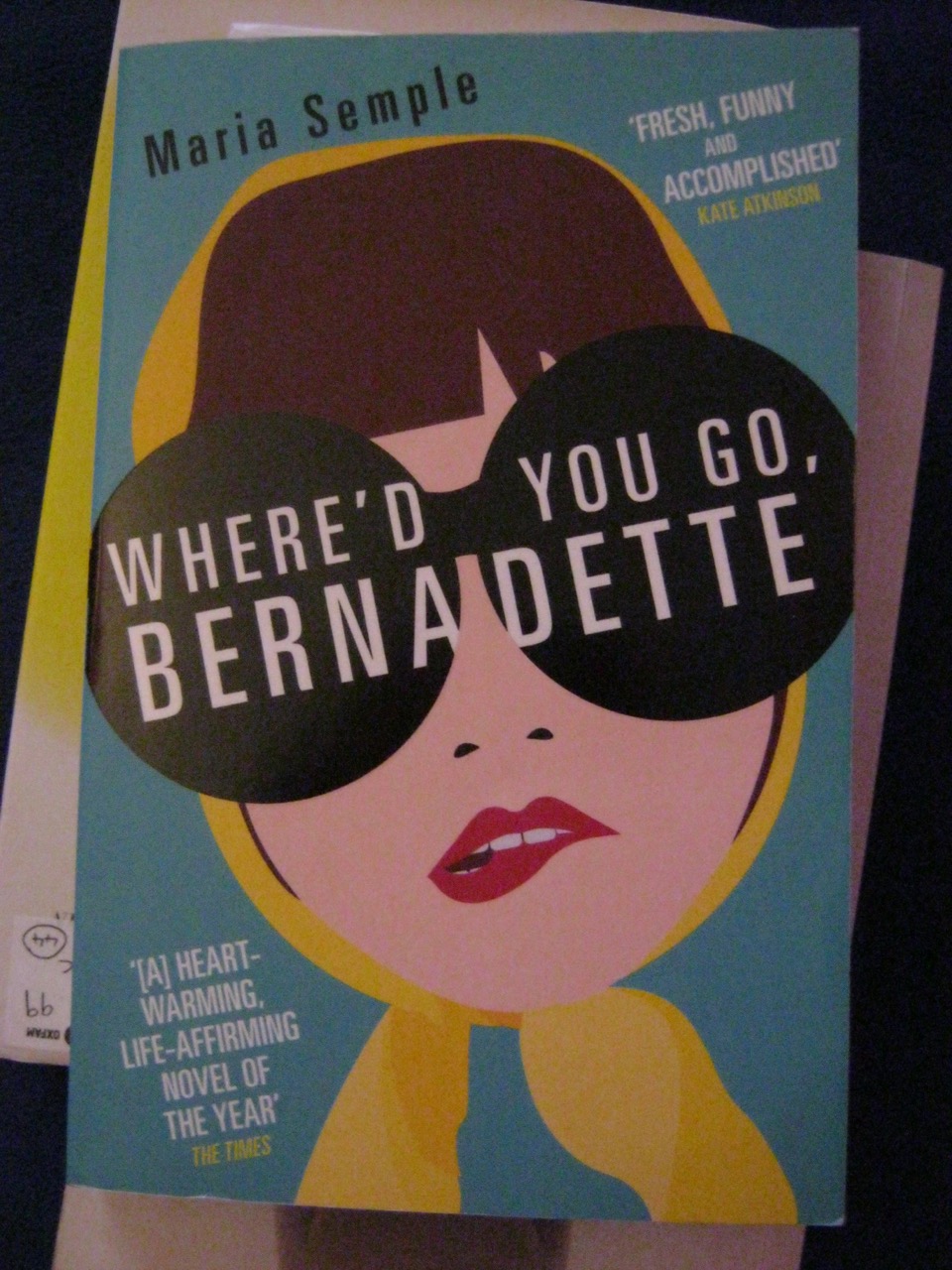
Then I came home and picked 'Where'd You Go Bernadette' by Maria Semple from the TBR pile in my room. You'd think I was sick of books about geniuses ... and yes, I think I am now. I have read lots of wonderful, well written and still engaging stories that are about ordinary people, living mostly unremarkable lives, but some writers just can't resist making their characters over-achievers, and I find them much less relatable. And this is a book with emails and hashtags and all manner of 21st century social media stuff, but I managed to get past that and just enjoy the mystery. So Bernadette is a genius who has plainly had a mental breakdown and her husband just seemed to have ignored it for a decade. That kind of trope annoys me to. Do people really just live so far up their own arse that they don't notice someone they love fall to pieces? (Turns out he is a bit of an arsehole so no surprise). So there was a lot to forgive in the book but I still managed to enjoy it, because she writes about the breakdown in a very real way and gets inside Bernadette's head so well, so we give her brownie points for that. Here, Bernadette's thoughts:

"What you've heard about the rain: it's all true. So you'd think it would be part of the fabric, especially among lifers. But every time it rains, and you have to interact with someone, here's what they'll say: 'Can you believe the weather?' And what you want to say, 'Actually, I can believe the weather. What I can't believe is that I'm actually have a conversation about the weather.' But I don't say that, you see, because that would be instigating a fight, something I try my best to avoid, with mixed results.
Getting into fights with people makes my heart race. Not getting into fights with people makes my heart race. Even sleeping makes my heart race! I'm lying in bed when the thumping arrives, like a foreign invader. It's a horrible dark mass, like the monolith in 2001, self-organised but completely unknowable, and it enters my body and releases adrenaline. Like a black hole, it sucks in any benign thoughts that might be scrolling across my brain and attaches visceral panic to them. for instance, during the day I might have mused, Hey, I should pack more fresh fruit in Bee's lunch. That night, with the arrival of The Thumper, it becomes I'VE GOT TO PACK MORE FRESH FRUIT IN BEE'S LUNCH!!! I can feel the irrationality and anxiety draining my store of energy like a battery-operated racer grinding away in the corner. This is energy I will need to get through the next day. But I lie in bed and watch it burn, and with it any hope of a productive tomorrow. There go the dishes, there goes the grocery store, there goes exercise, there goes bringing in the garbage cans. There goes basic human kindness. I wake up in a sweat so thorough I sleep with a pitcher of water by the bed or I might die of dehydration. (p.129-130)

So that was the pile, though I have already finished another, that I think might get more than two lines. All enjoyable in their own way and a nicely mixed bunch.
I left behind in Devon some unfinished business, but Claire managed to complete it ... and then take it back to the charity shop:
Oh yes, Monkey is home:
and we have been stepping over the suitcase in the living room for a week, but then we are experts at that, having lived with two bags of compost in the kitchen for a month (you stop noticing them after a while):

Stay safe. Be kind. Step around life's obstacles.

Wednesday, 22 June 2022

Read a book in one sitting

I don't often read books in one sitting. I remember doing it with 'The Road' (a long time ago), that was so gripping I could not put it down. I picked up 'Unsettled Ground' by Claire Fuller (who I find I have reviewed twice before) (and now I want to get the fourth of her novels and read that too) on Sunday afternoon after work and just kind of sat reading while Tish watched some true crime drama thing, thinking I would just make a start on it. I went to bed two-thirds of the way through and just carried on reading, until I got to the point where I might as well do another half an hour and finish. 

It tells the story of Jeanie and Julius, who, when their mother dies very abruptly, find they must deal with the outside world that they have mostly managed to avoid. It is a tale of smothering mothering and slightly socially awkward people, who, because they are bound together find that maybe they can face the world after all. But what emerges is that their mother had other things going on in her life of which they were unaware. I find it sad that there are people who see life as a transaction. Their mother refuses to take from society, because she fears owing anything in return, and so taking assistance from others comes hard to her twins (who are 51, by the way). Their bond is threatened when Julius develops a crush on a local woman, who appears to reciprocate, and Jeanie fears she will be abandoned. Her life has been filled with fears, and she is forced to face up to some of them, and I found her surprisingly adaptable and resourceful.
Here, the root of all her fears, from her childhood illness (Dot is her mother):

"Dot got her handkerchief out from her handbag and covered her face with it, rocking back and forth where she sat on the chair next to the doctor's desk. He called for the receptionist to come in, and Jeanie was led by the hand, back to the waiting room. There, heels on her chair and arms hugging her knees, she stayed until her mother came to fetch her. Was it then, when they got home, that Dot explained that the fever and the aches that Jeanie had suffered from when she was younger had weakened her heart and made it fragile, or was it later? Either way, her mother said, 'Think of your heart like an egg. You know what happens if you drop an egg?' Jeanie was worried her mother was going to start crying again and if she did Jeanie wouldn't know what to do. Perhaps the doctor had given her mother a pill to stop her crying when Jeanie had been in the waiting room. As her mother spoke, Jeanie imagined something within her chest the size and shape of a duck's egg but with a pinkish tinge and its shell so thin that the creature inside was visible: curled, bloody and featherless, it knocked and scraped on the shell's inner layer. What mayhem would it cause if it broke free?" (p.18)

That's all, no disclosure. An excellent read, thoroughly engaging, lots of real people, even the incidental characters have depth and subtleties. The library has 'Swimming Lessons' for me so am off to the gym now.

Stay safe. Be kind. Read a book in one sitting.

Monday, 28 March 2022

Holiday reading

(Another post sitting unfinished in the drafts, so I have to get it done so I can move on to the next one, which was most infuriating.)
'Lilian's Story' by Kate Grenville was in the charity shop pile (author previously reviewed here and here).  It follows Lil through life a ups and downs, from a childhood heavy with parental expectations to an adulthood of disappointment and an old age of couldn't-give-a-damn. I liked her because of her refusal to conform to society's expectations, but I pitied her because those expectations still managed to hang over her.
Here, an example of how she evokes the place they live (Australia) so vividly, something I loved about previous books, after their slightly deranged father has harangued her and her brother John at the dinner table:
"Some bird flew in and perched on the branch over our heads, blinking at us out of one eye, then the other. When the sun had slid behind the roof of Miss Gash's house and the sky began to turn pink, the bird flew away with a twitter and insects began to croak. Out of the lantana bush Miss Gash's tabby crept, stared at us with a paw raised, and crept on. John lay in his vomit and I watched pink dusk die into grey. Somewhere, streets away, someone was practicing the bugle, sending sad, random notes into the shallow pink sky like something lost." (p.86)

It is just a life, which she tries to create for herself, in spite of the world around her. This sums it up. She meets Jewel again, a woman from when she had been institutionalised, and she asks her about her regrets:
"She nodded seriously as I spoke, as if taking notes. I regretted almost nothing. There was a leather-bound copy of William that Father had given me long ago, before he knew that William was not just words. I regretted that, and it must have bubbled heavily, like a desperate drowning person, as he dropped it over the stern of the boat, but it had already been too late, I had already learned enough to keep me going. There were a few people I regretted not hitting. They might have thanked me for it in the end. I regretted not having said yes to F.J. Stroud, all those years ago. And of course I regretted the islands in the sun, the jungles, the gibber deserts, Niagara Falls, sleds drawn by reindeer, the feel of whale lifting my boat into the air under me. Naturally I regretted all that." (p.256)

I often find myself drawn in by books like this, that just follow a life. I don't need anything very much to happen. In fact some of the best books have very little happen in them. You just let yourself get attached to the person, wonder sometimes at their choices, but in the end a life is just a life, it matters whatever.


'No one is talking about this' by Patricia Lockwood was shortlisted for both the Booker and the Women's Ficton prizes last year. I started out not sure if I liked it; I almost gave up on it quite quickly thinking it was some kind of gimmicky 'internet generation' novel, but it turned out to be something else and I loved it. It is written in these weird disjointed paragraphs, that don't follow on from one another or flow like a story in any meaningful way. It could be described as stream-of-consciousness except it is third person. At times it feels like it is the woman writing, it is so immediate and intimate and often inside her head and her feelings, so it feels unsettling that it is third person. 

Here is an example of the early part, and why it made me cringe. I find that people who are obsessed with their 'online existence' think that it is real, when it's not. And the superficiality of it all makes me nauseous. ('This' refers to a post she had made that went 'viral'):
"This had raised her to a certain airy prominence. All round the world, she was invited to speak from what felt like a cloud bank, about the new communication, the new slipstream of information. She sat onstage next to men who were better known by their usernames and women who drew their eyebrows on so hard they looked insane, and tried to explain why it was objectively funnier to spell it sneazing. This did not feel like real life, exactly, but nowadays what did?" (p.13-14)

I liked this one because it is astute and perceptive, and witty:
"White people, who had the political education of potatoes - lumpy, unseasoned, and biased towards the Irish - were suddenly feeling compelled to speak out about injustice. This happened once every forty years on average, usually after a period when folk music became popular again. When folk music became popular again, it reminded people that they had ancestors, and then, after a considerable delay, that their ancestors had done bad things." (p.33-34)

I think what makes me bored by the internet is that people 'discover' stuff, but you know what, mostly it is not new stuff, it's stuff we already knew, it's just a new generation getting all excited about old stuff. But then I am an old fuddy-duddy who is confused when her kids are familiar with music that I listened to as a teenager. So this one too:
"Modern womanhood was more about rubbing snail mucus on your face than she had thought it would be. But it had always been something hadn't it? Taking drops of arsenic. Winding bandages around the feet. Polishing your teeth with lead. It was so easy to believe you freely chose the paints, polishes, and waist-trainers of your own time, while looking back with tremendous pity to the women of the past in their whalebones; that you took the longest strides your body was capable of, while women of the past limped forward on broken arches." (p.86)

So then her sister gets pregnant. And life changes. The baby has Proteus Syndrome, and her presence in their lives just takes over. And it is beautiful. Because you see the transformation of a person totally obsessed with herself into someone who comes to see someone else as the most important person on the planet. The style of the book remains the same; disjointed paragraphs, but they are telling someone else's story instead; it documents a tiny life in its entirety and established once and for all what really matters:
"On New Year's eve, she leaned over the baby with a glass of champagne and sang 'Bali Ha'i' right next to her ear and the baby's eyes flew wide, she went to the island. She sang 'Do Re Mi' and the baby followed up and down the stairs; she sang 'Over the Rainbow' and the rainbow went round. She sang 'If I Were a Bell' and that really did it; the baby pedalled her legs with excitement, she gripped her fingers with both hands, she cooed and cooed on the same pitch, she pushed the oxygen mask away and then clutched it to her face; if I were a bell I'd go ding dong ding dong ding.

Why not, she thought, and began to read the baby Marlon Brando's Wikipedia entry. Maybe it was the champagne, but it suddenly struck her as a democratic principle, that everyone should get to know about Marlon Brando: how he looked like a wet knife in a t-shirt, the cotton balls in each cheek when he talked, rumours of him wearing diapers on the set of Apocalypse Now. Nothing useful, but one of the fine spendthrift privileges of being alive - wasting a cubic inch of mind and memory on the vital statistics of Marlon Brando." (p.177-78)

Stay safe. Be kind. Enjoy the privilege of being alive.

Wednesday, 6 May 2020

100 Days - day eleven Living Otherwise

I acquired Milkman by Anna Burns from mum when I visited, what now feels like years ago but was only in February. It has taken me quite some time to read as I kept falling asleep abruptly while reading then waking up half an hour later with a very stiff neck. None of the people in the story have real names. This matters because who they are is not important. The book is about this profoundly dysfunctional society (Northern Ireland) and the way it affects people's lives, their interactions and relationships and even what they think.

"I myself spent most of of my time with my back turned in the nineteenth century, even the eighteenth century, sometimes the seventeenth and sixteenth centuries, yet even then, I couldn't stop having a view. Third brother-in-law too, for all his exercise obsession and of whom everybody in my district could have sworn didn't have a view, turned out to have a sharp view. There was no getting away from views and of course, the problem was these views between the areas, between one side and the other, were not just not the same. It was that each was intolerant of the other to the extent that highly volatile, built-up contentions periodically would result from them; the reason why too, if you didn't want to get into that explosive upsurge despite your views which you can't help having, you had to have manners and exercise politeness to overcome, or at any rate balance out, the violence, the hatred, the blaming - for how to live otherwise? This was not schizophrenia. This was living otherwise." (p.112)

So middle sister, as she is called, likes to read while walking. Unbeknownst to her people are disapproving of this weird behaviour and she is being viewed as 'beyond the pale', a category of people who are seen as outsiders. However when out running she finds herself being stalked by milkman, a member of the paramilitaries, who has decided that she is the girl for him. She tries to ignore him, even when he makes veiled and not-so-veiled threats against maybe-boyfriend. The community notice this stalking and assume the worst. Even her mother does not believe her when she insists she is not having an affair with milkman. All the while she is trying desperately to get on with life but against her will is drawn into the world of renouncers.

It took me many many pages to understand. Why doesn't she just tell him to go away I wondered. But thats not how things work. Mum summed it up after I emailed her about reading it. She said it's about a society based on fear. Life has to be lived as is dictated by the paramilitaries; where you live, who you associate with, what you say, where you shop, how you behave. Because if you don't someone may just turn up on your doorstep and shoot you. Families are both guilty by association and protected by association. And it becomes so normalised that people police themselves, and each other, because they are afraid. I grew up during this period, and the 'troubles' was a constant feature on the news in my childhood. I never understood this division along catholic/protestant lines. I never understood how the disagreement went so deep that people could be killed for it. I'm not sure I do now, but this book has certainly helped me understand how people lived their lives and why.

This statement by middle sister about marriage sums it up (marrying the wrong person and her ma's pressure on her to get married are constant themes throughout):

"Of course there was the big one, the biggest reason for not marrying the right spouse. If you married that one, the one you loved and desired and who lived and desired you back, with the union proving true and good and replete with the most fulfilling happiness, well, what if this wonderful spouse didn't fall out of love with you, or you with them, and neither of you either, got killed in the political problems? All those joyful evers and infinites? Are you sure, really, really sure, you could cope with the prospect of that? The community decided that no, it couldn't. Great and sustained happiness was far too much to ask of it. That was why marrying in doubt, marrying in guilt, marrying in regret, in fear, in despair, in blame, also in terrible self-sacrifice was pretty much the unspoken matrimonial requisite here. That was why too, I protected myself by not getting married; further, by sticking to maybe-relationships in spite of my intermittent longing for, and futile attempts to mould me and maybe-boyfriend into, a proper relationship." (p.256)

So, there are far reaching and convoluted consequences to the situation, even though there is never a 'situation' between middle sister and milkman (not to be confused with real milkman, who is actually a milkman). People die. For random and often unrelated reasons. It is the uncertainty that keeps everyone in line. The notion that you don't even know what thing you might do that will be disapproved of. And of course people can take the political situation and use it for their own desires. But try and do that and they are still watching you:

"So they beat him up. And it was for his behaviour that they beat him up, not for the irritation of guns, for wearing a balaclava when everybody knew who he was anyway; not for threatening me either, a woman, one of their soul sisters. No. It was for being a man and coming into the Ladies unannounced. He had shown disrespect, been dismissive of female fragilities and delicacies and sensibilities, had shown no courtesy, displayed no chivalry, no gallantry, no honour. It was that he had no manners basically. If he chose to walk in on them while they were applying lipstick, adjusting hair, sharing secrets, changing sanitary towels, then so be it, there would be consequences. And here they were, those consequences, happening now. After the current consequences, after they told their men which they were going to do in a minute, there would be further consequences." (p.310)

So. I was just about to write that this was a 'proper' blogpost. Despite my original intent when I started this blog eleven long years ago I have drifted in to only expressing opinions about books. The purpose of 100DaysToOffLoad is to share what you are thinking. I am going to have to work on the idea that I can share opinions about other things too and it will be a proper blogpost. This book has caused me to think a lot. In fact that is why I like reading. Although I do read for entertainment the books I enjoy the most are the ones that make me think, the ones that show me something about life that I had not encountered before. So in light of that I am going to start a Books to Make You Think link in each of my posts: Fugitive Pieces by Anne Michaels from 2010.

Stay safe. See you tomorrow.

#100DaysToOffload

Sunday, 26 August 2018

Sing, Unburied, Sing

'Sing, Unburied, Sing' by Jesmyn Ward was number three of my reads from the Women's Fiction shortlist. It is a family tale of three generations, with quiet, and then not so quiet supernatural undertones. It is told in alternating chapters, in the first half, by Jojo and Leonie, son and mother, living together with Pop and Mam, who is dying quietly in the back room. But they live in very different worlds; Leonie exists in the current day, the journey to collect her partner Michael from prison and all that involves, and Jojo lives in a past that his Pop has shown him, while also trying desperately to care for his little sister Kayla. On their journey they acquire a hitchhiker in the form of Richie, a ghost from their Pop's past, who's story joins theirs in the second half. I was confused at first, but he really is a ghost and only Jojo can see him. 

I spent the entire book wanting to wrap Jojo up and take care of him. He is a young boy desperately trying to make sense of the world, but with no-one to help him, and at the same time being forced to grow up and protect his sister from the worst of Leonie's parental neglect. Where Leonie has rejected the history of their family and wants to inhabit a world of drugs, Jojo is drawn to the past that Pop has tried to share with him, all tangled up with a collection of weird superstitions. It is a strange slow unravelling of a disturbing tale from Pop's youth, becoming more of a ghost story as it evolves, with Leonie's murdered brother Given reappearing too, all of whom seem unable to find peace in death. There is such a stark contrast between the tales of violence and the tenderness with which Jojo watches over Kayla. I found myself, quite common with this style of story telling, liking some narrators more than others, and I so actively disliked Leonie because of her attitude towards her children that it coloured my view of the book. The saving grace for me was Jojo and his determination to be a good person. 

Two quotes, this one from when they arrive at the prison, it evokes the grinding, relentless poverty of the place:

"The jail is all low, concrete buildings and barbed-wire fences crisscrossing through fields. The road stretches onward, out into the distance, and for a while, the road points us toward the men housed here. There's no other sign, nothing in those fields, no cows, no pigs, no chickens. There are crops coming in, baby plants, but they looks small and stunted, as if they'll never grow. But a great flock of birds wheels through the sky, swooping and fluttering, moving graceful as a jellyfish. I watch them as Kayla mewls in my ear, as we pass another sign, old and wooden, that says Welcome to Parchman, Ms. And then: Coke is it! But by the time we get out of the car in the parking lot, the birds have turned north, fluttered over the horizon. I hear the tail end of their chatter, of all those voices calling at once, and I wish I could feel their excitement, feel the joy of the rising, the swinging into the blue, the great flight, the return home, but all I feel is a solid ball go something in my gut, heavy as the head of a hammer." (p.123)

This second is Leonie talking as she watches her children asleep, part of it is tenderness towards them, but it is pushed away by her resentment of their closeness:

"They sleep as one: Michaela wraps herself around Jojo, her head on his armpit, her arm over his chest, her leg over his stomach. Jojo pulls her in to him: his forearm curled under her head and around her neck, his other arm a bar across them both to lay flat against her back. His hand hard in protection, stiff as siding. But their faces make me feel two ways at once: their faces turn towards each other, sleep-smoothed to an infant's fatness, so soft and open that I want to leave them asleep so they can feel what they will. I think Given must have held me like that once, that once we breathed mouth to mouth and inhaled the same air. But another part of me wants to shake Jojo and Michaela awake, to lean down and yell so they startle and sit up so I don't have to see the way they turn to each other like plants following the sun across the sky. They are each other's light." (p.151)

An intense and atmospheric book that packs a lot into 24 hours or so, and leaves the reader dazed and unsteady at the end. There is no neat and tidy resolution for the ghost, nor for the people either. Yet another book that deserves a more thoughtful review but has lingered too long in the draft folder.

Wednesday, 25 July 2018

Mushrooms and Idiots

I managed almost exactly 7 hours of reading on Saturday for the 24 in 48 readathon. Sunday Dunk and I went for our annual day out to New Mills in Derbyshire, a mere half an hour on the train, to take a little stroll along the Goyt Way. The girls went to the coast with some friends and played on the beach, so a good time was had by all. This morning I checked on the avocado tree and found the pot now has its own little ecosystem.


'The Idiot' by Elif Batuman is my number four from the Women's Prize for Fiction shortlist (though I have not read the winner yet) and also a finalist for the 2018 Pulitzer Fiction prize. 'Sprawling' is what Miranda July called it on the front cover, and I think that would be my reaction too. It follows the freshman college experience of Selin as she struggles to make friends and find out what she thinks about life, the universe and everything. There is a wonderful cast of characters who all seem to have themselves much more 'together' making Selin feel that she must be doing something wrong. She drifts between classes, seeking something that will tell her the true direction her life should take. Although written in past tense it has a very immediate feel to it, as if she is relating stuff that only just happened, with lots of extraneous and trifling details about what people (and Selin herself) wore and ate and said, but this has the effect of making you feel intimately involved in their lives. All of the characters are either learning languages, or not native english speakers, and much of the discussion revolves around national and linguistic identity, and also interesting conversations about language use and how it differs and how words are shared between cultures. Selin is rather sweet and naive and often takes things too much at face value:

"In philosophy class, we talked about the problems we would have on Mars - the language problems. Supposing we went to Mars and the Martians said 'gavagai' every time a rabbit ran by; we would have no way of knowing whether 'gavagai' referred to rabbits, to running, or to a kind of fly that lived in rabbit's ears. I found this incredibly depressing - both the obstacles to understanding and the rabbits with flies in their ears." (p.125-6)

"At some point in our conversation, Ivan mentioned that strawberries grew on trees. I said I thought they grew on little plants close to the ground. No, he said - trees.
'Okay,' I said. I knew that in my life I had seen strawberries growing, on plants, but this didn't seem like irrefutable proof that they didn't grow on trees.
'You're easy to convince,' he said.
We walked for three hours. On the way back we got lost and had to climb down a steep hill. I really didn't want to climb down the hill. I actually walked into a tree and then stayed there for a minute.
'What are you doing?' Ivan asked.
'I don't know,' I said.
He nodded. He said that there were lots of possible ways down the hill, but probably the best way was one where you didn't have to go through a tree. Then he started talking about the execution of Ceausescu and his wife." (p.161)

At the same time she can also be quite astute. She sums up nicely a conversation Monkey and I have had on several occasions about the consumption of alcohol. I find this does not just apply to college students but in my own experience with work colleagues, people thinking that if you don't drink on a regular basis it is for some kind of principle like being a vegetarian:

"This obsession with drinking was one of the things that had most surprised me abut college. I had always looked down on alcohol, both my parents liked to drink at dinner and it always made them more annoying. I had known that alcohol was supposed to be a big part of college life and that some people would really care about it, but I hadn't realised it would be basically everyone, except the most humourless or childish people, and also some people who were religious. There didn't seem to be any way of not drinking without it being a statement." (p.174)

Somewhat in pursuant of Ivan, her elusive, email love interest, she takes herself off to teach English in Hungary for the summer, an experience that seems to serve to leave her more confused about the whole life and universe thing. I liked Selin immensely and the book is very witty and perceptive; that while it sometimes tries to argue that language and culture dictate identity equally people's experience of their struggle with identity is universal and something we share across national boundaries.

"I read a book of fables and read two fables about harts. They both ended badly. In 'The Hart in the Ox-Stall', the hart hid from the hunter in an ox-stall. The hunter noticed its antlers sticking out of the straw and killed it, proving that 'nothing escapes the master's eye.' In 'The Hart and the Hunter', the hart deplored its legs for being less handsome than its antlers. Later, when it was running from a hunter on its legs, its antlers got tangled in a tree and it got killed. The moral was: 'We often despise that which is most useful to us.' In general, the hart's biggest problem was antlers. Or no, it wasn't antlers at all, it was hunters." (p.189)