Monday, 27 June 2022
Failing
Wednesday, 26 January 2022
Daughters and Mothers
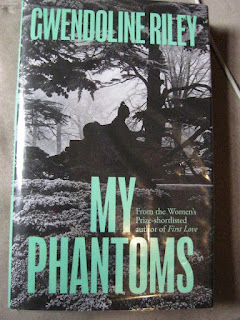
Back in 2013 I enjoyed 'Sick Notes' by Manchester author Gwendoline Riley and so pounced when I read a review of 'My Phantoms'. In it a young woman negotiates a somewhat fraught and distant relationship with her mother. Bridget can manage with their annual birthday dinner but as her mother gets older and unwell she seems to want them to be closer. It's not even that she dislikes her, it's more ambivalent; that the mother, Hen, is just needy, has unspoken expectations of her daughter and seems to look in all the wrong places for companionship. It is a portrait of two people just not getting on, with Bridget caught between what she ought to feel and do as a dutiful daughter and what she does feel and want to do. And then there's the father in the background, and you begin to wonder how the two girls are functioning adults. It's funny (funny weird, not funny ha ha) how often I read books that just make me and my family seem so normal, and make me feel grateful. Sorry, it had to go back to the library last week so no further thoughts, but very much worth the read. Quote, as the two girls are getting ready for a weekend visit with their dad:
"'There's no point in provoking him, is there?' she used to say - to repeat - chivvying Michelle and me to find our coats and shoes; to be ready ten minutes before our father was due. Even back then I knew that she was talking to herself, really; whisking herself through the task in hand. My mother had her sayings, but she did not give real advice, ever, about anything.
Here, 'there's no point in provoking him, is there?' seemed to mean, 'There's no reason for me to behave in a sane and civilised way when he doesn't (is there?), not when there's a golden opportunity here for me to join in and be mad too.' And she didn't even mean 'provoking', did she? She meant an omission, not an action. She meant: You mustn't fail to anticipate something he could plausibly decide to be affronted by. Which rather left one with nowhere to go. Michelle and I had never been cheeky or disruptive. We'd been mild and quiet from the start when he was around, and it made no difference. Anything could set him off, or not set him off. All depending on how he wanted to feel; on what kind of satisfaction he wanted to extract. Not provoking him could provoke him. It often did provoke him. She knew that. Why did she like to pretend otherwise? For excitement's sake, perhaps? Or because she didn't want to feel left out? I've an image of a dog trying to join in with a football match, but that's possibly too wretched. I think her mental sleight was more akin to the way Michelle and I, after our swimming lessons, used to hit the buttons of the arcade games in the snack bar: we hadn't put any money in, but nonetheless persuaded ourselves that we were affecting the progress of the yellow lights, which flashed in steps, then slowly cascaded. In fact, there were a lot of children who liked to do that, as I remember. It must be a thing children like to pretend. If someone else had got there first, I used to wait my turn, not too close to the machines, but not too far away either." (p.26-7)
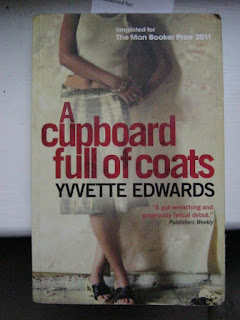
'A cupboard full of coats' by Yvvette Edwards is the story of Jinx, and her mother. But her mother is dead, and the how and the why form that basis for a long weekend of soul searching by Jinx and Lemon. Neither of them killed her but they have both felt responsible. I find it hard to get my head around volatile, abusive relationships, and why people stay in them, but it does make for emotionally fraught story telling. So we watch Jinx, watching her mother, falling for this charming man, this man who invades their lives and then their space, who gets his feet under the table and has no intention of moving. Jinx sees, and she knows, but there is no one to tell, and as her mother lurches from joy to misery and back again she can only watch from the sidelines, powerless to stop it.
But her guilt and sense of responsibility has over the years translated itself into feeling unable to bond with her own child, a son who now lives with his father, and conversely to the situation in My Phantoms, comes over to visit her. And unlike Bridget's father who ignores or lords it over his daughters, Jinx's feelings of inadequacy drown her every interaction with her son. Here she watches, jealously, as Ben chats animatedly with Lemon:
"I listened as he told Lemon about Max in his class whose tooth came out when he bit an apple in his packed lunch. There were anecdotes about his Power Ranger toys, Thomas the Tank Engine, and Shaggy's exploits in Scooby-Doo. He talked about his new teacher, Mrs Smith, and how impressed she was with his reading. Lemon gave him piece of paper and a pen and Ben proved once and for all that he could write his name himself without any help from anyone.
I was in shock. I had never heard my son like this before. I had simply thought he was a morose child, because morose was how he always was when he was with me. I had never seen this side of him, this laughing chattiness, the non-stop outpouring of everything going on in his life, the pleasure he took in his accomplishments, such as they were. And I felt hurt. Really hurt. Wounded to the core just listening to how natural and happy he could be with a virtual stranger, when I had been trying for nearly five years to have a relationship with him and had come up against brick after brick after brick.
He made me feel how he had made me feel when he was a baby. Like no matter what I did or how much time I put in or how hard i tried, anyone could walk into his life and they were immediately more important than I was. Like I did not matter. My existence meant nothing. And all the while, as I sat on the periphery of their conversation, I could feel myself getting angrier and angrier, and though I tried to rationalize my way out of it, I just couldn't stop myself." (p.38-9)
She is a very unhappy young woman, with so much hurt and grief bottled up, thrust into premature adulthood by the loss of her mother, and so good at covering it all up. So Lemon stays, and cooks for her, and in caring for her and making her vulnerable they each share their story of what happened, and the unfolding of the story, the build up of the violence, and the silence, is very skilfully handled. Here Jinx watches Lemon bring Berris and try to make peace after the first beating:
"I'd hated that man so bad for weeks, wanted nothing else in that time but that he pack up and get out of our home, yet he looked more wretched than any man, woman or child I'd ever seen in my life. Like he knew he'd done the worst thing a person could ever do and was truly, to the heart, sick and remorseful and sorry. He couldn't lookout her and he couldn't stop himself from bawling like a baby. It was the most pathetic thing I'd ever seen.
In that moment, because I knew what he'd done, how he'd smashed in my mother's face in temper, because the memory of him polishing off his dinner and the look of pure satisfaction in his eyes was still fresh and vivid in my mind, my feelings shocked me. I looked at the man who had caused our family so much hurt, so much upset, and there was no denying it; I felt sorry for him.
I felt sorry for him." (p116)
And much of the book I liked Lemon, he cared about music and food, and loved Jinx's mother from the sidelines. But then he tells his side of the events, and I rethink. And then he meets up with Berris after he is released from prison and he says this:
"'You know, after what he done, I thought for a long time he was the hardest-hearted man alive, the coldest, the evilest. But after I spoke to him last time, watching him, listening, not how I done most of my life but kind of fair-like, not squeezing him into the way I wanted to think of him, but looking hard to see who he really was, what he was, after all that I come to the conclusion he was just sensitive. Oversensitive. Even small things that wasn't meant to be no slight hurt him. I tried to imagine how it felt to be in his shoes, and they was small and tight and uncomfortable ...' " (p.247)
and reading it made me feel sick, because she captures here so succinctly how men justify violence against women, as if it was all ok, and he was forgiven, because he was sensitive and her going out dancing and having a nice time without him is behaviour deserving of death.
Sometimes it feels hard to take stuff in, because stories like this repeat down the years, in real life as well as fiction. But Tish and I enjoyed this article about Grace Tame who steadfastly refused to politely smile on camera with the Australian prime minister, and people go ape-shit about it. Women don't owe the world a smile.
Stay safe. Be kind. Don't smile if you don't want to.
Saturday, 2 November 2019
Feminists at the Manchester Literature Fesitval
Saturday, 28 September 2019
How to get into Manchester University
Monday, 3 June 2019
Welcome to Moss Side
Within four days I had made an offer that was accepted and it should have all gone swimmingly. The best laid plans and all that, complications with the land registry, meant that things dragged on for many more weeks than I anticipated. We lived surrounded by piles of boxes, coming home from work every day expecting ... hoping ... that there would be a message from the solicitor that we were ready to complete. I never want to buy a house again. Yes, I know some work needs doing on that flashing over the bay window ... trust me, it's high up the list. It is small, cosy and has everything we need. We are painting, and more painting, photos of fun stuff coming soon.
Tuesday, 20 February 2018
Welcome to Old Trafford
Many, many new crafty projects are in the pipeline for the new house, some functional, some purely decorative, from new bath mats to a fire screen. When we put all our crafty stuff in one place it was quite worrying how large the collection was, however we are fortunate enough to have a cellar which is becoming a craft room. I have managed to re-read 'A Month in the Country' by J.L. Carr that mum bought me for Christmas, and that I read many years ago when I joined a book club in Stow-on-the -Wold. It is a mere handful of pages long. Meanwhile Monkey has finally arrived at the end of Anna Karenina that she first started reading eight years ago. I have struggled to concentrate on reading so will probably stick to less demanding books for a while. And there is still so much white wall space just crying out to be covered in something.
Sunday, 9 October 2016
Literary failures and successes
On the plus side the Manchester Literature Festival is now well under way. I went to my first event last month however, one of the preview events, that saw my wonderful Professor Harari visiting to promote his new book. I did his Coursera course, 'A Brief History of Human Kind' three years ago (unfortunately it no longer seems to be available) and I was so excited to discover he was going to be coming to the festival. His new book, Homo Deus, is an examination of where the human race might be headed next.
Saturday, 14 May 2016
Gale warnings at Home
![]() |
| Home |
Friday, 9 October 2015
Theatre and Literature
Saturday, 23 May 2015
Austerity Rules UK
Michael Rosen (his blog is here and well worth a read) summed the situation up just perfectly on Facebook the other day:
"The government's trick is to convince enough people that cuts in healthcare, education and welfare are inevitable and necessary whereas a redistribution of wealth from the rich to the poor (and to provide better healthcare, education and welfare) is impossible, crazy and dangerous. Meanwhile UKIP (with Tory and Labour nodding in the background) claim that poor healthcare, education and welfare is caused by immigrants and not as a result of the super-rich hoarding wealth."
There is a big demonstration planned at the Bank of England in London on 20th June, so if you are at all despondent get out and add your voice to the gathering crowd.
Tuesday, 19 May 2015
Chorlton Arts Festival
Paper, thread, scissors and needles were all provided for a very modest fee, and armed with some basic instructions we were set loose.
And a good time was had by all. Including me. Many other events of all shapes and sizes happening this week, many for free. Check out the calendar on the website if you happen to be in the vicinity.
Sunday, 19 October 2014
Listening not reading (much)
I went last night, as a volunteer that is (not that we had much to do), to hear Kate Tempest at the Contact Theatre as one of the last event of the Manchester Literature Festival. I was probably the only person in the audience who had not heard of her. She was this lovely mixture of worldly and naive, looking at first glance so young but with a voice that has quite a gritty quality that usually comes with years of hard living. She recited from memory for over 20 minutes her version of the story of Tiresias, it was utterly spellbinding. This is just a little taster of her style to tempt you, there is lots more on Youtube, and if you ever get the chance, do go and see her.
As a consequence I did not really get going on the Read-a-thon until this morning, and actually we have been planning a trip to the Manchester Art Gallery to see an exhibition about the First World War, so the reading has been quite limited compared to last time. Also there has been no cake this time:-( The Monkey is in London so I have not had company to stay up all night with.
I am really enjoying 'The Secret of Lost Things' by Sheridan Hay and also 'Notwithstanding' by Louis de Bernieres (that I picked up at random in the library when my reserved books had not arrived, despite being 'in transit' for three days.) I hope everyone else out there has been having a good weekend of slouching on the sofa surrounded by books.
Wednesday, 5 March 2014
Beta Testing the Central Library
Saturday, 14 December 2013
Sick Notes
This description from a brief stint at a boarding school where she meets Donna sets the tone somehow:
"At mealtimes we carried our food in moulded trays to large round tables. We poured glasses of squash from a huge jug. It was unwieldy, loosing its centre of gravity in those small hands and short arms, so the drinks as always sloshing out, sticking the paper cloth to the Formica then dripping over the table lip onto our laps. Whenever I spilt I heard my mum saying, 'You've never understood liquids, have you?' " (p.25)
And from there we move to a description of her mother's hoarding habit, her obsessive inability to throw anything away:
"One afternoon when I was skipping school I was making myself a cup of tea and I threw out a carton of sour milk. While the fridge door was open I found myself going though all the shelves in there, dropping jars of furry jam, a cracked block of cheese, my brother's half-finished turkey steak (that she'd put in a jiffy bag a week ago) into the bin too. I emptied the rotting contents of a stack of plastic tubs, and then from one cupboard I threw out a dozen empty jam jars, a box of pellet-dry raisins and a bag of grub infested flour." (p.34)
Everywhere just has this feeling of neglect, even squalor, as if people are only passing through, not stopping long, so it's not worth their trouble to take any care. This is the bar, where Donna works (and this seems to be describing the scene shown in the front cover image):
"I take my drink to one of the empty tables near the back of the room; lean back then lay back on it. I feel its viscid surface velcroing my coat. I lie completely still, with my mug on my chest, listening to my breathing and staring up at a tight tangle of wires falling through a hole in the patchy plaster. A sickly yellow glows in two enormous, leaded glass light shades which hang askew on gold chains." (p.43-4)
And the room she lives in:
"My room is a barren tip. The boxes are still stacked in the corners, the bare duvet is on the floor by the record player and there are half-full mugs and scraps of scrawled-on paper everywhere.
'As you can see: I'm currently - riding the crest of a slump,' I say. 'Excuse the ...'
I sweep a hand around the carnage, but he isn't looking anywhere except at me. There are unfinished books everywhere: resting open on my bed like pitched roofs, like dead birds. He picks one up as he sits down next to me." (p.93)
And then on the bus:
"Upstairs on the bus I sit in the last empty double seat. The thin air is dank and there's a breathy grey film on the windows. There's the smell of worn-out mint gum and of sweet shampoo, from the girl in front of me who is combing her wet blonde hair out over and over. I watch her and I don't think of anything. Then I watch a puddle of spilt drink in the aisle elongating with the acceleration, licking at a screwed-up sweet wrapper as the bus heaves itself away from a stop." (p.117)
I partly enjoyed the book because as she wanders she recites places and streets that are so familiar so I can visualise her environment: Market Street, Oldham Street, Hulme Asda, Central Library, the Arndale, Victoria Station, Piccadilly Gardens. It wasn't until I was browsing for quotes when I came across the reason why it is entitled Sick Notes; she refers to writing sick notes for herself for the last two years of school, and it occurred to me that the story of this interlude in her life is a kind of sick note, a made up excuse to avoid getting on with the serious business of living. I think this is why there is such a thing as Young Adult fiction, because, although I liked the book, it is such a long time since I have had things and people to be responsible for that I cannot recall what it is like to have *nothing* to do, no demands on your time and no one to consider but yourself. It was as if I was reading the thoughts of another species.
The book is wonderfully astute and full of little details of observation that make it very immediate. I'll give you two tiny sentences that counteract the grubbiness of all the other quotes:
"When I crouch down to tie a lace that's trailing through old puddles I see how the setting sun is making sparks of the hairs on my ankles." (p.139)
"I'm reading the graffiti on the bench, fitting my thumbnail in the lines of the runic romances." (p.169)
So, what is it all about? I'm not really sure, but it did inspire me to take maybe a 'sick day' sometime, to do nothing, to wander aimlessly and see where it takes me. But the middle aged me needs a day without rain.
Friday, 22 November 2013
TNT arrives in Manchester
Sunday, 15 September 2013
Dead Dog Poems
I find that I didn't really get around to reviewing Don Paterson's Rain that mum bought for me several years ago, I will try and rectify that soon. He was a lovely reader, very chatty in style and shuffling through his papers as if he were picking his choices spontaneously. He seemed to feel that his style was a little depressing, making several references to his penchant for dead dog poems, but on the whole I found him the more entertaining of the two. I particularly loved when he talked about having 'googled' himself and found the vast array of people determined to destroy his carefully constructed reputation, and he read us a poem which set out all the various criticisms of his poetry that had appeared online. It appears that poetry reviewers can be as pretentious as some poets.
Here he is reading Rain. On watching it again I realise how typical it is of how he read, as if he just happened to be reading a poem and someone came along to listen, not that he is reading to anyone. Every time I go to a poetry reading (and it's been a few now) it remind me how much this is an auditory medium, that listening is a whole other layer of experience over merely reading poetry.
I confess to knowing nothing of Paul Muldoon, who described himself as a wanderer; having a tendency to wander the stage while reading rather than some kind of poetic style. Neither did I have a pen and paper to write notes so I was only left with an impression that I would need to give his poems more attention in print to appreciate them; several times he reached the end of a poem when I was expecting more so I was left with a feeling of having missed the point. He was much more methodical and had his selection properly scheduled with sheets and books arranged in order for the reading, and I felt a little as if he were hiding behind his mop of grey hair.
This video shows him noticeably more relaxed and humorous.
All in all a great start to this year's events. My first event of the festival proper is Patrick Ness. (Warning, don't go to youtube and start watching poetry videos, it could swallow up the rest of your day.)