Thursday, 5 June 2014

Wild and Reckless - Costa Rican Adventure Part 5

On our penultimate night we went for dinner at The Treehouse in Monteverde, though it was raining when we walked over to eat so they were not seating anyone under the tree as it is in the open.
For our last day in Costa Rica we took a hike to the San Luis Waterfall (or catarata, a word we became very familiar with in chatting to various people along the way). It seemed straightforward. Take the early bus to the cloudforest but get off at the turning to San Luis, walk downhill 7 km until you find it. It turned out that Jovan probably hadn't ever been to the San Luis Waterfall (but it was the only time they let us down).
Another of my best photos, a green spiny lizard on the walk down the hill:
So we walked and we walked. It was downhill all the way. Past the school:
Past the health centre (these buildings were sprawled randomly down the hillside, seemingly nowhere near where anyone lived):
We saw plenty of birds, and then a very camera-shy squirrel:
We were very hot, very tired when we reached the bottom of the valley and the village of San Luis, having descended several thousand feet. There was no sign of the waterfall. I insisted that we walk out the other side of the village, where we finally encountered a man who told us it was back up the hill. Mum then knocked on someone's door and after a long chat established that we had to go back up past the school and take a turning. This was 3km ... back up the hill. In the scorching, midday, heat. We stopped by the river for a drink and to reapply suncream. Someone had thoughtfully dammed the river and created a deep luscious pool. Although just behind us the road crossed the river on a little metal bridge no vehicles had come past us in over an hour and there was no one about. 
It was irresistible:
Having been cooled and refreshed I was all set to march back up the hill. Mum was a bit more the worse for wear so the walk back up was done in tiny stints between patches of shade and included a welcome sit-down at the cemetery. Having got off the bus around 8am it was 1.30pm by the time we arrived at the entrance to the waterfall. From there it was another 1km to the fall itself. The perk was it was through the rainforest along the river.

I am trying to upload the video of the final stretch and the waterfall itself, but am not sure it is working. (Gave up on the video, in fact the two short films that I put together with these photos at the end wouldn't even load to Flickr). You can go to the 'Search for the San Luis Waterfall' album on Flickr and see the little videos of us making the final trek (actually, go to just this one, the first one has not loaded properly either). 


The water was take-your-breath-away cold but very exhilarating. It was so beautiful and we sat and watched a flock of swift type birds swooping in and out of their nests in the rocks around the valley and up above the waterfall. We had hoped to be there for the middle part of the day when the valley is a sun trap, to sit on the rocks and read and have our lunch. The perk of being late was that we had the place to ourselves, but the sun had moved around and it was cooling off down in the valley, so we only stayed about an hour, allowing plenty of time to walk back and call the taxi. We waited half an hour for it to arrive, admiring the fruit in the garden of the people who ran the little cafe and trying (and failing) to capture more hummingbird photos. 
The final one of my wildlife photos, and probably the best. This is a Glasswinged butterfly:
At 6am on the 23rd we said our goodbyes to Pension Santa Elena and caught the bus back to San José.
We left San José just after 5pm. As we flew away we briefly had the sunset through the window and then about eight hours later were awoken with the sunrise on the other side of the world.

Biodiversity rules ok - Costa Rican Adventure Part 4

This is too big a topic to write about in such a small space, and I have become distracted reading about the geology and background of Costa Rica, so I'm sorry if this post takes a circuitous route to the subject in hand. It was sparked by an interesting comment that Jim (our guide at La Leona) made; Costa Rica had no dinosaurs. This is because (obvious to anyone with interest in such things but it never occurred to me before) the central american land bridge between the continents was formed a mere 15-20 million years ago by tectonic plate movements and volcanic activity (see here). But the real distraction started when thinking about the current concern with the rate of species extinction caused by human interference. Alongside the normal very gradual process of extinction there have been what are termed the big five 'extinction events' in the course of the existence of our planet. During each of these a huge proportion of the species on the planet died off. I had became curious as to how long this process took. The most recent of these extinctions, which happened 66 million years ago and famously killed off the dinosaurs as well as up to 75% of all plant and animal species, is referred to as the Cretaceous-Paleogene extinction event. It was caused (at least in part, there is of course much debate on the subject) by the impact of an asteroid. This quote comes from the wiki page where it describes the effects of the impact:

"Such an impact would have inhibited photosynthesis by generating a dust cloud that blocked sunlight for a year or less, and by injecting sulphuric acid aerosols into the stratosphere, which would have reduced the sunlight reaching the Earth's surface by 10-20%. It would take at least ten years for those aerosols to dissipate, which would account for the extinction of plants and phytoplankton, and of organisms dependent on them (including predatory animals as well as herbivores). Small creatures whose food chains were based on detritus would have had a reasonable chance of survival. The consequences of reentry of ejecta into the Earth's atmosphere would include a brief (hours long) but intense pulse of infrared radiation, killing exposed organisms. Global firestorms likely resulted from the heat pulse and the fall back to earth of incendiary fragments from the blast. Recent research indicates that the global debris layer deposited by the impact contained enough soot to suggest that the entire terrestrial biosphere had burned." (my emphasis)

Isn't that mind boggling. Everything on the planet burned, and yet here we are. This extinction took place possibly in as little as 10-12 years. But each time evolution stepped in, plants and animals literally rushed to fill the gaps left by species that had gone and a whole new round of change and growth started. 
Doesn't it make human influence seem slightly irrelevant. But don't be fooled. Life can survive these catastrophes ... humans might not. The biodiversity of the planet is important because nature provides us with our food and water.  Nature is the expert at balance, and when we disrupt that balance we tamper with our own survival. As I pointed out in a previous post, strangler figs do not throttle all the trees in the rainforest, but Britain used to be an island entirely covered in forest, but thanks to human destruction nowadays a mere 12% of our land is forested, and even ancient woodland is controlled and managed by people.  It was the most striking thing about walking in the rainforest, that, apart from the cleared path, it was untouched. 

Pretty pictures now. The animals moved around too much, but the plants stayed still. I know pretty much nothing about plants. Mum however is very knowledgable. These are ferns, all photographed within a few feet of each other. Even I could see the variety in the species. Why? They all occupy the same space and the same niche, so why is there so much variety?


I am more of a fungus fan myself, though still know nothing. But some of them are strikingly beautiful.


Size is everything in the rainforest it seems. Things are huge. Trees are huge, leaves are huge, insects are huge. Or they are tiny.
This is the biggest termite nest we saw, it is about as big as me:
Inside the termite nest (and Jim got me to eat a termite ... they don't taste like chicken.)
Mum spotted this, it is the tiniest ants nest. It is about the size of my finger and the ants were like tiny black specks of dirt:
And beetles come in a mind-boggling variety. I didn't get a photo of the fabulous Hercules Beetle that Jim had as a pet and let me hold, or the phosphorescent click beetle that he caught on our night hike. This is a jewel beetle that landed on mum:
And then there were big ones:
and even bigger ones (probably a Longhorn Beetle); this poor thing appeared to have been half eaten, he had a front leg and half an antenna missing and he limped away up the path:
And a very large bee, that made mum walk swiftly away up the path while I followed it to get a photograph:
One of my favourite photos of the holiday. I don't object to the label 'tree-hugger', it implies a certain sentimentality about nature, but I prefer to think of it more as awe.

Sunday, 1 June 2014

Nevertheless, I forgive you.

It was an unintentional coincidence that both the books I read on holiday had 'flight' in the title ... or maybe not? I reviewed 'The man who disappeared' recently and was not so impressed, but we did a quick charity shop trawl a couple of days before I went away and I picked up 'Natural Flights of the Human Mind' which I have absolutely loved. When I took it out and started reading mum mentioned that her friend Margaret goes to the same book group as Clare Morrall ... small world.

Doody and Straker are the most unlikeable of characters, but in a wonderful rather than an annoying way. Neither of them is much of a conversationalist; Straker is known in his community as the man who never speaks, a fact that makes him an object of fear and some awe amongst the locals. Doody is much too angry to want to talk to anyone. I have never encountered a character so perpetually angry. Both have run away from lives, but for very different reasons. Doody was abandoned by her husband and simply walked out of an empty life and found a corner of Bristol to hide in, keeping minimally in touch with a family who she feels blame and disdain her. Straker on the other hand has escaped a catastrophic event, that he does not remember but which occupies his thoughts nevertheless, the details of which are gradually revealed as the story progresses. The 78 victims of the catastrophe monopolise his dreams and the regimented structure of his life appears to be designed to both elude them and antithetically to honour them. Having shunned human contact for many years Straker is dragged back to the human race by his first meeting with Doody and their friendship continues in the same vein for some time, with her venting her spleen in his general direction and him finding small ways in which to teach her to be a better human being. 

Running alongside we have their back stories, how they came to be in their current situation, but also the internal 'dialogues' that Straker has with the '78' (as he refers to them). Initially I was impatient to know what had happened but I think that she sustains the uncertainty just long enough to make you intrigued; what exactly is the role that Straker played in the disaster, and is he really responsible? His contrition, his remorse, and the penance that he has made himself pay for his crime all seem to point to his guilt. Occasionally there were little flashes that made you think that he would have a sudden 'remembering' and everything would fall into place, and all the questions would be answered, but I was pleased that she didn't fall into that trap. Life is full of uncertainties and the loose ends are not all neatly tied up, and books that do that can sometimes be less satisfying. 

A couple of quotes, marked by turning the page corners (sacrilege! I hear you cry) because I didn't have a pen handy to note them down. Mostly I feel angry at spoiled-rich-kid type characters, but Straker managed to stay just the right side of the sympathetic line and it never feels like he's spinning a sob story. Here he tells of the aftermath of the accident:

"Watching him there in front of the fire, absorbed in his own greatness, Pete discovered with a jolt that he hated him. It rushed into him like a strong taste in his mouth, the bitterness of it infecting every part of his body. Pete saw his father's height, his huge weight, his florid complexion and Saville Row suit, and realised that he'd never even liked him. The man who'd always towered above him, manipulated his life, made decisions for him, was a fraud. He had so much money he didn't know what to do with it, and so much power that he had no idea how to use it.
'I don't want to see the solicitor,' said Pete. He wanted to say, 'I've changed my mind. It wasn't an accident,' but he couldn't.
'Don't be stupid,' said his father, walking to the door. 'The car'll be out the front at three o'clock.' He went out, slamming the door behind him out of habit. " (p. 146)

This little scene between Straker and Doody, just lovely, quiet:

"It's an aeroplane, an old-fashioned one, with double wings and a propellor. It stands on the floor of the barn in an attitude of ancient pride, its nose pointing up to the sky, the red underside of the wings looming over them. It's large but fragile, a giant butterfly dropped subversively into a world of helicopters and stealth bombers.
They stand in silence for some time, and Doody discovers that she's holding her breath. she makes herself breathe in and out, but it's an effort, and she's shaking with excitement.
'It's a Camel,' she says at last.
'No, an aeroplane,' he says, his voice deep and stilted.
'A Camel is an aeroplane. First World War.'
'Yes,' he says. 'but I think you're mistaken.'
She wants it to be a Camel. She wants it so much that she thinks she can change whatever it is by willpower." (p. 167)

What I liked also was the genuine alteration in the characters, that came about through their change in circumstance and their new relationship. It was not weird or awkward or as if they had become someone else, it was natural evolution. Doody on first meeting Straker:

" 'Moron,' she says. 'Idiot, fool, imbecile.'
The trouble is she needs his help. Her foot is caught upside down and he leg is awkwardly twisted. She can't get into a comfortable position so she can reach her foot and pull it out.
'Haven't you heard of being helpful?' she yells at him, desperate to break up his hysterical laughter. 'Didn't you do the Good Samaritan when you were at school?'
He ignored her.
'What's the purpose of you?' she shouts. 'You're ugly, you trespass on people's property, you steal shopping trolleys, and you're incredibly stupid.'
Everything she says makes him laugh more. She's not used to people laughing at her anger. It makes her feel insignificant." (p.29)

and his thoughts towards the end:

"She's standing in front of Straker, all flushed and excited, and she seems to glow, her eyes sparkling more than they used to. There's gentle pink in her cheeks, and she appears quite different from when he first met her. Has she lost weight, become fitter and browner from working at the cottage, less sharp-edged? He's not sure about this - he needs to think - " (p.320)

I found it really hard that almost everyone in the story is so utterly crushed and destroyed by their loss. It is a very tragic book, full of human failings; people fail to communicate, are unspeakable cruel to each other, isolate themselves with their grief, hide from their failures and are angry with the world. The one uplifting scene is where Straker goes to visit Simon Taverner (Maggie's husband, she is one of the 78) and he finds someone who truly has forgiven him. There is a fair bit of symbolism going on, what with the lighthouse and the aeroplanes but it's mostly quite understated, apart from the less than subtle ending scene, which was fairly well anticipated but still surprisingly satisfying. Disappearances and grief and loss seem to be themes that Clare Morrall has running though her writing; her book 'Astonishing Splashes of Colour' that was shortlisted for the Booker in 2003 also seems to be about loss, ones that are hidden and denied and forgotten. I have put this one on the library list and look forward to reading it.

Friday, 30 May 2014

Two years on - hexipuffs and holiday socks for Fibre Arts Friday

Just over two years ago we started knitting a Beekeeper Quilt for Monkey. While I have been away Monkey and Tish pulled out all the stops and surpassed our target total of 400 - we may have to knit a few more and make an extra row, or we might miss out a few of the boring blue ones (made with leftover yarn from dad's jumper). However once they are in a huge heap you can spend a good twenty minutes just picking up random hexipuffs and saying "Oooooh, I love this one, it's my favourite .... no, I like this one even more."
The lengthy process of sewing them all together has begun. The instructions suggest joining them only at the corners but I felt that it needs to be more robust than that as she will want to sit on it and pull it around rather than it being draped artistically over the back of the sofa, so I will be sewing all edges. This chunk took me about an hour and a half so I recon it will be several weeks worth of evenings to do the whole thing. Quite a high proportion are striped, either deliberately or caused by variegated yarn, but we decided to orientate them randomly rather than line up all the horizontal lines.
My holiday project was a pair of socks, and this is the sum total of my efforts, the vast majority of which was done on the plane journeys. They are being done to the Jigsaw Socks pattern on Pink Monkey Knits. Pop over to Fibre Arts Friday and share your projects or show some appreciation. 


Thursday, 29 May 2014

The Cloudforest Canopy - Costa Rican Adventure Part 3

Continuing our adventure in Costa Rica on Saturday 17th we tore ourselves away from La Leona and took the walk-cattle truck journey in reverse, stopped the night in a lovely cabin at Cacao Monkeys in Puerto Jimenez then on Sunday took the plane back to San José. From there we caught the bus to Monteverde, for the princely sum of $6, a distance of 144km, and though it felt almost entirely uphill we only rose around 800 feet.
Alternating with the clock at the front of the bus there was a readout of temperature and humidity. When we left at 2.30pm it read 35˚ and 34%. After half an hour it was 32˚ and 48%; by 4pm 30˚ and 68%. At around 5.30pm we left the tarmac and the final 21km took an hour, crawling up a single track road with only a few feet and a barbed wire fence between us and the sheer drop down the mountain. When we arrived around 6.30pm it was 29˚ and 71% humidity. Don't believe everything you read about the driving in Costa Rica, on these roads everyone was very slow and very courteous.
We spent the remainder of our trip here at Pension Santa Elena in Monteverde.
I was still waking up before dawn most days so just listened to the birds in the garden until the reception opened and the coffee was ready. I took mum a cuppa in bed and chatted to people at home on the computer for a while before anyone else was around, and waited to get our breakfast taco when the stall opened at 7am.
The next three days were spent almost entirely in the forest, firstly the canopy walkways at Selvatura, then the reserves at Monteverde and Santa Elena
There was no cloud the days we visited the cloudforest, I felt slightly cheated. It was warm and fresh, and, thanks to the start of the rainy season, practically deserted. The first thing you notice is how different it is from the forest by the coast. We are several thousand feet higher here, right on the ridge of the continental divide that runs all the way from the Rocky Mountains to Tierra Del Fuego. Because of the altitude and the prevailing winds this area of forest gets rain all year round, but not torrential rainstorms as elsewhere, it is more in the form of low cloud that drops a persistent fine mist on the forest. All the trees here are covered in moss, and although it is not apparent to the causal observer apparently they are not generally as tall as in other types of forest because they grow steadily all year rather than in spurts. 
We also found the forest noisier, more insect and bird noise, 
compared to Corcovado that was at times almost silent. The lower temperature obviously did not suit the lizards as we didn't see a single one the whole three days, and the previously ubiquitous leafcutter ants were also nowhere to be seen.
One new species mum identified immediately is the tree fern, which forms a new canopy of leaves as they grow, leaving the layer underneath to die off so you are left with a tall bare trunk with an umbrella-like fan of foliage on the top.
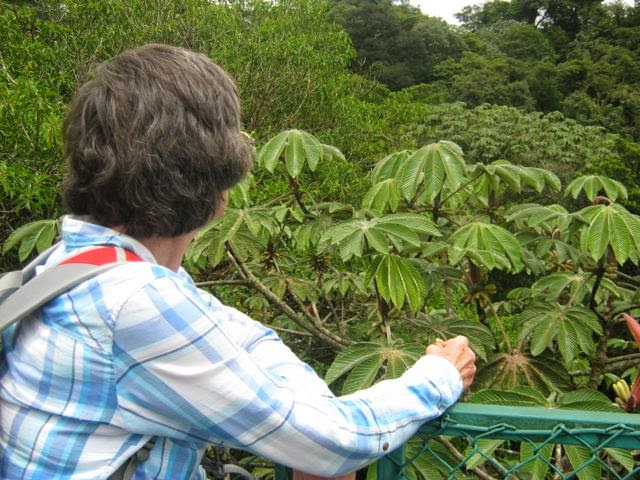
While the other visitors headed off to queue for the zip wires we had the canopy walkways to ourselves.

It was strange to be walking across something so engineered when in every direction all you can see are trees. At one point we passed within a foot or two of a tree branch and I was tempted to climb over into the canopy, but the hundred foot drop below me was a little intimidating.

We were taunted the entire time by the metallic squeaking call of the Three Wattled Bellbird, which we heard almost constantly but never saw. And we got tired necks craning upwards in hope of catching sight of a sloth, something else that we failed to see.
This tiny waterfall at the Monteverde reserve, with its so tempting but utterly inaccessible pool was the deciding factor in our decision to trek to the San Luis Waterfall (post to come later).
The exotic birds finally made an appearance at Monteverde. This is a quetzal, taken through the scope that the guide had. The group stood a long time watching the pair come and go from their protected nest site where they were feeding young.
We had seen a few hummingbirds at La Leona, but they flitted away very swiftly. Here there was a garden with feeders where seven or eight species hovered by the dozen, often fighting each other away from the perches. 
This one is a violet sabrewing.
The pathways at Corcovado had been cleared but were otherwise unmarked, we often had to pick our way over tree roots and fallen branches. The sheer number of visitors that come to the Monteverde reserve (over 200,000 a year) means that they need more robust and safer pathways. They were all laid with these concrete grille slabs that allowed the leaf litter to gather in the holes so they felt much more integrated with the forest, rather than slicing through it.
This picture was taken at the Santa Elena reserve and shows the upgrades that have to be made to cope with the increasing tourism in the area. The old rotting wooden bridge in the background has been replaced with a shiny new metal one.
Having planned initially to go across the lake to the Arenal volcano we discovered that it has not been active for several years so decided the extra travelling was not worth it. As we did the long hike around the Santa Elena reserve we came upon the viewpoint that overlooked the volcano. A small bench had been thoughtfully placed so we sat for a drink and snack and admired the view. The low cloud made it suitably volcano-ish.
More to come soon.