Thursday, 29 May 2014

Flight Behaviour

I bought 'Flight Behaviour' by Barbara Kingsolver as a birthday treat and saved it for my holiday. I reviewed 'The Lacuna' nearly three years ago and loved it so much, though I had not tackled anything else by her until this one, which was shortlisted for the Women's Prize for Fiction last year. This book tells the story of Dellarobia and the monarch butterflies that adorn the front cover. She is a young woman, married in haste very young and is repenting at her leisure. Except there is not much leisure in her existence where she and her husband Cub (nicknamed after his father, Bear) live in the shadow of her in-laws, both physically at the edge of their failing farm, and metaphorically in that their lives are controlled by the decisions of the domineering Hester. The monarch's migration has been disrupted by a landslide in Mexico (this really happened though the change in their migration is fictional) and they end up in the forest on the hill behind the Turnbows' farm. Their arrival brings not just curious sightseers but also a cohort of scientist who want to find out what has caused this aberration, and it is the arrival of Ovid Byron that really shakes up Dellarobia's life and forces her to reconsider the path she had been obliged to take. 

In Dellarobia we have a woman who seems to accept that her options in life are severely limited. She remaining stubbornly loyal to her marriage and Cub despite acknowledging that they have nothing in common and also in spite of intermittent romantic flirtations that never venture outside her imagination. However her growing fascination with the butterflies, and wanting to encourage her son Preson's growing interest in nature, rekindles her desire to do something more with her life and draws her into the world of the scientists. Breaking away from the very confining expectations of her community she  gets caught up in the scientists' struggle to understand what is going on before time runs out and the plummeting temperature threatens the butterflies with devastation. The environmental messages come thick and fast in this story but everything that I learned about migration and climate change was skilfully integrated into the narrative and it was never overwhelmed with scientific jargon. 

The most interesting relationship in the book is between Dellarobia and her mother-in-law Hester; forced together by their relationships with Cub, there is an unspoken resentment covered by politeness and reserve. They never really get to know each other until the arrival of the butterflies changes everything:

" 'If you were going, you were going, I figured. Taking those babies with you.'
'Preston and Cordie?' Dellarobia turned to stare. Could any of this be true? That Hester expected to lose them, all this time? The woman had practically pronounced the marriage vows herself, she and Bear, and thrown together that house before the ink was dry. Built, though not paid for. 'You built us a house,' she said.
'It's what we owed our son.'
'And you think I've had one foot out the door. All along.'
'Have you not?'
'No!' Dellarobia drew the vowel out into two syllables as in, No stupid. She made herself breathe slowly, feeling numb. It was an earthquake, an upheaval of buried surfaces in which nothing was added or taken away. Her family was still her family, an alliance of people at odds, surviving like any other by turning the everyday blind eye. But someone had seen the whole thing." (p.477)

But it's the big ideas that are played out that make it such an interesting read.
While the scientists scrabble around in their lab, nature finds the way:

"Salted across the dun floor of the woods she counted three, four, a dozen small bouquets. Once her eyes knew how to see them, they became abundant. She took the trowel from her bag and dug into the dank forest floor, which was wet and gravelly just under the top inch of matted leaves. While she chipped away at the inhospitable garden, the air stirred and in plain sight the experiment ran ahead of itself. Monarchs were already here, this source discovered. She saw two bright drifters coasting tentatively in the woods, and near Hester's boots, the duller orange of folded wings at rest on a flower cluster. Nectaring, that was the verb. King Billy nectaring on the harbinger." (p.479-80)

Science versus the media and the general public:

"Science as a process is never complete. It is not a foot race with a finish line. He warned her about this, as a standard point of contention. People will always be waiting at a particular finish line: journalists with their cameras, impatient crowds eager to call the race, astounded to see the scientists approach, pass the mark and keep running. It's a common misunderstanding, he said. They conclude there was no race. As long as we won't commit to knowing everything, the presumption is we know nothing." (p.484)

And just below this, science and god:

"And even while he warned her of these caveats, Dellarobia felt a settling down of her lifelong plague of impatience. He did not claim that God moves in mysterious ways. Instead he seemed to believe, as she did, though they never discussed it, that everything else is in motion while God does not move at all. God sits still, perfectly at rest, the silver dollar at the bottom of the well, the question." (p.484)

But Preston is the highlight of the story for me, because he reminded me of my own children's intense curiosity about the world and the joy of watching them make their own sense of things, and I identified with Dellarobia's urge to protect him from anything that might crush it. One lovely final scene between them:

"They watched the sun break over the stippled backs of the wooded hills that swam along the horizon. First it was a shapeless fire blazing through bare trees, quickly gaining the yolk of its sphere, and then they could not look at it directly.
'Today smells like the time when the lambs get born,' he said.
'It does. Like spring.' She closed her eyes and inhaled. 'What is that, dirt?'
They stood together drawing in the day through their noses. At length Preston said, 'I think it's worms. And baby grass.' " (p.511)

Tuesday, 27 May 2014

Parasites, Epiphytes and Symbiosis - Costa Rican Adventure Part 2

Before I went there I assumed that rainforest was rainforest; you know, big trees, dripping water, humidity, biting insects and wary animals. But rainforests are not just big forests. Lets start with the basics: 'primary' and 'secondary' rainforest is the most important distinction, and one that is vital to understanding why the destruction of the rain forests is so devastating to the global environment. Primary rainforest is 'real' rainforest, that's always been there, with the depth of complexity and biodiversity that distinguishes it from so many other natural environments. Secondary rainforest is forest that is being regrown after the land has previously been cleared. The Reserve at La Leona is a small area of primary forest. Much of the Corcovado National Park is primary forest, with some pockets of secondary forest, areas which was forcibly reclaimed by the government from local people who farmed there. These areas have been regrowing for about forty years now. The problem is that we have no idea how long it might take for secondary forest to return to the level of complexity of primary forest, if ever. Some scientists think that once the forest has been cut down the biodiversity that you have lost is gone forever.


Imagine what happens in this country when a piece of land is allowed to go wild, it will become quickly overrun with a few very dominant species; nettles, brambles, dandelions etc. The biodiversity that exists in the rainforest can only come about because of a very delicate balance between the strong and the weaker species, with different kinds of relationships existing between plants, and between plants and animals. Secondary forest is much more vulnerable because the subtleties take such a long time to emerge. This little tree stump shows, even to the untrained eye, the immense diversity of plants that will colonise every available inch of forest, but no one thing is able to dominate. Where Britain has a mere 32 native tree species (and the wiki page also states "There is no woodland in Britain that has not been profoundly affected by human intervention"), a square kilometre of rainforest may have in excess of 300 species

A sign on one of the walkways in the Selvatura Park pointed out that an ordinary medium size tree will support about 70 other plant species living on it. Mostly these plants are epiphytes, taking their water from the rain, or sending down roots as many of the long dangling vines do, and merely using the tree as a platform, not damaging it in any way.
This photo shows a strangler fig. It is a parasitic plant. It begins life high in the canopy as a little shoot, gradually sending out roots down the trunk of its host tree. Over the course of about twenty years it will gradually wrap the host tree, depriving it of water and nutrients from the soil and eventually killing it. This benefits the forest because it returns the tree's nutrients to the ground and provides a living environment for many insects and the hollow left by the decayed tree provides a home for many animals. But how good would it be if every tree in the forest was throttled by a strangler fig? This does not happen precisely because of the balance: the seed has to land in the right kind of spot, the shoot has to be not eaten by animals or insects, or not pulled out by passing monkeys. No humans have to go in and chop off the burgeoning strangler figs to protect the trees, nature does this all by herself.

This next photo is an acacia tree. It thrives in a symbiotic relationship with a species of ant which lives in its hollow thorns and feeds on the tree. In return the ants provide protection against herbivores and keep the ground around the tree clear of other plants that would compete for water and nutrients.

Intimate relationships like this exist between species and then the whole forest also exists in a cycle of growth and death. When a tree dies and falls it creates a light hole within the forest allowing a whole new layer of growth to happen in the understory. I noticed in several places along sloping areas and by streams that trees looked as if they were falling over, their huge roots hanging on like grim death, but Jim our guide said no, they grew like that. Light is at a premium in the dense forest so trees will grow in the direction of light however apparently precarious the position. 


Monday, 26 May 2014

Journey into the wild - Costa Rican Adventure Part 1

I'm sure other people's holiday photos are pretty dull. We take them, I ended up feeling, to remind ourselves that it was all real. While it was happening each day seemed long and full of activity but when you get to the end it takes on a dreamlike quality. It is going to take quite a few posts but I am writing partly as a record for myself and the family of our adventure, because I will enjoy reading them over to remember the details, but also because I feel that I learned so much about the rainforest and why it is so important that I hope visitors might find interesting. There might be a few pretty pictures, despite my really unimpressive camera occasionally I got a good shot. The first post is a brief overview of our first week.

The most welcome of sights after nearly 11 hours on a plane, the coast of Costa Rica. Even from the grand heights of nearly 40,000 feet I could see a tanker on the ocean below at one point. We landed in San José early afternoon Monday 12th and stayed the night at the Costa Rica Backpackers hostel. The city had more the feel of the scruffy parts of Manchester than Costa Rica and we were glad to leave again. The main danger was breaking your ankle in the deep rain gutters along the edges of the roads.
Tuesday 13th the taxi picked us up at 7am and took us back to the airport for the internal flight to Puerto Jimenez on the Osa Peninsula. This is the little twelve seater plane that took us the 370km across the country. 
No one else seemed to want the front seats so mum and I ended up behind the pilots. I could watch the instruments all the way; we flew at 9,500 feet and 140 knots. 
Below us the entire country seemed to be covered in forest.
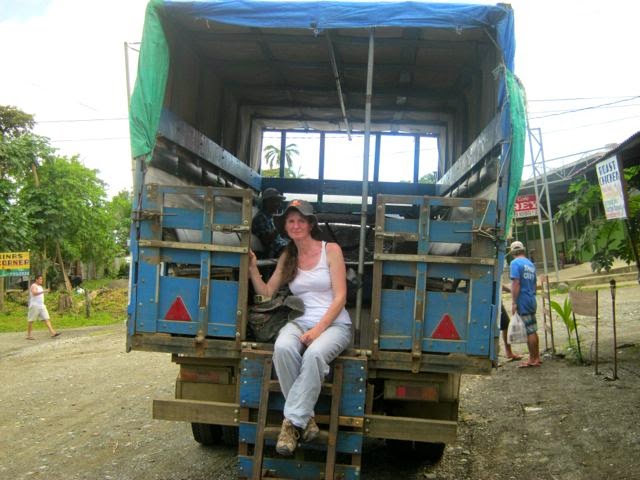
The flight is only an hour then we taxied (unnecessarily it turned out as it was only a kilometre) into the town centre. It is the ultimate one horse town, a single main road with some shops (without any of the american chains that had been all over San José) and a few side roads of houses, mostly traditional single storey, breeze block built with corrugated iron roofs, painted in bright colours ( I failed to get a photo of the houses). We took a walk round the bay, where I got a little sunburnt but we saw our first lizard, then came back to wait at the soda (cafe) for the collectivo. In this case the collectivo is a converted cattle truck that would take us (for a couple of quid) on the 42km 2 hour ride to Carate. Despite the bumpy ride it was lovely because the breeze blew through the back of the lorry, and I spotted my first monkey too.
The horse and cart from La Leona met us from the collectivo and took our luggage while we walked the kilometre along the beach (there is no other way there). It took about an hour and the rain caught up with us just before we arrived, but that was lovely too.
One of the perks of coming outside the high tourist season is the lack of other visitors. Because the place was so quiet Joel upgraded our accommodation to an ocean view tent with private bathroom. It is basically a wood and bamboo structure with mosquito net walls, it zips up to keep the insects out. I could lie in bed and see the pacific ocean, and several mornings got up before sunrise to sit on the veranda and watch the waves (they were pretty noisy so it was hard to get back to sleep. I assume maybe it's like living near a motorway, that after a while the sound ceases to disturb you.)
The bathroom at the back was outside the main part of the tent and then there was this tiny enclosed 'garden' that contained the shower; a bamboo pole supports the pipe and the shower head is a coconut with holes drilled in it, it worked surprisingly well. The water was cold, but after the first one I really enjoyed them and took several every day. Fun experiences sitting on an outside loo included a visit from the huge marine toad, copulating anole lizards amongst the rocks, leaf cutter ants and a halloween crab in the bin one night. After this last incident I started checking the floor with the torch before venturing for a midnight pee; there was no electric in the tents, we went to bed by candlelight.
Fabulous as it was we didn't linger in the tent much and set off first thing the next morning, and every morning that we were there, into the rainforest. This is a tiny sample of the things we saw. You can visit my Flickr albums and see more.
Scarlet Macaw - saw them every day, often many, always in pairs, they mate for life:
First big rainforest tree:
Basilisk, another creature that I thought would be rare but we saw loads of:
Coati, a couple of times we saw them singly but as we walked back to the lodge on our guided tour of Corcovado we encountered a whole group of about twenty, including youngsters:
This White Faced Capuchin came down to the ground and startled the group of coati causing them all to leap instantaneously onto the nearest trees, where they paused for a few seconds before they ascertained there was no danger and then returned to their browsing:
Poison Dart Frog, I recognised this at once because the kids used to have some plastic ones when they were little:
Anteater with a nearly full grown baby on its back:
Baird's Tapir is probably the most endangered species we saw, it is in danger of extinction, and also the largest mammal in the rainforest; this one was in the Corcovado reserve but we also saw two asleep under the trees on our first morning at the La Leona reserve:
Leafcutter Ants became my absolute favourite creature, I enjoyed watching them everywhere, these ones were in the garden area outside our tent. I first spotted them carrying a line of tiny white blossom. Apparently the nest they build under the ground is huge and the colonies can be millions strong:
This photo of Black Vultures feasting on what looked like a dead Iguana was taken on our last morning at La Leona. Another bird that was everywhere, we frequently saw them circling overhead:
More to come soon.


Sunday, 11 May 2014

Hasta la vista baby

My bag is packed and tomorrow I will be jetting off to ... the rain. The green season has started in Costa Rica, though it mostly rains in the afternoons and it is still the tropics so we are not expecting to be chilly. One creature I am really looking forward to spotting is a sloth. Apparently it is quite rare to see them in the wild, they are very reclusive, but mum and I plan on spending quite a bit of time in the jungle so I am hopeful. They have a sloth on the 10,000 colón note.
The girls have both made contributions to the trip. Tish gave me some linen trousers and a top that we bought for her when she went to Borneo, and these fabulous 'leech socks' that she acquired there. I am relatively un-squeamish about most creepy crawlies but leeches are the one thing that really freaks me out so all efforts will be made to avoid being suckered.
And Monkey donated her backpack when I said I had been thinking about buying a new one for the trip. I wanted something a little more hippy so I have spent a couple of evenings embellishing it with some embroidery. 
It is going to be an adventure. I feel a little wild and reckless
See you in a fortnight.

Thursday, 8 May 2014

All the birds, singing

Evie Wyld's 'All the birds, singing" is such a ... book. I'm really not sure what the right word is. Wonderful yes, dark and brooding, atmospheric, a little scary even. Jake has every reason for wanting to hide from the world, and by the time you have learned even a small part of her story you want to hide with her. You want to sit and drink whisky and slouch on the sofa smelling faintly of wet dog and sheep. 

The story's construction confused me for the first few chapters; the 'current' narrative follows Jake in her tiny isolated sheep farm somewhere I guess in Scotland, and the alternate story runs in reverse, following this tough and vulnerable young woman working as a sheep shearer in Australia and threads slowly back through the previous years of her life bringing us to the events that set her on the path. The world and her legally bonded life partner have been waxing lyrical about this book and there aren't any unused superlatives left. I feel as if I could open it at random and whatever was there would be the perfect quote. Everything Jake does seems to speak volumes about the inner turmoil and fear. She puts on this fierce shell for the world, the 'I don't need anyone' attitude, until she becomes convinced that something is hunting her sheep, and very possibly her as well. Into the picture steps a man. Your eyes pass over him at first meeting, he is just a random trespasser, another person she just wants to keep away. But gradually he is allowed to loiter on the periphery and almost without noticing he stays. We don't learn much about him, he obviously has troubles of his own, but he asks nothing and in return she lets down her guard. He's not some kind of hero who comes and slays the beast, in fact he is frequently rather useless, but he simply makes her feel less like she has to handle her fears alone. 

So here are some totally random quotes, because I was too involved to note down specific things I liked. Firstly from her old life in Australia:

"In the morning, Sid finds weevils have made it into the flour.
'I don't particularly mind,' he says.  'I'm just saying in case anyone has an aversion to having the buggers in the bread.' There is silence while the table takes this in, and it is broken by a shout from Alan by the side of the woodshed.
Something has taken bite out of the side of one of the rams. He's not dead, just looks like someone tore past him and took a chunk out. Flies swarm the wound. Connor shoots the ram, while we all stand around. The animal twitches.
'Just nerves firing,' Denis says to me, like I am a hysterical woman who needs comforting. But I'm thinking how quick it was and what a mercy. One second horribly wounded, feeling flies lay their eggs in your flesh and watching the currawong circle, and the next, in a flash, all is safe. I will learn to fire a gun, I think, they are the answer." (p.25)

And secondly, life on the sheep farm:

"Inside, while Lloyd sat on the sofa, I'd filled a mug with water. He drank it and then held his forehead in his hands. I washed the mud off my face and dried it with a tea towel. Outside rattled against the window. I turned the kitchen light on and it flickered on and off and on again.
I wondered how old he was - younger than my father the last time I'd seen him, but older than the farmers who came to offer their services. I took mugs out of the cupboard and put them back. I found a pack of paracetamol and set them on the counter, wondering if I should offer them to him, or if that would encourage him to stay. I watched him from the corner of my eye, watched for a look or a sudden movement. I ran an itinerary of the kitchen. Hammer under the sink, half a brick on the window sill." (p.84)

I really love that "Outside rattled against the window", it doesn't need any further explanations, you know what she means. The supporting cast are all so beautifully drawn; Don, the old farmer down the valley, Greg on the shearing team, temporary roommate Karen and even the weird Otto, who's probably more sad than threatening. What I loved was the striking contrast between the two environments; the hot, flyblown sheep station and the dark, rain-sodden farm. And yet they are both so unremitting, and so dominate the way people in them have to live. Both are also isolated, though in slightly different ways, from 'civilization' and have their own sense of self reliance and rules of behaviour. Jake is using them to hide from her past, and from people, but you get the feeling that the beast of her imaginings will try and catch up with her. All round a perfect book, it gets inside the life and the mindset of its character so deeply the closing scene is something of a relief. 

(Review here of 'After the fire, a still small voice'.)

Sunday, 4 May 2014

The May blogging lull - an A to Z reflections post

Firstly a huge thank you to all the organisers at the Blogging from A to Z Challenge for thinking up this hair-brained scheme and sharing their time and effort to make it such a great challenge.
Secondly a huge thank you to everyone who visited through April, and hello and welcome to my new followers, I hope you will stick around and enjoy the odd book review and other random stuff that make up this blog.
Thirdly a huge thank you to Monkey for kicking my butt and making me join in when I was trying to cry off at the last minute, and providing me with (most of) the random words for my flash fiction.

Rather like NaNoWriMo the A to Z provides a bit of external discipline and motivation that stops me sinking into 'I never achieve anything with my free time' mode, something that inevitably leads to even worse procrastination and more loitering on Facebook. I like the challenge because it gives me an excuse to do something different on my blog and gets me back into the random blog browsing that I did so much of when I first started blogging.

Each year I have tended to scroll down the signup list clicking on blogs; I go for quirky titles, or sometimes because they are labelled as book bloggers, or sometimes just utterly at random. I have found many interesting blogs this way and always add some to my follow list. I can't guarantee I'll visit all the time but I do go down my RSS and blogger feeds every day and visit a few, and always read the ones that arrive by email.
New blogs I have enjoyed this year:
The Weekend Baker and Jo on Food, My Travels and a Scent of Chocolate are both great foodie blogs. Fanny Barnes Thornton's A to Z was about quilts, but she writes about all sorts of stuff. Zombie Flamingos wrote about house renovations, but was picked as the best blog name. Dave Graham at espresso coco reviewed some excellent films and gets a mention for the unforgettable photo of Sean Connery he included in the last day. Shahira at The Word Trance did a most fascinating A to Z of English words that originated in Arabic, and confesses a love of language. K.L. and Catherine blog at Spirit of Children's Literature and introduced me to lots of books I had never come across as well as old favourites. Jenn Lost in Chaos and This Nomadic Life (anonymous expat blog) both just struck a chord with what they wrote about.

My only quibble with the challenge is the number of people who were signed up but did not join in. It must be hard to keep up with everyone on such a long list, and to be honest, I just leave again if a blogger is not posting and go to the next one. The wonderful enthusiasm of most of the participants makes up for the few who didn't bother. 
It was a busy April, but May will be quiet; I am off on holiday in 7 days time so there will be a distinct lull in posts this month.

Thursday, 1 May 2014

The Innocents

'The Innocents' by Francesca Segal was apparently long listed for the Women's Fiction Prize, and to be honest it surprised me to discover this. The two women in Adam's life, Rachel and Ellie, are, in my humble opinion, rather tired clichés; long term girlfriend Rachel is the naive, demure innocent who longs for the perfect wedding, while her cousin Ellie is the wild child with a troubled past, who's arrival on the scene in the run up to the wedding throws the poor man into a turmoil about what kind of woman he really wants. I did not warm to anyone in the book really, except maybe the grandma. While it purports to be a novel about Adam and his tussle with his conscience I actually found it to be more about the negative side of a close community. How do you make choices about your future when so many other people have such overwhelming expectations about your behaviour and your life. It's not just the immediate families that Adam knows is watching, and judging him, but the entire community. Should he marry Rachel, as he has promised, to keep everyone happy, because it is the 'right thing to do'? Would she really want to be married to someone who's choice was made on that basis? I found the whole thing rather screwed up. The huge sense of belonging that their community provides is balanced by this sense of having your life dictated by other people's expectations, and knowing that if you don't live up to them then you risk being cast out. I found this aspect of the story far more interesting than the supposed suppressed passion between Adam and Ellie. All in all I stuck with it to see where she took the idea, and was very disappointed with the unsatisfactory ending.