This much procrastinated post will be a race through the books that I have read over the last two months because the pile is now so tall it teeters. 'Girl, Woman, Other' by Bernadine Evaristo won the Booker in 2019 and has been on the TBR list since then. It is a tangled tale of many women, their lives, and how the world changed around them and with them. It was very readable and the characters engaging but I was not bowled over by it, but what I did appreciate was that it managed to be political and thought provoking without being self-conscious with it. Here, Carole (and I kind of liked her lack of punctuation, it was stylistically interesting and informal):"she's used to clients and new colleagues looking past her to the person they are clearly expecting to meet
she will stride up to the client, shake his hand firmly (yet femininely), while looking him warmly (yet confidently) in the eye and smiling innocently, and delivering her name unto him with perfectly clipped Received Pronunciation, showing off her pretty (thank-god-they're-not-too-thick) lips coated in a discreet shade of pink, baring her perfect teeth as he adjusts to the collision between reality and expectation, and tries not to show it while she assumes control of the situation and the conversation" (p.117)

A charity shop unread copy of 'Piranesi' by Susanna Clarke (which won the Women's Fiction Prize in 2021) was an utterly different kind of read. In a strange hidden world that consists entirely of vast rooms of statues lives Piranesi; he lives off fish and seaweed and things brought to him occasionally by the 'Other'. How does he come to be here, and who is this person who comes and goes? All will be revealed, as his own curiosity it piqued by strange occurrences that force him to rethink everything he thinks he remembers about his own life. A clever book and intriguing... but it reminded me so forcefully of something else I have read that uses a similar scenario, and I cannot remember what it is. Frustrating.
"The World (so far as I can tell) does not bear out the Other's claim that there are gaps in my memory.
While he was explaining it to me - and for some time afterwards - I did not know what to think. At several points I experienced a feeling akin to panic. Could it really be the case that I had forgotten whole conversations?
But as the day went on, I could find no evidence of memory loss to support the Other's claim. I busied Myself with my ordinary, everyday tasks. I mended one of my fishing nets and worked on my Catalogue of Statues. In the early evening I went to the Eighth Vestibule to fish in the Waters of the Lower Staircase. The Beams of the Declining Sun shone through the Windows of the Lower Halls, striking the Surface of the Waves and making ripples of golden Light flow across the Ceiling of the Staircase and over the Faces of the Statues. When night fell, I listened to the Song that the Moon and Stars were singing and I sang with them." (p70-71)

What a varied selection I realise I have read as I list them. Next up, 'Doggerland' by Ben Smith, set in a not-so-distant future where there is a lot of sea, and life seems to be controlled by a 'company', and the boy has been sent to work maintenance on an offshore windfarm (the title made me assume it was a reference to Dogger Bank in the shipping forecast), obliged to take on a job abandoned by his father. It is grim and meaningless and his only companion is the old man, who does little work and disappears regularly on mysterious fishing trips. It has much of the atmosphere of 'The Road'; the greyness, the claustrophobic atmosphere, the sense of hopeless helplessness and powerlessness, though there is less drama, the boy and the old man exist in a timeless vacuum. But the boy is obsessed with what happened to his father and the old man drops hints, but in reality has his own agenda to which the boy is irrelevant. And it manages something similar in that you root for the boy, you want him to win, he tempts you to hope for the future, and again, I'm warning you ... don't.
"The old man's hand hovered over the tin on his left, then switched sides and picked upon from his right. He took a penknife from his pocket and scraped round the rim, clearing away the rust and dirt. He blew off the power residue, then got up, went to the sink and came back with the tin opener. He sat back down and fitted it to the top of the tin, jolting it around until the wheel bit into the lid.
The boy watched the old man closely. He was turning the handle too fast, so that the wheel kept slipping off the tin; and then he would mutter something, fit it back on and start again. There were streaks of power rust on the table and on his hands.
The old man turned the handle again but it didn't move. He tried to take the tin opener off but it stuck. 'Bloody thing's broken.'" (p.88)
'When we cease to understand the world' by Benjamin Labatut is a fictionalised version of the lives of a selection of the world's most astounding mathematical minds. Not traditionally fodder for a novel, but just go with it. Some I had heard of, Schrodinger, Neils Bohr, Heisenberg, some not, Grothendieck, Louis de Broglie, but what they had in common was their utter obsession with their subjects. The book sank periodically into descriptions of how they worked so hard they forgot to eat and sleep until it drove them out of their minds. I felt like I learned quite a lot from it, about physics and mathematics, and about the pursuit of esoteric knowledge.
"Most nights he fell prey to insomnia. In his delirium, his mood would establish strange connections that allowed him to achieve direct results, foregoing intermediate steps. He felt his brain split in two: each hemisphere worked on its own, without needing to communicate with the other, and as a result his matrices violated all the rules of ordinary algebra and obeyed the logic of dreams, where one thing can be many: he was capable of adding two quantities together and obtaining different answers depending on the order in which he proceeded. Three plus two was five, but two plus three might be ten. Too weary to question himself, he continued working until he had reached the final matrix. When he solved it, he left his bed and ran around his room sorting, 'Unobservable! Unimaginable! Unthinkable!' until the entire hotel was awakened. Frau Rosenthal entered in time to see him collapse on the floor and recoiled at the stench of his soiled pyjama bottoms. When she managed to calm him, she put him back to bed and ran off to fetch a doctor, paying no attention to his complaints, as he was passing in and out of his hallucinations." (Heisenberg, P.104)
I read most of this book on the train south and then abandoned it in favour of lighter reading that I found on a table in Claire's living room.

What I found most interesting about 'An Unequal Stillness' by Francesca Kay was the striking contrast between the life of her 'genius' artist and that of the scientists in the previous book. The men in Labatut's book were free to do nothing but pursue their obsession, real life barely seemed to exist for them, the practicalities of existence were provided by the women around them, but in this book Jennet must juggle her family and domestic responsibilities, snatching time for her real work where she can. I find myself annoyed by stories of women who pander to and continually forgive alcoholic husbands, but to be honest he was not that important to the story, she got on with things in spite of him. While I found the descriptions of her paintings rather annoying, because I was visualising them and wanted to see them, the writing was engaging and had some wonderful moments:
"Scouring out a cast-iron pot at the kitchen sink, Jennet stops to watch the reflection of a light above it glinting in the greasy water and her own hands submerged. Out of nowhere a wave of fear crashes over her and she is suddenly quite sure she will never lift her hands out of the water or unglue her feet from the floor. Only her wildly pounding heart is evidence of life. Otherwise she might as well be paralysed, like Lot's wife trapped in salt. Somewhere in the distance there is a baby crying, but Jennet cannot go to it. She cannot move at all. She must stand there forever with her hands beneath the water in the blackened pot."
'Ice Cream' is a book of short stories by the inimitable Helen Dunmore, read on the train on the way back north, in one sitting. Her writing is always so perfect, little vignettes of people's lives, capturing something that is essential to being human. Here, a lighthouse keeper's wife:
"The bed was too big when she lay alone in it. He was an off-shore lighthouseman and she knew that when she married him. If the lighthouse tender couldn't land to change the crew on relief day, Nancy might be waiting for him another week. Often the weather was bad when it came to changeover. He'd watch the wall of white foam crash against the glass and know he wasn't going to get off. But Nancy stood it. She had her little garden. She didn't flinch. She knew the fishing boats and would stand to watch them go out around the point, her skirts blown back against her legs, moulded to them by the wind. He was glad there was no one else to see her like that. She fed her garden with fish-meal and rotted-down seaweed, and when the salt-storms burnt off the leaves of her spinach and lettuces, she planted again. He would see her kneeling on the path, skirts bunched under her, tamping the seedlings in with her quick fingers." (p.56-57)

Then I came home and picked 'Where'd You Go Bernadette' by Maria Semple from the TBR pile in my room. You'd think I was sick of books about geniuses ... and yes, I think I am now. I have read lots of wonderful, well written and still engaging stories that are about ordinary people, living mostly unremarkable lives, but some writers just can't resist making their characters over-achievers, and I find them much less relatable. And this is a book with emails and hashtags and all manner of 21st century social media stuff, but I managed to get past that and just enjoy the mystery. So Bernadette is a genius who has plainly had a mental breakdown and her husband just seemed to have ignored it for a decade. That kind of trope annoys me to. Do people really just live so far up their own arse that they don't notice someone they love fall to pieces? (Turns out he is a bit of an arsehole so no surprise). So there was a lot to forgive in the book but I still managed to enjoy it, because she writes about the breakdown in a very real way and gets inside Bernadette's head so well, so we give her brownie points for that. Here, Bernadette's thoughts:
"What you've heard about the rain: it's all true. So you'd think it would be part of the fabric, especially among lifers. But every time it rains, and you have to interact with someone, here's what they'll say: 'Can you believe the weather?' And what you want to say, 'Actually, I can believe the weather. What I can't believe is that I'm actually have a conversation about the weather.' But I don't say that, you see, because that would be instigating a fight, something I try my best to avoid, with mixed results.
Getting into fights with people makes my heart race. Not getting into fights with people makes my heart race. Even sleeping makes my heart race! I'm lying in bed when the thumping arrives, like a foreign invader. It's a horrible dark mass, like the monolith in 2001, self-organised but completely unknowable, and it enters my body and releases adrenaline. Like a black hole, it sucks in any benign thoughts that might be scrolling across my brain and attaches visceral panic to them. for instance, during the day I might have mused, Hey, I should pack more fresh fruit in Bee's lunch. That night, with the arrival of The Thumper, it becomes I'VE GOT TO PACK MORE FRESH FRUIT IN BEE'S LUNCH!!! I can feel the irrationality and anxiety draining my store of energy like a battery-operated racer grinding away in the corner. This is energy I will need to get through the next day. But I lie in bed and watch it burn, and with it any hope of a productive tomorrow. There go the dishes, there goes the grocery store, there goes exercise, there goes bringing in the garbage cans. There goes basic human kindness. I wake up in a sweat so thorough I sleep with a pitcher of water by the bed or I might die of dehydration. (p.129-130)
So that was the pile, though I have already finished another, that I think might get more than two lines. All enjoyable in their own way and a nicely mixed bunch.
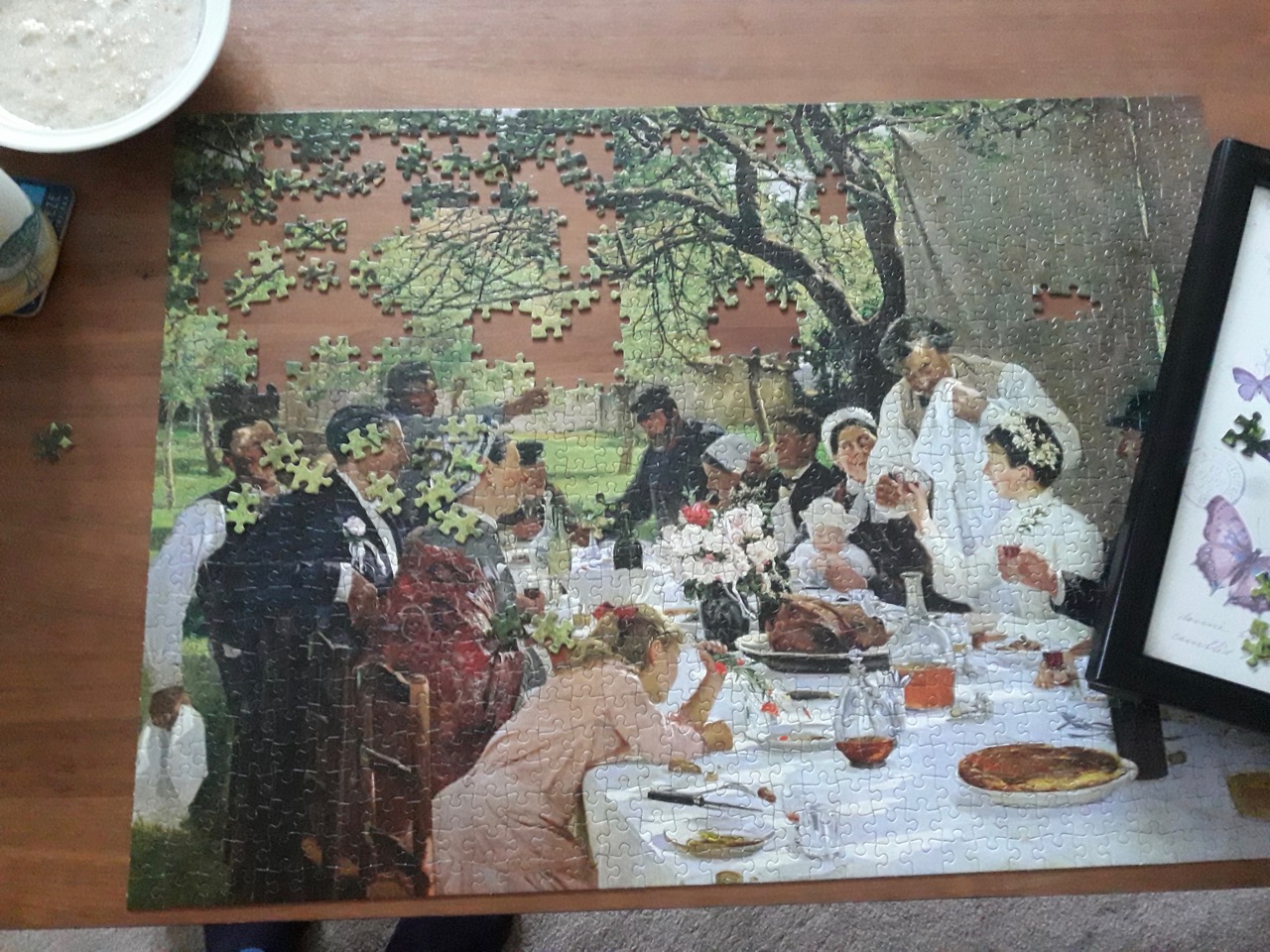
I left behind in Devon some unfinished business, but Claire managed to complete it ... and then take it back to the charity shop:
Oh yes, Monkey is home:
and we have been stepping over the suitcase in the living room for a week, but then we are experts at that, having lived with two bags of compost in the kitchen for a month (you stop noticing them after a while):
Stay safe. Be kind. Step around life's obstacles.