Showing posts with label theatre. Show all posts

Monday, 11 November 2019

24 Hours of Peace

Peace means so many different things to different people. Peace is not just an absence of war, it is the creation of a world in which all people are safe to make a life for themselves. On Saturday, in advance of Remembrance Sunday, Hannah in the Manchester XR group organised a vigil for the 1700 environmental defenders who have been killed between 2002 and 2018. People all over the world die defending the natural world and protecting their land and lives from destruction, often at the hands of illegal loggers or miners, in collusion with the authorities.  About a dozen of us sat in St Peter's Square for an hour, and talked with a visitor from Brazil about the reality of life for campaigners in the majority world.

I spent Sunday night at 24 Hours of Peace. This has been a piece of theatre taking place from 11am on Sunday 10th through to 11am on Monday 11th November at the Royal Exchange Theatre. It was created by Neil Bartlett from 100 interviews that were done with campaigners and peace activists across the country; mostly just ordinary people discussing their work, how they came to be doing it and how they feel about the fight for peace in the world. Some work directly with victims of violent conflict, some teach about conflict resolution and others are active in political campaigning and direct action. While some of the interviewees seem to drift in to political activism for others their role comes from troubles within their community or country and for others it is trauma within the family. Whatever the route they all have in common a huge personal commitment to creating change and working to make the world more peaceful. The theatre performance was sometimes quite harrowing as people describe their own experiences or the lives of the people they are trying to help. It was punctuated by a rhythmical repetition of lists of people's names, ages and locations, and some of the key ideas that many of them shared. The project was intended as an extension of the two minutes silence that is intended for people to reflect on the sacrifice of soldiers and the hope for a world without such sacrifice. Many of the speakers questioned the role of the military and its acceptance by our society, the way the news becomes an agent of despair, making conflict seem inevitable and creating a feeling of weakness and powerlessness in the face of global conflicts. Neil himself spoke about the need to get past antagonism and see each other as equally human, to find the common ground and expect good from others as a means to solving conflicts. The message was very much that there is no magic route to peace, but that asking people what they imagine for their lives is an important starting point. The recording of the performance will be repeated on Resonance Radio on Wednesday and I believe may be available to listen on the website also. I particularly enjoyed Derbhle Crothy who told the story of a woman from Northern Ireland who set up the Women's Coalition and was involved in negotiating the Good Friday Agreement.


Friday, 8 June 2018

The Trial

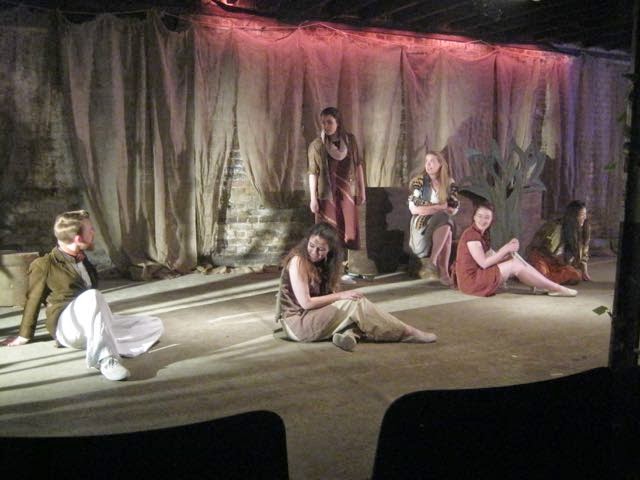
The Actor's Wheel is a touring and actor training company based in Plymouth. Last night they brought one of their current productions, The Trial by Steven Berkoff, to Z-Arts in Hulme. The play is an adaptation of the novel by Franz Kafka, and having listened to 'The Metamorphosis' on the radio some time ago I was anticipating something unconventional. We were greeted in the theatre by smoke, atmospheric lighting, 
and loud music, and were drawn swiftly into a disorientating dystopic world where questions definitely were not answered. The scenery consisted of multiple wheeled filing cabinets, very emblematic of bureaucracy, which were repeatedly moved around the stage and used for different purposes. The actors, most of whom were on the stage almost continuously, moved themselves and the filing cabinets around in a complex and beautifully choreographed dance, interacting and then moving on in one flowing scene. The whole staging was very imaginative, using duplicate characters, on stage together, acting out mirror images of the same scene. Four women played Josephine K, the main character; each one taking turns to express her outrage and confusion at her arrest, each one in turn pleading to be heard, and for answers. The performances were all excellent, and I liked the fact that the staging allowed more cast members to take centre stage, rather than a single central character surrounded by a multitude of minor players. The whole production was engaging and the execution very slick; they certainly created a world worthy of the adjective Kafkaesque. The audience was very small and I apologise to the actors if I was a little droopy by the end, I had been up since 4am; the company has not been around long but I definitely think they are worth keeping an eye on if you are interested in experimental theatre.

Sunday, 1 April 2018

The Sunset Limited

'The Sunset Limited' by Cormac McCarthy is a play, subtitled 'A novel in dramatic form'. It is a single scene, between two players, originally designated White and Black, but in the narration of this audiobook the characters is referred to as The Professor and The Black. The Black character is an evangelical Christian and ex-convict, and he has just saved the Professor from jumping in front of the Sunset Limited express train. It is a philosophical discussion on the nature of life, death, existence, religious belief. The Black feels he was sent to the spot to save the other man and as such has taken on some measure of responsibility for changing his mind. The Professor repeatedly says he has to leave, but does not, and allows himself to be distracted, to be nurtured, by the care and attention of the other man. The story has no axe to grind, it is not portraying one belief as more reasonable or natural than the other, it is just presenting the views of the two sides, and as such what it achieves is to show quite how wide the gulf is between them. The Professor explains quite accurately the nature of existential angst and how it makes life meaningless, and in a way I felt frustrated because it made it seem as if that is what atheism is; the idea that atheism is 'believing' in nothing. But the Black's belief is also presented as a simplistic acceptance of something else being 'in charge' of life, of knowing or understanding things as not being relevant to whether life was worth living. The Professors listens curiously to the Black's tales of his time in prison and how he came to find God. He seems quite unmoved by the gratuitous violence of his life, and it is he who manages to shock the other man with his description of the worst thing in his life. They part with neither having changed their view, but not without having had an impact on the other. It was interesting because it was not polemical but just a quiet exchange between two men, a real conversation where they learned about each other's lives. 

(Other reviews of Cormac McCarthy: The Road and All the Pretty Horses)

Tuesday, 22 August 2017

All the shows we did not see

Dunk and I ventured back to Edinburgh yesterday, to see if it was as good as we remembered. It was. The streets teemed, the flyers flew, lines, jokes, poems and tunes tumbled in abundance, much tea was drunk, some good (at the Bedlam Theatre), some not so good (St Giles Café again). We took an early train, via Wigan, and arrived just as the Mile was waking up. Much loitering and dithering ensued, during which I wished we had planned more in advance and not gone with the 'lets just do stuff on the spur of the moment' thing. We saw a sketch show at the Underbelly then had a mediocre sandwich. More dithering then we went back to Underbelly and saw 'The Man on the Moor' written and performed by Max Dickins, based around the story of an unidentified man found dead on Saddleworth Moor at the end of 2015. An excellent show, brilliantly performed, it certainly made my visit worthwhile. We took a more leisurely stroll down South Bridge and on to the Meadows to pass the time until we wandered back to St George's Square to see Wereldband: Slapstick, a riotous blend of musical virtuosity and slapstick comedy. After dinner at Café Turquaz we hot-footed it back for the 8.14 train that got us home just after midnight. Long day. Not sure I would recommend it was a way to experience the Fringe but we were glad we went in the end.


Friday, 16 June 2017

The Tempest

I bought 'Hag-Seed' by Margaret Atwood for Monkey for Christmas, since we seem to be working our way through her complete oeuvre (her 'by the same author' section in this book takes up two pages). Monkey recommended I read the story of The Tempest from Leon Garfield's Shakespeare Stories, and it was certainly a good idea because what you are appreciating in this book is the skill in the retelling of the classic tale of enchantment and revenge. This book is one of eight being published under the title of Hogarth Shakespeare (named for the Hogarth Press founded by Leonard and Virginia Woolf), that are retellings of Shakespeare stories by modern authors (more to come as I have just, by coincidence, read another of them).

In this tale we have Felix, a renown theatre director, who gets usurped by one of his assistants and pushed out of his beloved Makeshiweg Festival, just as he is planning a flamboyant production of The Tempest. He takes his ejection seriously and disappears himself to a remote farmhouse cottage where he lives an austere and lonely life with only the ghost of his long dead daughter Miranda for company. After many years of brooding and plotting he sees an advertisement for someone to take over a Literacy Through Literature project for inmates at the local prison. Estelle, the woman who hires him, knows who he is, but agrees to keep his real identity secret when he takes on the job. He introduces the inmates to the joys of Shakespeare, and over the next few years they create productions (on film for the entertainment of the staff and other inmates only) of some of the more macho tragedies. I was a little disappointed with Margaret Atwood's assumption that the men would reject anything vaguely sappy or sentimental and would only play the female parts if they were 'nasty' people. Felix develops quite a reputation and the courses are popular, and then one year he hears that his former adversaries, who have now both gone into politics, will be coming to visit the prison and are planning to remove the funding for his project. It is at this point that he decides to exact his revenge. With the help of Bent Pencil, SnakeEye, 8Handz, Wonderboy, Leggs and the rest of the gang they put on a performance that will not be soon forgotten. 

The book takes us through the stages of their rehearsals and develops Felix's relationships with the prisoners, and the young woman Anne-Marie who he brings in to play Miranda opposite himself as Prospero. And all the while, back at his cottage waits the ghost of his daughter, who, strangely, has grown up with the passing years, and gone from playing outdoors to playing chess with him in the evenings. What is so good about the book is how closely she has stuck to the plot and characters of the play, their motivations and alterations, and even the denouement with its nightmare-like tempest. I found myself both rooting for Prospero/Felix and despising his selfishness. I particularly liked the way that the inmates are only allowed to use curse words that appear in the play, and then how at the end they all have to write a piece about what might happen to their character after the play, and their ideas point out quite neatly how the ending that Shakespeare wrote was rather limp and does not follow well from the previous behaviour of the characters. 

Here we get an idea of the early years in the cottage, Felix 'imagining' Miranda:

"During the day she was often outside, playing in the field behind the house or in the woodlot at the back. He would see a cloud of butterflies lift in the meadow : she must have startled them. When blue jays or crows would make a fuss in the woods, he'd conclude that Miranda had been walking there. Squirrels chattered at her, grouse whirred away at her approach. In the dusk, fireflies marked her path, and owls greeted her with muffled calls.
In winters, when the snow drifted in the laneway and the wind howled, she'd slip outside without a second thought. She didn't dress as warmly as she ought to have done, despite his nagging about mittens, but nothing happened as a consequence: no colds, no flu. In fact, she was never ill, unlike himself. When he was sick she tiptoed around him, anxious; but he never had to worry about her, because what harm could possibly come to her? She was beyond harm." (p.46-7)

Now Miranda is a teenager. While I felt sad for him in his grief what you also see is, like Prospero, Felix has his daughter captive, he can turn her into exactly the person he wants her to be:

"But what has his care amounted to? He's protected her, true, but hasn't he overdone it? There are so many things he should be able to offer her. She should have what other girls her age take for granted, not that he know what those things are. Clothes, certainly. Pretty clothes, more clothes than she has at her disposal now. She seems to go around in makeshifts, fabricated out of cheesecloth and old bedsheets. She ought to have silks and velvets, or mini-skirts and those tall boots girls these days seems so fond of. She ought to have an iPhone, in a pastel shade. She ought to be painting her nails blue or silver or green, chattering with her friends, listening to music through pink ear buds. Going to parties.
He's been such a failure as a parent. How can he make it up to her? It's a wonder she isn't sulkier, cooped up here with nobody but her shabby old father; but then, she doesn't know what she's missing. Still, he's been able to teach her a lot of things that most girls her age would never have a chance of learning."

I enjoyed that the book is not just a rewriting of the play, but it is also about the play itself; I felt like I got to know the plot and the characters in two layers, from both the overarching story and the play within it. Here Felix is preparing for the final performance:

"His voice sounded fraudulent. Where is the authentic pitch, the true note? Why did he ever think he could play this impossible part? So many contradictions to Prospero! Entitled aristocrat, modest hermit? Wise old mage, revengeful old poop? Irritable and unreasonable, kindly and caring? Sadistic, forgiving? Too suspicious, too trusting? How to convey each delicate shade of meaning and intention? It can't be done.
They had cheated for centuries when presenting this play. They cut speeches, they edited sentences, trying to confine Prospero within their calculated perimeters. Trying to make him one thing or the other. Trying to make him fit.
Don't quit now, he tells himself. There's too much at stake.
He'll try the line again. Should it be more like an order or more like an invitation? How far away does he think Ariel is when he's saying this? Or calling it? A sibilant or a shout? He's imagined himself in the scene so often he hardly knows how to play it. He can never match his own exalted conception of it.
'Approach, my Ariel.' He leans forward, as if listening. 'Come!'
Right next to his ear he hears Miranda's voice. It's barely a whisper, but he hears it.

All hail, great master, grave sir, hail! I come
to answer thy best pleasure, be't to fly,
To swim, to dive into the fire, to ride
On the curled clouds; to thy strong bidding, task
Ariel and all his quality.

Felix drops his staff as if it's burning him. Did that really happen? Yes, it did! He heard it! 
Miranda's made a decision: she'll be understudying Ariel - surely he can't raise any objection to that.
How clever of her, how perfect! She's found the one part that will let her blend seamlessly at rehearsals. Only he will be able to see her, from time to time. Only he will hear her. She'll be invisible to every eyeball else." (p.179-80)

Unlike Prospero we see a change in Felix, his life is transformed by his connection with the people who are in a real life prison, they are not just tools with which he wishes to enact his revenge, they make his life better and he learns from them. I think the book is an excellent testament to Margaret Atwood's true skill as a writer. She tells the story faithfully as Shakespeare created it, but still manages to make both it and the characters her own. 


Sunday, 12 March 2017

Pandiagonal magic squares

The last week started on Monday evening with Simon Armitage (cool portrait on his website, do go and see), a Manchester Literature Festival event to launch his new collection 'The Unaccompanied'. Julie and I have seen him several times before and it was an excellent and entertaining evening, where I resisted buying the book. 

Monkey and I have been hard at work learning the capital cities of the world, so she made me a birthday cake with a map on it; she was disappointed to be unable to fit in Greenland once America was stuck on, but Africa is excellent. There were candles to mark specific capitals that I mainly failed to get right.
Then we did a charity shop trawl around Chorlton and came home with quite a substantial pile of books. I am particularly pleased with Paul Auster's New York Trilogy and Sebastian Barry. Candide and the two Asimov are for Monkey, and Ulysses is just to sit on the shelf for that moment when I feel inspired to tackle something hard.


Today Julie took me out to Elizabeth Gaskell's House to see a performance called 'Exploding Women', part of the Manchester Histories Festival, produced by the dynamic duo LipService Theatre. The show presented the chequered history of Manchester women of science, including Caroline Birley, Marie Stopes, Kathleen Mary Drew-Baker and Dame Kathleen Ollerenshaw (The pandiagonal magic squares are one of Kathleen Ollerenshaw's significant contributions to mathematics.) We also had an interesting conversation with one of the volunteers at the house, about Mrs Gaskell's friendship with Charlotte Bronté, and, after my unexpected enjoyment of Emily Dickinson's biography this time last year, I am definitely inspired to read her biography of Charlotte. 

Saturday, 21 May 2016

Hamlet: Shakespeare Part Three

Lawrence Olivier's 1948 film version of Hamlet was in stark contrast to the other two we have watched this week, being a traditional rendering of the text, and it is the only Shakespeare to have won the best picture and best actor Oscars. It was interesting to find that though I had only the vaguest notion of the story (from minor references to it in Terry Pratchett's Wyrd Sisters) I had little difficulty in following the language and the plot. I enjoyed spotting the many, many quotes that have become a ubiquitous part of english usage: lots of timeless advice, "Neither a borrower nor a lender be" and "to thine own self be true" and a selection of  literary and film titles: 'Infinite Jest' and 'Undiscovered Country'. If you check this Wiki page Hamlet is pretty much the most mined of Shakespeare's plays for inspiration for other creators. If you are looking for a version to help you with academic studies you really need to go with the 1996 Kenneth Branagh version which is the only film using the full text, and running to four hours. Experts however seem to agree that the 1964 Russian film, with the text translated by Boris Pasternak, is the definitive performance.

Saturday, 14 May 2016

Gale warnings at Home

Home 
There are lots of interesting (and also free) things going on at Home (formerly The Corner House) next weekend to celebrate their first birthday, but Monkey and I went today to see a production of Twelfth Night by Filter Theatre. A riotous gig is how the website describes it and it was certainly most loud, hilarious and unconventional Shakespeare. The audience were a little slow on the uptake of the players requests for participation, but once we got into the swing of it the party really took off. A bare stage that looked more like a rehearsal space containing only musical instruments lets you know right off they are not going for a conventional setting, and then we had some dialogue over a mobile phone and the arrival of Viola is accompanied by the BBC shipping forecast, interrupted by further dialogue over the radio. Sir Toby seemed a little confused as to which play he was meant to be in, spouting lines from Macbeth, Hamlet and Henry V, at one point sporting a donkey head hat, and wandering down the aisle saying 'a plague on these McVitie's Jaffa Cakes'. There was pizza and tequila shots and a conga line on the stage, followed by a cascade of small sponge balls. The physical comedy was so well rehearsed and put together and it came across as very spontaneous, and never interfered with the intrinsic humour of the tale. We were a little confused because several players were playing more than one part and it was not entirely obvious (to me anyway, Monkey was more familiar with the cues), but for people familiar with the plot (which I was not) I'm sure it was fine. Shakespeare plays are very self-consciously 'plays', often talking directly to the audience and telling you that they are telling a story. Just the other day I reread my review of Hard Times from five years ago and the immersive nature of that performance contrasted very sharply with this play, that continually reminded you that you were watching performance. They are ending their tour this week at the Theatre Royal in Plymouth.

Friday, 9 October 2015

Theatre and Literature

Another posting lull will hopefully be followed by a massive surge in posts as a lot is going on in the next couple of weeks. My son Jacob has just been for a visit and I took the offspring out for a joint birthday outing to the Corner House. It recently renamed itself 'Home' which I find to be the worst name for a theatre ever and so I am pledged to continue to refer to it as the Corner House (though the theatre building is not on the corner of Oxford Road and Whitworth Street where the cinema is but further down the road and round the corner). We went to see the performance company 1927 on the opening night (in Manchester that is, it has been touring worldwide for some time) of their intriguing piece of theatre entitled Golem (do visit their website and watch the trailer). Described as somewhat like a comic book come to life, it was thoroughly engaging and brilliantly put together, with performers interacting with a projected animation; it tells a cautionary tale of the insidious nature of consumerism. 
Starting on Monday is the annual Manchester Literature Festival. This year they are celebrating their tenth anniversary and the brochure (mine is already looking a little the worse for wear, tea stains mainly) has photos of the participants at age ten. I have a lovely selection of events that I am volunteering for this year, starting with the wonderful Michael Rosen on Monday evening, discussing the future of children's poetry. Many of the events are free so if you are in the vicinity do check out the website, find someone you have never heard of and open a new door in your life.

Sunday, 16 August 2015

The Grim Tales

The Fourth Monkey Theatre Company are presenting four productions this year; Year of the Monkey participants are putting on three Grimm's TalesRapunzel, Little Red Cap and Hansel and Gretel, while the two year course are doing 'The Bloody Countess(which we did not see), based on the true story of mass murderer Elizabeth Bathory.
While they have all been directed by different people the three productions have all used a dual narrative, with the original tale running parallel to an alternate more modern story. Their interpretations have more in common with the disturbing original tales than any sanitised version that you might be familiar with, and are not suitable for families. In fact Steve had to insist that one parent who came in with a young child was asked to leave by the box office staff. Rapunzel gives us three witches who jealously guard the innocence of their 'adoptive' daughter, with the parallel story being about a modern day mother suffering from post-natal depression. Little Red Cap follows the naive young girl sent into the woods to face a fantastic wolf. The second story mirrors it more directly with a tale of a young girl coming to work in a care home, and finding that there are unpleasant goings on beneath the benign surface. Hansel and Gretel gets to grips with the big issues of child abuse, neglect and incest, in a dark and disturbing story told without words. Their second story tells the life of Antonin Artaud whose theories about the Theatre of Cruelty have influenced 20th century theatre, and this production. They have had one 'bad' review (all publicity is good publicity so they say) and one good one, and they have enjoyed counting how many people walk out each evening (only three on Friday), but the flyering has obviously been going well as they have been consistently packed and even sold out several nights. 

They are preforming in Space 9 on Niddry Street every day until the 29th, at 4.30pm, then 6.00pm and 7.30pm. I left Monkey my camera so hope she will get some other photos of them in costume/on stage, but Dunk caught some of the cast doing an impromptu rehearsal outside just before their performance earlier this week:
(Edited 15th September) The cast of Hansel and Gretel looking awesome after their last performance.

Theatre at the Edinburgh Fringe

The 'What was your favourite show?' question is really impossible to answer, because everything we saw was so different. I have divided the shows we saw up, roughly, by genre.

At the Bedlam Theatre we saw Ada (trailer on Youtube here), the story of Ada Lovelace, who worked with Charles Babbage, and whose notes on his Analytical Engine is considered to be the first computer programme. The piece blends technology and creativity, with cast members explaining the science behind their work alongside telling the story of her achievements. They incorporated imagery of computing into the play with a repetitive cycling of some of the dialogue, and people mimicking the workings of Babbage's machine. A fascinating and beautifully put together production, this was the only thing that Dunk chose for us to go to. Venue 49 is a real theatre (unlike many of the spaces that are often function rooms or spaces carved out for the purpose) and there were many other interesting productions going on there. Their tea was only £1 and there are comfy seats in a room papered with posters from years of past productions.

The second morning (I think) we were sitting on the Mile early discussing our plans when we were approached by Teresa herself and handed this flyer. I said what a coincidence that we had no plans for twelve o'clock. 'Wing It Dusty' sets its scene in the bedroom of a middle aged lesbian couple discussing the history of their relationship. It was one of those plays that seems small and intimate, and yet touches on universal themes of belonging and acceptance, just quietly getting under your skin. We ended up seeing a lot of things in Space 39. I began to notice a theme developing, we saw an awful lot of plays where people changed their costume on stage ... is that just the way they do things these days?


 'Consumption' was another spur-of-the-moment choice, also in Space 39, is by Two Forty Two Theatre. It is the story of Sebastian and Penelope who fall for each other at a speed dating event. Sebastian finds himself sucked into the aspiration lifestyle that Penelope enjoys, sinking further and further into debt, while his mum seems to be having problems of her own. A morality tale certainly, and while it was really well executed I was not convinced by their relationship and sat through it thinking 'stupid people' and having very little sympathy for his troubles, a bit too much 'Made in Chelsea' for my taste.


I went to see 'The Beanfield' by myself. Produced by Breach Theatre Company it is a reconstruction of the events surrounding the 'Battle of the Beanfield' that took place in 1985 when the police, enforcing an injunction to prevent a festival that had been taking place at Stonehenge, instigated a violent confrontation with Travellers in a nearby field. The story is told through correspondence between the participants as they researched the story, the testimony of eye witnesses in pre-recorded interviews, but also recounts the experiences of the students themselves as they piece together the story and try to discover the truth about the events. It highlights the change in policing tactics that had been taking place during this period, that coincided with the miner's strike. A very emotionally charged piece that got me caught up with the story, taking me back to a period that I remember quite vividly.


The thing I enjoyed very much when walking the Mile (people did flyer other places, there was just such a concentration of them there) was stopping to let people tell you about their show. And so it was with 'The Very Grey Matter of Edward Blank', where a man painted orange was sitting on the curb and another in a brown suit introduced us to his imaginary friend. Produced by Familia de la Noche this was probably the most 'straight' theatre that we saw, as in it was a single story, told by a set of fixed characters, on a stage with actual scenery. But I think it was my favourite. Edward's troubles seem to be quite deep seated. His imaginary friend from childhood never left him, and in fact has been joined by several others, and in spite of 'treatment' he choses not to silence them with pills, and so hides in his flat and makes a living by typing up, and editing, bad manuscripts. It is a very vivid portrayal of mental illness; the voices of his 'friends' lurch from being companionable and encouraging to being chaotic and threatening. It moved me to tears, which is high praise indeed. We saw 'Edward' when we were queueing to see 'Bruce', but I was too shy to ask him to sign my flyer. 

(Tickets for all events can be booked through the Edfringe Website.)

Flyers, flyers and yet more flyers

Walking the The Royal Mile in Edinburgh during August is not for the faint hearted, even on a damp day it can be quite an ordeal (though fortunately for us the sun shone most of the time). Everyone has a suggestion for how you might like to spend an hour or so of your day. I had browsed the Edinburgh Fringe Festival website quite extensively and had a handy list of things that I thought I might see. As you might imagine, I did not see many of them, because there were so many other, much more exciting things to see.
People turned up with banners, in costume, and with puppets of every shape and size:
From the monotone:
to the vibrant:
to the downright scary:
Some with interesting techniques for staking out their spot:
It is part of Monkey's responsibilities to spend a couple of hours flyering every day (that's Casey, not everyone is so enthusiastic):
Though it is exhausting work, so you do get to take a break:
Flyers, and more flyers
and yet more flyers
inside and outside, on every available surface...
And then you carry them home and use them to repaper the living room.
Coming up next, reviews and recommendations.

Sunday, 19 April 2015

Trinity Buoy Wharf (not an A to Z post)

It is not a journey for the faint-hearted to make your way down to Trinity Buoy Wharf, hidden in the backwaters of east London, for there are strange sights and sounds to encounter there.  

The Floodtide listening post makes music determined by the tide of the Thames. A submerged sensor reads tidal flow data and converts it into notation that is played by the listening post:
Then just around the corner the Time and Tide Bell is one of a series of bells planned around the coast of Britain; the bell is rung by the high tide, but because of the unique shape one ring makes a series of notes one after another (we weren't around to hear it unfortunately).
And across the courtyard a sign outside a tiny wooden shed invites you to enter and experience the sights and sounds of the scientist Michael Faraday, who worked there on the electrification of lighthouses. Here I was thinking it was some kind of mock up but according to the wikipedia page, "His workshop still stands at Trinity Buoy Wharf above the Chain and Buoy Store, next to London's only lighthouse where he carried out the first experiments in electric lighting for lighthouses". 
More strange sights and sounds were in store when I descended into the basement of the Electrician's Shop to see Monkey performing in Midsummer Night's Dream and (here below) As You Like It. The Year of the Monkey are currently doing three Shakespeare comedies for the London season. The run finishes on 25th April and shortly after that they will begin rehearsals for the Edinburgh Fringe.


Friday, 6 March 2015

Letters and Plays

Just a brief recap on my participation in the Month of Letters in February, which I enjoyed very much. While I did not manage to post something every day I did write a lot of proper letters including several to friends who I had not been in touch with for several years. I have had a couple of replies which was really wonderful, including a long missive from my Uncle Den, and I plan to keep going and try and write a letter at least every couple of weeks. The down side of hand writing is that I don't have any record of what I wrote to each person and so risk waffling on repetitively ... ho hum.

I have spent the last couple of days with Monkey down in London; she was having a break in the rehearsals for the London season (Fourth Monkey) which begins on 11th April. I am so annoyed that I took my camera but failed to take it out of my rucksack and so did not get pictures of us being silly in the Natural History Museum or eating Mexican street food at Wahaca round the corner from Waterloo station.
We very carefully copied down the instruction on how to find the Vault Festival and were glad we did because you would be unlikely to come across it by chance:
Leake Street Wiki commons
The entrance is off the notorious Leake Street graffiti tunnel (apparently also called 'Banksy tunnel') and the venue was in the railway arches under Waterloo, the performances were provided with added atmosphere by the gentle rumble of trains passing overhead.
First we saw a performance entitled 'Bitesize Chekov' by a small company called 'D'Animate'. Neither of us had ever seen any Chekov before. It was very physical and the three characters on the stage moved through a variety of scenes that gave us a flavour of his lesser known works (from the list on Wikipedia two of them were 'On the harmful effects of tobacco' and 'A Marriage Proposal'). Monkey said she liked this one better because of the clowning (and that doesn't mean red noses and grease paint type clowns, it's a theatre thing) that she learned about during her training last term and was enjoying seeing it put into practice. 
After going off to eat we came back and saw 'King of the Fucking Castle' by LAB Theatre, about a homeless man living by Edinburgh Castle who befriends a young homeless girl, and the story traces their volatile relationship over a few weeks. I felt that the atmosphere in the railway arches really added something to the performance and the two actors were utterly compelling; it really got across a sense of how homeless people experience life and how invisible they are. I am not sure I have ever heard the word 'fuck' quite so often in such a short space of time, it was more like punctuation than a word with any meaning by the time they finished. While the story felt a little predictable it conveyed some timeless themes about the need for human connection. We agreed that the most striking thing about the performance was the moment when they took their bow at the end, and the tension and anger in the stance and expression of the man were gone, and he looked like an utterly different person. 
The festival is finishing on Sunday but I would certainly recommend you look out for next year if you like that kind of thing. We are going to be looking out at Edinburgh for Charlie Tuesday Gates, who's show 'Sing for your Life', with taxidermy roadkill puppets, was sold out.

Sunday, 19 October 2014

Listening not reading (much)


I went last night, as a volunteer that is (not that we had much to do), to hear Kate Tempest at the Contact Theatre as one of the last event of the Manchester Literature Festival. I was probably the only person in the audience who had not heard of her. She was this lovely mixture of worldly and naive, looking at first glance so young but with a voice that has quite a gritty quality that usually comes with years of hard living. She recited from memory for over 20 minutes her version of the story of Tiresias, it was utterly spellbinding. This is just a little taster of her style to tempt you, there is lots more on Youtube, and if you ever get the chance, do go and see her.

As a consequence I did not really get going on the Read-a-thon until this morning, and actually we have been planning a trip to the Manchester Art Gallery to see an exhibition about the First World War, so the reading has been quite limited compared to last time. Also there has been no cake this time:-( The Monkey is in London so I have not had company to stay up all night with.
I am really enjoying 'The Secret of Lost Things'  by Sheridan Hay and also 'Notwithstanding' by Louis de Bernieres (that I picked up at random in the library when my reserved books had not arrived, despite being 'in transit' for three days.) I hope everyone else out there has been having a good weekend of slouching on the sofa surrounded by books. 

Wednesday, 8 June 2011

Two deaths, three kisses and a punch-up

Following on from my experience of sitting in on a rehearsal nearly a month ago I went up to Ancoats on Monday evening to view one of the preview performances of Hard Times. Although the play is sold out there are apparently a few 'on the door' tickets available for each performance, you'd have to contact the theatre to find the details. The post I have written for the Library Theatre blog is up now and you can read it at librarytheatre.posterous.com (this link goes to my post, just click the header to read the impressions of the other bloggers as well.)


I realise that I concentrated very much on my response to the entirety of the performance rather than the 'play' so I just wanted to add that all the components that made it up were just perfect; the performances were all powerful and convincing, particularly Louisa (who I think had the most interesting and challenging part), the set design, the music and sound effects, the costumes and the circus performers were all wonderful, and I just loved the slow-motion fist fight, it was excellent. These elements all came together to create a simply amazing experience, but it was the staging that turned it into something utterly unique. I am not sure I would have been so interested to see this play performed on a stage, it would have lacked so much. It was just the most captivating evening, I am going to keep an eye out for future projects with great interest.


Edited 5/7/12 to include the text of my contribution to the Library Theatre blog since it was sitting around in the list and had not been posted here:


The clean air, the sanitised streets around Murray's Mill and the quietly dozing geese by the canal-side don't give much of an impression of the harsh reality of the lives of Victorian mill workers ... but the atmosphere that has been created inside the building does a much better job. We descend into the basement to the scents and sounds of Victorian street life and a few moments later I am startled out of museum mode by the thundering footfalls of a woman in a shawl and in a hurry; the play has begun without ceremony or curtain raise. After watching the comings and goings for a little while we are unobtrusively invited to go up to the main performance stage. The space is huge, and emptier than I had anticipated; the props and furnishings are minimal, authentic but unassuming, and benches for the audience are the only physical dividers between the sets.

My fears about the audience were totally unfounded, they were, as predicted, 'very well behaved'. It never felt crowded and everyone was quietly attentive to the occasional need for the actors to move among us. The lighting and sounds were used to direct the audience's attention when the action moved to a new area but it all felt very low key, with no rushing back and forth. Often action was taking place in adjacent sets so our attention just followed the actors as they moved. I noticed the director Chris mingling unassumingly with the audience, paying just as close attention as he had done in the rehearsal. I wanted to go up and ask him if he had to stop himself from interrupting the performance and asking them to try something again. The concentration of the actors was just incredible. They focussed so entirely on each other and seemed utterly unaware of our presence. Louisa and Cissy brush past us to get their hats at the end of lessons as if we were all merely other class members. The direction makes wonderful use of the space; twice Bounderby stalks the length of the mill, once with Louisa and once alone, both times his coat tails fluttering behind as he disappears into the shadows, a powerfully dramatic departure.

What I enjoyed most about the performance was the way it flowed so beautifully. The lack of dividers made the mill feel like just one set, not a series of mini-sets. Unlike a stage play where the curtains close for a scene change and chop the performance into pieces, this felt like one continuous piece of theatre (I was sorry for the interlude, though I am sure the actors needed the break). Even when not participating in a scene the actors were often still on set, unmoving and unspeaking, continuing to be part of the whole. At one point, when Mrs Sparsit has fainted and is carried into the bank, the action moved from the central area back to the Gradgrind living room. I remained where I was on a bench as the rest of the audience followed, and I found that the scene left behind in relative darkness continued silently, without audience, as Bounderby and Mrs Sparsit prepared to re-enter the fray a few moments later.

The experience was so unlike watching a play on a stage as to be almost a different art form. I enjoyed being able to walk through the sets and look closely at the details ... a letter on Gradgrind's desk is addressed and stamped with a Victorian stamp, and being able to see that the tea was real tea and Bounderby really ate his dinner. The scale of the cast was an important part of the whole effect, the role of the Community Company was vital to creating the atmosphere, lots of people milling around, often just passing through, apparently on their way somewhere else, as if life really was still going on while the Gradgrinds go through their family crisis. The feeling of intimacy was enthralling, being so close to the performance made it so much more intense. With actors and audience sharing the same space I felt almost part of the story. I was sorry when they came on to take a bow, it broke the spell. I wanted them to just vanish quietly into the night, to be able to imagine their stories continuing, thrust back into the twenty-first century street I wanted to hear the sound of clogs clattering down the cobbles into the dark.

Thursday, 12 May 2011

The Hard Times Rehearsal

Photo here from the Library Theatre website showing some of the cast at their first read through. Having slaved over a hot keyboard all afternoon and evening my piece about the Hard Times rehearsal is now up on the Library Theatre's blog. It can be read over at librarytheatre.posterous.com
At the bottom of my post is a little film showing the cast visiting the mill for the first time to see their performance space. I am so enjoying feeling involved, however superficially, with such an interesting project. The preview is on the 6th June, so I will let you know how it all turns out.