Showing posts with label art. Show all posts

Monday, 26 May 2025

Sixth day: Completely, unjustly, darkly alone

I bought 'Orbital' by Samantha Harvey and sent it to Monkey, fully intending to pinch it back when I visited. Interestingly mum did not enjoy it at all, but Monkey and I both loved it. I love a book where nothing much happens. And floating around in space nothing much happens. Is it like being dead I wonder. I mean they are almost like Schrodinger's astronauts, there is a nasty crack in the space station so potentially they are kind of alive and dead at the same time, since nobody could save them if there is a breach.

This was quite a scientific book. Much research must have gone in to understanding the flight path and also the experience of the astronauts/cosmonauts. Six people are sealed in a tiny container rushing at thousands of miles an hour around the planet. And they just wake up and get on with their routine day. The book hops from one to another of the people, telling you what they are doing, what they are thinking, what they are eating, what they are talking about. I expected it to feel claustrophobic but they spend so much time looking out that it doesn't feel confined; it's almost as if they live in the whole of space. And I loved the fact that they never seemed to lose their sense of awe at what they are getting to experience. 

Queue the quotes, so much good writing in this book:

"At first on their missions they each miss their families, sometimes so much that it seems to scrape out their insides; now, out of necessity, they've come to see that their family is this one here, these others who know the things they know and see the things they see, with whom they need no word of explanation. When they get back how will they even begin to say what happened to them, who and what they were? They want no view except this view from the window of the solar arrays as they taper into emptiness. No rivets in the entirety of the world will do except these rivets around the window frames. They want padded gangways for the rest of their lives. This continuous hum." (p.12-13)

I love her long convoluted sentences. She has so much to say each time she starts one that she just keeps going:

"This planet that's been relegated out of the centre and into the sidelines - the thing that goes around rather than is gone around, except for by its knobble of moon. This thing that harbours we humans who polish the ever-larger lenses of our telescopes that tell us how ever-smaller we are. And we stand there gaping. And in time we come to see that not only are we on the sidelines of the universe but that it's a universe of sidelines, that there is no centre, just a giddy mass of waltzing things, and that perhaps the entirety of our understanding consists of an elaborate and ever-evolving knowledge of our extraneousness, a bashing away of mankind's ego by the instruments of scientific enquiry until it is, that ego, a shattered edifice that lets light through." (p.28)

Here Nell is on a spacewalk:

"She was outside for hours - almost seven, so she was told. You have no idea at all of the passing of time. You install or repair whatever you are tasked to install or repair; you photograph some of the hatches, the external tools, you do a litter pick of debris, plucking from space a few of those tens of thousands of remnants of jettisoned or exploded satellites and launch-vehicle stages and craft; wherever mankind goes it leaves some kind of destruction behind it, perhaps the nature of all life, to do this. Dusk steals upon you and the earth is a bruising of azure and purple and green, and you remove your sun visor and turn on your light and darkness brings out the stars and Asia passes by bejewelled and you work in your light-pool until the sun comes up once more behind you and burnishes an ocean you can't identify. Daylight spills blue on a snowy landmass moving into view and, against the black, the rim of the earth is a light bright mauve that brings a pain of elation to the gut. What might be the Gobi Desert rolls out beneath you while ground crews give soothing instructions and your partner leafs through the manual attached to the arm of his spacesuit and you can just about see his face through the sun visor, a tranquil oval of human face in the enormous anonymity of our landscape, and meanwhile the solar arrays drink the sun until dusk comes back and your partner is blackened by the sunset behind him and night creeps from the underside of the earth and engulfs it." (p.69-70)

Here Shaun and Pietro discuss a postcard. It is of a painting that, earlier in the book, we had learned was discussed in a class where Shaun and his wife first encountered each other. I liked this conversation because I like art, and I like how sometimes you have to really look. And so much of the book is just about looking. So much of science is just about looking. You have to look to understand, in both art and science. 

"Did someone send you a postcard? Pietro jokes, coming to the doorway of Shaun's quarters and nodding at the Las Meninas that's in free drift.
My wife, fifteen years ago, he says.
Pietro nods, and Shaun nips the postcard from its drift and hands it to him.
Read the back, Shaun says.
I wouldn't - 
No, go ahead.
What is the subject of the painting? his wife has written on the postcard's reverse. Who is looking at whom? the painter at the king and queen; the king and queen at themselves in a mirror; the viewer at the king and queen in the mirror; the viewer at the painter; the painter at the viewer, the viewer at the princes, the viewer at the ladies-in-waiting? Welcome to the labyrinth of mirror that is human life.
Is your wife always so obsessed with petty small-talk? Pietro asks.
And Shaun replies: I'm telling you, it's relentless.
Pietro stares for a while at the painting, and a while longer, then says, It's the dog.
Pardon?
To answer your wife's question, the subject of the painting is the dog.
He looks then - when Pietyro hands back the postcard, reaches across to squeeze the bony dome of Shaun's shoulder before diving away - at the dog in the foreground. He's never given it a second glance, but now he can't look at anything else. It has its eyes closed. In a painting that's all about looking and seeing, it's the only living thing in the scene that isn't looking anywhere, at anyone or anything. He sees now how large and handsome it is, and how prominent - and though it's dozing there's nothing slumped or dumb in that doze. Its paws are outstretched, its head erected and proud.
This can't be coincidental, he thinks, in so orchestrated and symbolic a scene, and it suddenly seems that Pietro is right, that he's understood the painting, or that his comment has made Shaun see a different painting altogether to the one he'd seen before. Now he doesn't see a painter or princess or dwarf or monarch, he sees a portrait of a dog. An animal surrounded by the strangeness of humans, all their odd cuffs and ruffles and silks and posturing, the mirrors and angles and viewpoints; all the ways they've tried not to be animals and how comical this is, when he looks at it now. And how the dog is the only thing in the painting that isn't slightly laughable or trapped within a matrix of vanities. The only thing in the painting that could be called vaguely free." (p104-105)
Las Meninas by Velazques
You could read this book in one sitting it is so short, in fact I might recommend it, for total absorption into their experience. And finally:

"Pietro doesn't dream. He has a rare night of deep and solid unthinking sleep. His breaths and heartbeats are smooth and few, his face resolves of its crease, his body a well of atom-self, an unworried sum of parts, as if he knows that outside the earth falls away in perpetual invention and leaves nothing more for him to do. Our lives here are inexpressible trivial and momentous at once, it seems he's about to wake up and say. Both repetitive and unprecedented. We matter greatly and not at all. To reach some pinnacle of human achievement only to discover that your achievements are next to nothing and that to understand this is the greatest achievement of any life, which itself is nothing, and also much more than everything. Some metal separates us from the void; death is so close. Life is everywhere, everywhere." (p.121)

Stay safe. Be kind. See you tomorrow.

Tuesday, 29 April 2025

Reflections on Art

My first day in Japan we took the train to Tokyo and went to the Ueno Park to the National Museum and the Metropolitan Art Museum. The Joan Miro exhibition was so extensive that we didn't have time to look at anything else, but it was ok as it was fascinating and we learned a lot about him.

The island of Naoshima was my inspiration for our trip to Shikoku, so at the other end of our holiday we took the ferry from Takamatsu to see the extensive collection of modern art. Much of it is very large and site specific. First up Narcissus Garden by Yayoi Kusama, hundreds of metal spheres, floating in a huge pond, filling the garden and inside the rooms of a concrete bunker, reflecting the viewer, each other and their surroundings:

We moved on to the Benesse House Museum,
Fish and Bread by Jennifer Bartlett
Inland Sea Driftwood Circle by Richard Long, which I photographed for my dad, who has made driftwood art himself, and the lovely muddy circles on the wall that are made with River Avon mud, transported all the way to Japan.
100 live and Die by Bruce Nauman

The Secret of the Sky by Kan Yasuda (who has a very cool website), 
and I thought the little sign said no climbing on the stones, but on second glance realised it meant 'take your shoes off the climb on the stones' and look at the sky.
Seen/Unseen Known/Unknown by Walter De Maria, reflecting the view across the sea.
Don't know what/who this was: a circular structure of mirrors that you can enter, creating a surreal illusion ... here we are actually facing each other on either side of the central divider:
Is this a sculpture that is also a bike park ... or a bike park that is also a sculpture?
(What's more fun is the little sign that says 'no 
bikes' and 'no parking')
We took the bus to Honmura to the Art House Project, where seven abandoned houses have been repurposed as art. This is the Go'o Shrine, the glass steps continue down into an underground cavern beneath the huge stone.
One of the transformed houses. 
The Yellow Pumpkin by Yayoi Kusama. It was this image that I saw online, never imagining that we would actually end up here. The queue of Instagrammers is just out of shot.
So much art, so little time, we had to catch the boat back at 3 to stay on schedule for the mountain ... 


Friday, 20 December 2024

Art and Meditation

One of the perks of my loft bed is that I can have a whole stash of books tucked down the side and they don't fall off. 'The Yellow House' by Martin Gayford has been renewed several times as other things have interrupted the reading. (I think I read a review of another of his books and the library happened to have this one.) It tells the story of a brief period in 1888 when Paul Gauguin lived with Vincent Van Gogh in a house in Arles. It was just such an interesting book because it gives you the two artists as real people, their lives together and the impact they had on each other's work. It is a detailed timeline of the works they produced during this brief intense period. Vincent had this idea of creating a place where artists could come and work together and share ideas and influences. He had set a lot of store by his invitation to Gauguin and admired him greatly, though it turned out Vincent himself was not an easy person to live with. There is much discussion of the art they created but it also charts the development of the crisis in Vincent's mental health, an issue that had haunted his life and would lead finally to him taking his own life. The books brings to life the real person behind the myth that is Vincent.


'Meditations for Mortals' by Oliver Burkeman has been just a lovely and helpful as 'Four Thousand Weeks' was in 2022. It's all about considering what's important in life and not sweating about being a 'better person'. I loved this notion, 'cosmic debt': 
"Of course, there's the mundane sense in which we 'need' to do all sorts of things: in order to pay the rent, you must generate an income; if you do that by working at a job, you'd better meet your employer's requirements, or you can expect to run into trouble. If you have kids, it's generally a good idea to provide them with food and clothing. But we overlay this everyday sense of obligation with the existential duty described above: the feeling that we need to get things done not only to achieve certain ends, or to meet our basic responsibilities to others, but because it's a cosmic debt we've somehow incurred in exchange for being alive. As the philosopher Byung-Chul Han has written, 'we produce against the feeling of lack'. Our frenetic activity is often an effort to shore up a sense of ourselves as minimally acceptable members of society." (p.21)
Designed to be read over four weeks, not as a blueprint for 'action' but as a guide to considering different kinds of problems and getting comfortable with imperfection, insecurity, and inevitable oblivion, and I was left with much to ponder. 
I very much liked this analysis of Robert Frost's 'The Road Not Taken' poem (which I understand he grew to hate since it was so much requested at readings), taking a closer and slightly alternative reading of it, and it kind of sums up much of the book's message:
"Frost's poem undermines the conventional reading on almost every line. No sooner has the speaker told us about the road less travelled than he admits that, in fact, previous travellers had left the two paths worn 'really about the same'. And on closer examination, he never asserts that his choice of path 'made all the difference' in his life, either. How could he know, since he never got to compare it to the other one? What the speaker of the poem may be saying is that 'ages and ages hence' when he's an old man, he expects that's what he'll claim. Because he'll want to rationalise the choices he made - like everyone else does.
The true insight of Frost's poem, on this interpretation, isn't that you should opt for an unconventional life. It's that the only way to live authentically is to acknowledge that you're inevitably always making decision after decision, decisions that will shape your life in lasting ways, even though you can't ever know in advance what the best choice might be. In fact, you'll never know in hindsight, either - because not matter how great or how appalling the consequences of heading down any given path, you'll never learn whether heading down a different one might have brought something better or worse. Even so, to move forward, you still have to choose, and keep on choosing." (p.49-50)

Stay safe. Be kind. Eat the damn marshmallow.

Saturday, 13 July 2024

The Summer Exhibition


Some years ago Dunk and I watched a programme, probably on Sky Arts, about the Royal Academy Summer Exhibition. The notion that anybody can submit a work of art for this exhibition is enchanting. Some 30,000 people do every year. The 'List of Works' tells me there are 1710 works in the exhibition. Of course many are works by members of the Royal Academy, but they are mixed up on the walls and you can't tell professional from amateur until you consult the listing in the book (the price is usually a clue). I was so pleased that it wasn't at all crowded, plenty of room to stand around looking at the art and not feel like you were in anyone's way. Some rooms were more sparse but many were like this, pictures all the way up, somewhat above a good height to see them well, which must be disappointing for people with their work up the top. A huge range of styles and subject matter and formats. In the end my eyes felt tired ... just from looking so much.

Following are a few of the ones I particularly noticed. No sense of scale here, some were quite small, others huge. I forgot to note down the numbers when I photographed so cant necessarily tell you who they are.
This lovely dandelion. 'The great survivor' Kaye Maahs
Back gardens (no artist name):
'Orlando' by Georgia Green, a friend of Monkey's, one of two that she has in the exhibition.
'Homebase' Jock McFadyen, one of my favourites, but out of my price range.
In the first room, but not sure, possibly (because that's what it looks like) 'Spinney with startled birds' by Anthony Wishaw
'Across the River' Christopher Thompson
Have tea-towel ... make art. 
My favourite, already sold or this would have been the one. 'Strutting' Lisa Badau
And one of multiple cat paintings that I sent to the girls while I was looking around. Monkey said she loved it the best, and so did lots of other people judging by the dots (indicating print purchases)
We got lost on the way, but next time we'll know it's quicker to just take the tube to Green Park. The cake was a bit overpriced but the cafe wasn't crowded either. All round a most enjoyable visit. Next year beckons.
Stay safe. Be kind. See some art.


Tuesday, 7 June 2022

Don't Touch

Dunk and I went out over the bank holiday to the Hepworth Gallery in Wakefield after I saw a review of the Sheila Hicks exhibition. While it was worth the trip, I am left bemused by artists who create works where texture is an important feature, only to find that you cannot touch anything.


They were huge and visually striking but nothing that was particularly thought provoking, that I tend to feel is important in art. It is work that raises questions about the lines between art and craft. There were many small weavings that were nothing special, and I have seem similar and more interesting things on Etsy. We then stepped to the next gallery to find, naturally, Barbara Hepworth,
and Henry Moore,
who also tend to suffer from the 'no touching' instruction, because both artists create forms which just beg to be touched.
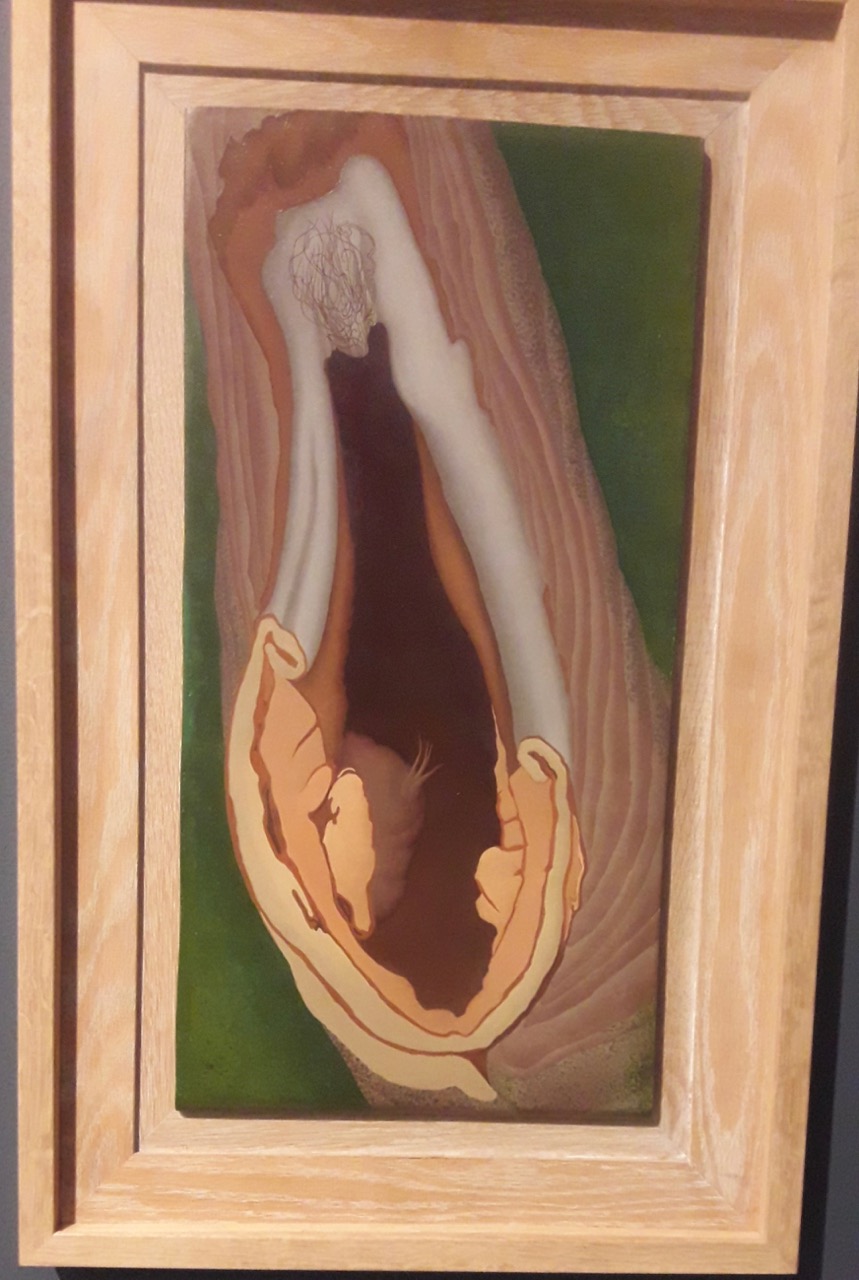
But my favourite artwork was this one, by Ithel Colquhoun. The sign next to it informed me that it was snuck into an exhibition in Bradford in 1943 under the title 'Tree anatomy', and nobody questioned its presence:
Meanwhile in Japan, Monkey was at a gallery too, but no vaginas there:

Stay safe. Be kind. Look closely, things are not always what they first appear.
(Found art, at Leeds station, tentatively entitled, 'Squashed squirrel')


Thursday, 14 April 2022

K is for Kiss, L is for Lemon Cake

Dunk suggested kiss for K but I find that I do not have a picture of us kissing, maybe we don't kiss enough. Kissing gives me joy. Even a text with a kiss emoji can do the trick. Back in 2016, the last time I did the A to Z Challenge, I did art as my theme, so I thought I would revisit one that I love to illustrate the kiss, which is The Kiss by Gustav Klimt. I learn from his wikipedia page that he died during the 1918 pandemic, which made me pause and feel sad, even though it was so long ago. I trust that many people continue to get joy from his paintings as I do.

Cake generally gives me much joy, but lemon cake has to be the best, it is the tart/sweet thing that it has going on. We use a recipe from my very old Cranks cookbook (though it doesn't appear to be on their website). The picture shows the purist version, nowadays we make two layers and sandwich them together with lemon water icing and then drizzle more over the top.

Linking back to the A to Z Challenge.
Stay safe. Be kind. Eat cake.

Saturday, 12 March 2022

Pretty please with a cherry on top


'The End' by Heather  Phillipson is currently on the fourth plinth in Trafalgar Square, and it utterly delighted us. I love the way it slumps over the sides, threatening to engulf the stonework. After Monkey and I had successfully located the Japanese embassy we sat in Cafe Nero and watched the comings and goings on the square for an hour (who knew there were so many we'll-get-your-shopping-for-you apps, every other bus had an advert for a different one). 
Then other thing that delighted me was this wonderful replacement for the 'little green man'. It had never occurred to me that the little man was not just a 'human being' and had no need for it to somehow also represent some cliched skirted version of a woman too. However symbols are important. The world is full of symbols of a male figure that are supposed to be accepted as a generic human. I am sorry (not sorry) if some people (men) get upset at the replacement of these symbols or think that people should "stop making a fuss" about such little things. It is about the fact that the symbols and messages are ubiquitous, and it is time for new symbols that include everyone. We should all feel safe to cross the road.

After our shared lemon muffin we wandered back down Piccadilly and whiled another hour away in the impossibly huge Waterstones. Then we wandered back to the embassy. It is so posh that during the winter when the trees are bare it has a view of Buckingham Palace. I sat in the park while Monkey sat in a queue to have her documents checked. She must do the whole horrible coach journey again next Wednesday to collect her visa, but all being good she will fly out a week on Monday.

I have enjoyed John Green's easy and slightly sentimental novels and also enjoyed 'The Anthropocene Reviewed'; he revels in the human world, what we have done to the planet, both the good and the bad, even when it descended into nostalgia and sentimentality. Each essay just talks about a particular thing that humans have created, how it has impacted the wider world as well as his own life, and then gives it stars, as if it were an online review. He is a thoughtful person and a good writer so although I flicked past the essays on Super Mario Cart and CNN I found myself very engaged in the history of the QWERTY keyboard. Here he talks about a conversation he has with a casino dealer:
"There's a certain way I talk about the things I don't talk about. Maybe it's true for all of us. We have ways of closing off the conversation so that we don't ever get directly asked what we can't bear to answer. The silence that followed James's comment about having been a kid reminded me of that, and reminded me that I had also been a kid. Of course it's possible that James was only referring to Wendover's shortage of playgrounds - but I doubted it. I started sweating. the casino's noises - the dinging of slot machines, the shouts at the craps tables - were suddenly overwhelming. I thought about that old Faulkner line that the past isn't dead; it's not even the past. One of the strange things about adulthood is that you are your current self, but you are also all the selves you used to be, the ones you grew out of but can't ever quite get rid of. I played out the hand, tipped the dealer, thanked the table for the conversation, and cashed out my remaining chips." (p.188)

He, in many ways, tells you far more about himself than I feel might have been his initial intent in any of these essays. But also, of course, about the human condition. Very readable. I will certainly be checking out The Mountain Goats on Spotify and possibly buying his wife Sarah's book 'You Are an Artist'. He ends most upliftingly, and in pleasing synchronicity with Oliver Burkeman:

"Sometimes, I wonder how I can survive in this world where, as Mary Oliver put it, 'everything/ Sooner or later/ Is part of everything else.' Other times, I remember that I won't survive, of course. But until then: What an astonishment to breathe on this breathing planet. What a blessing to be Earth loving Earth."

Stay safe. Be kind. Breathe.

Monday, 19 April 2021

the meaning of it all


Etienne Leopold Trouvelot

Brainpickings brought me today a reminder that we are all headed 'back to the void' and in the short space between our emergence from it and our return it is in the nature of human beings to try and find some meaning. So she shared this image and this poem:

Kiss of the sun by Mary Ruefle

If, as they say, poetry is a sign of something
among people, then let this be prearranged now,
between us, while we are still peoples: that
at the end of time, which is also the end of poetry
(and wheat and evil and insects and love),
when the entire human race gathers in the flesh,
reconstituted down to the infant’s tiniest fold
and littlest nail, I will be standing at the edge
of that fathomless crowd with an orange for you,
reconstituted down to its innermost seed protected
by white thread, in case you are thirsty, which
does not at this time seem like such a wild guess,
and though there will be no poetry between us then,
at the end of time, the geese all gone with the seas,
I hope you will take it, and remember on earth
I did not know how to touch it it was all so raw,
and if by chance there is no edge to the crowd
or anything else so that I am of it,
I will take the orange and toss it as high as I can.

In return I share this, since it is what is giving my life so much meaning, purpose and joy (foxglove seedlings):


Stay safe. Be kind. Find meaning and share it.


Thursday, 1 April 2021

Post from across the park

The Paston Treasure: Microcosm of the Known World from Tim Gray on Vimeo.

I am having a restful three day week (I mean four days, having worked Sunday, but it feels like three days) and just loafing at Dunk's (or should I say crumpetting since he is doing some experimental baking for lunch). Browsing the news this morning I went back to The Great British Art Tour feature in the Guardian, and happened across this fascinating video about The Paston Treasure, which caught my attention because it would make a great puzzle.

Spent ages waiting for the blue tit that is nesting in a hole in the wall of Dunk's bathroom but all I got was this:


Stay safe. Be kind. Stay human.