'This isn't the sort of thing that happens to someone like you' by Jon McGregor was started during the read-a-thon last month and it has taken me this long to get to the end of it. This collection seems based on the presumption that the place they live has some subtle impact on the people who live there. They are all set, as indicated in the story titles, in 'the fens', eastern England, an environment with which I assume he is familiar. It has a feeling of remoteness about it, and this is definitely something these stories share.
He experiments with slightly quirky formats, some a little unfathomable; the final 'story', Memorial Stone, is simply a list of place names, grouped by the suffixes they share, 'ham' or 'ton' or 'worth' or 'thorpe', and so on, there is something faintly poetic about it. Another, 'What Happened to Mr Davison' reads like an official meeting about some unfortunate workplace incident, but it cleverly parodies official language, skirting around the issue and never actually tells us anything about the incident or what the problem was. In 'In Winter the Sky' we find a farmer hiding an old secret, and on the opposite pages his wife is writing a poem, complete with edits and crossings-out. A few of them are heart-breaking, like 'Keeping Watch Over the Sheep', about a man wanting to see his daughter in her first nativity play but prevented by a court injunction from being near her; the man is plainly a little unstable but his devotion to her is palpable.
I like the way McGregor gets inside his character's heads, and inside their relationships. He is just so quietly observant. As I have noticed before, everything about his writing is subtle, understated, it sneaks up on you and leaves you with a wry smile. As usual it is hard to talk about so many different stories or do justice to the book as a whole. However I did find this wonderful video of Jon himself reading one of the stories in the book. It's called 'Looking Up Vagina'. People laugh as he reads, possibly because it makes them so uncomfortable, but this story made me want to cry because of the way the narrator manages to avoid saying anything about the way he feels about the bullying he experiences. It demonstrates so beautifully the way he gets to grips with the human condition.
Monday, 20 May 2013
Thursday, 16 May 2013
Stories are what keep us alive
Julie lent me 'If I Told You Once' by Judy Budnitz (who doesn't seem to have her own website). It is storytelling in the old tradition, a family saga that proceeds down the generations but with the mythology and history binding the whole thing together. Some things that are recounted seem to be myth but could be real, some that seem real could just be myth. It is the blurring of the lines that makes it such an interesting read.
I think I must have started reading this before, I kept finding passages that were very familiar, and I'm not sure you could ever read about Ilana's birth and forget it. Here her father opens the door to a gang of bandits while her mother is in labour:
"Then my father stepped full into the light. He stood drenched in sweat, shirt torn, his beard standing up on his face in wild tufts, eyes bulging, and his arms wet to the elbow with blood. My mother's squeals flew about him in a fury, a windstorm of shrieks and venom.
He held his hands out to them. Gentlemen he said softly, as soon as I finish killing my wife, I will be glad to oblige you.
They looked at the blood, his crazed eyes, the scratches my mother's nails had left on his chest. But it was my mother's wrenching, inhuman cries that drove them back out into the storm." (p.3)
Besides Ilana and her family few other characters appear through the book, but most significant are a trio of old village hags who terrify her as a child and then somehow come back to torment her in old age:
"Three old women.
They sat in a row on a single bench in the centre of the village. Three women with the same face. People said they were sisters, or mother and daughters, cousins, no one knew for sure. In winter they huddled in their shawls with snow up to their knees. In summer the flied hung back from them at a respectful distance.
They had the same face, skin delicate with age, soft and threatening to tear like wet paper. The same face three times over, same violet-coloured eyes in purple-veined pouches of skin. People said if you watched closely you'd see them blink and breathe in unison. The pulses beating together in their temples." (p.14)
And then after the village has been destroyed, on the horse Ilana steals from the soldiers:
"I saw it in the distance, rearing and frothing. Three skinny scarecrow figures sat jammed together on the saddle. They raised their arms and shrieked, in terror or delight, as the horse reared again, panicking. Three sets of bony heels stuck out from the sides of the animal, kicking against it impatiently. It began to run, the women clutched each other with their tattered shawls and long unbound skeins of hair streaming out behind them. I thought I could almost see their cries trailing in the cold air like ragged banners." (p.57)
And again she finds them on the streets in America, their appearance being a reminder of her inability to escape her past:
"I saw them a second time; three women, waiting for the bus, shopping bags at their feet. The bags reeked of fish, wetness leaked from them and crept into the pavement making ancient designs. Their mouths, constantly talking. Their hands never still. The roar of the bus drowned out their words. Bit I knew it was them; they did not board the bus when it came, they were waiting there for something else. They held their bench and watched the oblivious people passing by.
I wanted to be sure. I edged close to the back of their bench, I bent low, I sniffed softly and caught their smell, that distinctive smell, the sweetness and rot. No one else in the world had that smell." (p.236-7)
As much as it is about myths, it is also about history, and also to a certain extent about how history almost becomes myth. This a tale related by a young woman who arrives from Europe:
"She spoke of hunger and cold and disease, and these were things we could all understand. The confinement she spoke of, the sudden violence - we all had known that. But she also spoke of a world where logic had gone awry, where babies were taken from mothers, husbands separated from wives, gold teeth drawn from living mouths, bodies piled up like haystacks, hay made into soup, people given numbers because names were an indulgence. A place where great fires burned constantly, black smoke filled the sky yet everyone was dying from cold. A place of dogs and casual bullets meeting the backs of heads, everything as arbitrary as the made-up rules in a child's game." (p.111)
Time moves on in the story and Ilana's story is taken over by her daughter Sashie. The war takes her sons and then news of his family's fate takes her husband. Sashie chooses herself a husband in the hope of escaping her mother's story, to take herself into the modern world but when he turns out to be all surface and no substance between them they find the means to rid themselves of the encumbrance. The sinister 'cleaning company' that begins by removing rubbish and then morphs into something that removed unwanted 'stuff' from your life is obviously a reference to something that was lost on me. But life goes on, and without the income the husband provided they love back to the poor tenement they started in. Her son and daughter, Jonathan and Mara, again appear at first to be taking them into a new future but the gravitational pull of their past is too great, its influence is palpable. They try to resist it but cannot:
"She had always warned me to be sure to wear clean underwear without any tears. You never know when you might get run over by a bus, or fall in the river or something, she said. If the people at the hospital or the morgue discovered torn underpants, it would bring shame down upon the family for generations." (p.187)
Their lives are claustrophobic and insular, lived inside their apartment with little outside contact and no friendships. Jonathan goes to medical school, finds a girlfriend, but his attempts at normality are thwarted by Mara's obsessive jealousy and love for him. Again a means is found to rid them of unwanted elements, but not before Jonathan has disappeared and the young woman in question has left them with a baby to raise. Nomie is the next generation (a corruption of Naomi), the victim of an emotional tug-of-war between her aunt, grandmother and great-grandmother. She choses Ilana, and sits and listens to the lessons she has to tell:
"This girl sits near me sometimes, her face looks so familiar it might be my own. I looked like that once; I still do when I close my eyes. Mirrors are a cruel trick, they show you only one point in time when the truth lies elsewhere.
Talking to her is like talking to myself.
... She reminds me of babies born in the village where I grew up, babies whom people said were born old, babies who did not cry and watched us all with world-weary eyes and died within days.
this girl is like that. She looks as if she might understand if I tried to warn her, tried to explain, tried to tell her about the three of them." (p.235-6)
The three old women take on a symbolic representation of the inevitable and repeated cycles of life, the traps that people fall into and the unreflected lives they live.
"The only way to stave them off is to tell someone.
I needed to beat them at their own game, drown out their story with mine.
I thought suddenly of the girl who listens, that girl with my face, the only one who listens to me now.
I was afraid for you, I feared they would notice you, recognise my features on your face. They will drag you back with them and force you to repeat it all, go through the motions over and over, a treadmill life.
The only way to protect you is to warn you. That is what I am trying to do.
Please, listen. Please do not pat my hand or offer me tea.
If I tell you what I know then perhaps you will be able to evade them. Mara and Sashie have already failed without knowing it, they have fallen into the ruts long ago; they are treading in circles in their in-looking lives, circles within circles, getting smaller and smaller until soon they will be spinning in place. But you, I want to teach you to break away.
It is a paradox, isn't it? To make you learn about history and its patterns in the hope that you will rebel against the lesson, escape those patterns and go your own way." (p.239-40)
But in a way the words of Ilana are more profound than just for her. The story has a simple straightforward narrative, following the family's history, each new voice arrives and struggles for a while to be themselves but then finds herself sucked backwards into the past, and becomes just another layer; Ilana becomes just like her mother and in turn Sashie becomes like Ilana. It is as if their life exists in some kind of time warp, outside of the rest of the world, the power of tradition and superstition and myth is almost too great to resist. Nomie seems to resist, seems to fight, so there is hope. The whole book is just so dense and descriptive and luscious, it feels more like looking at a very large intricate painting where images swirl around each other, linking and circling round to link back to another place. One last one because this is such a beautiful example of the writing:
"The trouble is not with my eyes; my vision is as sharp as ever. It is the world that has become more blurred.
It is the air here, they talk of pollution, ions, electricity, ozone, something. The air is limp, greasy, it blunts the senses. No one sees clearly anymore." (p.238)
Judy Budnitz also has a collection of short stories called 'Flying Leap', I put them on my library request list. If you like traditional folk stories then this is definitely one for you.
I think I must have started reading this before, I kept finding passages that were very familiar, and I'm not sure you could ever read about Ilana's birth and forget it. Here her father opens the door to a gang of bandits while her mother is in labour:
"Then my father stepped full into the light. He stood drenched in sweat, shirt torn, his beard standing up on his face in wild tufts, eyes bulging, and his arms wet to the elbow with blood. My mother's squeals flew about him in a fury, a windstorm of shrieks and venom.
He held his hands out to them. Gentlemen he said softly, as soon as I finish killing my wife, I will be glad to oblige you.
They looked at the blood, his crazed eyes, the scratches my mother's nails had left on his chest. But it was my mother's wrenching, inhuman cries that drove them back out into the storm." (p.3)
Besides Ilana and her family few other characters appear through the book, but most significant are a trio of old village hags who terrify her as a child and then somehow come back to torment her in old age:
"Three old women.
They sat in a row on a single bench in the centre of the village. Three women with the same face. People said they were sisters, or mother and daughters, cousins, no one knew for sure. In winter they huddled in their shawls with snow up to their knees. In summer the flied hung back from them at a respectful distance.
They had the same face, skin delicate with age, soft and threatening to tear like wet paper. The same face three times over, same violet-coloured eyes in purple-veined pouches of skin. People said if you watched closely you'd see them blink and breathe in unison. The pulses beating together in their temples." (p.14)
And then after the village has been destroyed, on the horse Ilana steals from the soldiers:
"I saw it in the distance, rearing and frothing. Three skinny scarecrow figures sat jammed together on the saddle. They raised their arms and shrieked, in terror or delight, as the horse reared again, panicking. Three sets of bony heels stuck out from the sides of the animal, kicking against it impatiently. It began to run, the women clutched each other with their tattered shawls and long unbound skeins of hair streaming out behind them. I thought I could almost see their cries trailing in the cold air like ragged banners." (p.57)
And again she finds them on the streets in America, their appearance being a reminder of her inability to escape her past:
"I saw them a second time; three women, waiting for the bus, shopping bags at their feet. The bags reeked of fish, wetness leaked from them and crept into the pavement making ancient designs. Their mouths, constantly talking. Their hands never still. The roar of the bus drowned out their words. Bit I knew it was them; they did not board the bus when it came, they were waiting there for something else. They held their bench and watched the oblivious people passing by.
I wanted to be sure. I edged close to the back of their bench, I bent low, I sniffed softly and caught their smell, that distinctive smell, the sweetness and rot. No one else in the world had that smell." (p.236-7)
As much as it is about myths, it is also about history, and also to a certain extent about how history almost becomes myth. This a tale related by a young woman who arrives from Europe:
"She spoke of hunger and cold and disease, and these were things we could all understand. The confinement she spoke of, the sudden violence - we all had known that. But she also spoke of a world where logic had gone awry, where babies were taken from mothers, husbands separated from wives, gold teeth drawn from living mouths, bodies piled up like haystacks, hay made into soup, people given numbers because names were an indulgence. A place where great fires burned constantly, black smoke filled the sky yet everyone was dying from cold. A place of dogs and casual bullets meeting the backs of heads, everything as arbitrary as the made-up rules in a child's game." (p.111)
Time moves on in the story and Ilana's story is taken over by her daughter Sashie. The war takes her sons and then news of his family's fate takes her husband. Sashie chooses herself a husband in the hope of escaping her mother's story, to take herself into the modern world but when he turns out to be all surface and no substance between them they find the means to rid themselves of the encumbrance. The sinister 'cleaning company' that begins by removing rubbish and then morphs into something that removed unwanted 'stuff' from your life is obviously a reference to something that was lost on me. But life goes on, and without the income the husband provided they love back to the poor tenement they started in. Her son and daughter, Jonathan and Mara, again appear at first to be taking them into a new future but the gravitational pull of their past is too great, its influence is palpable. They try to resist it but cannot:
"She had always warned me to be sure to wear clean underwear without any tears. You never know when you might get run over by a bus, or fall in the river or something, she said. If the people at the hospital or the morgue discovered torn underpants, it would bring shame down upon the family for generations." (p.187)
Their lives are claustrophobic and insular, lived inside their apartment with little outside contact and no friendships. Jonathan goes to medical school, finds a girlfriend, but his attempts at normality are thwarted by Mara's obsessive jealousy and love for him. Again a means is found to rid them of unwanted elements, but not before Jonathan has disappeared and the young woman in question has left them with a baby to raise. Nomie is the next generation (a corruption of Naomi), the victim of an emotional tug-of-war between her aunt, grandmother and great-grandmother. She choses Ilana, and sits and listens to the lessons she has to tell:
"This girl sits near me sometimes, her face looks so familiar it might be my own. I looked like that once; I still do when I close my eyes. Mirrors are a cruel trick, they show you only one point in time when the truth lies elsewhere.
Talking to her is like talking to myself.
... She reminds me of babies born in the village where I grew up, babies whom people said were born old, babies who did not cry and watched us all with world-weary eyes and died within days.
this girl is like that. She looks as if she might understand if I tried to warn her, tried to explain, tried to tell her about the three of them." (p.235-6)
The three old women take on a symbolic representation of the inevitable and repeated cycles of life, the traps that people fall into and the unreflected lives they live.
"The only way to stave them off is to tell someone.
I needed to beat them at their own game, drown out their story with mine.
I thought suddenly of the girl who listens, that girl with my face, the only one who listens to me now.
I was afraid for you, I feared they would notice you, recognise my features on your face. They will drag you back with them and force you to repeat it all, go through the motions over and over, a treadmill life.
The only way to protect you is to warn you. That is what I am trying to do.
Please, listen. Please do not pat my hand or offer me tea.
If I tell you what I know then perhaps you will be able to evade them. Mara and Sashie have already failed without knowing it, they have fallen into the ruts long ago; they are treading in circles in their in-looking lives, circles within circles, getting smaller and smaller until soon they will be spinning in place. But you, I want to teach you to break away.
It is a paradox, isn't it? To make you learn about history and its patterns in the hope that you will rebel against the lesson, escape those patterns and go your own way." (p.239-40)
But in a way the words of Ilana are more profound than just for her. The story has a simple straightforward narrative, following the family's history, each new voice arrives and struggles for a while to be themselves but then finds herself sucked backwards into the past, and becomes just another layer; Ilana becomes just like her mother and in turn Sashie becomes like Ilana. It is as if their life exists in some kind of time warp, outside of the rest of the world, the power of tradition and superstition and myth is almost too great to resist. Nomie seems to resist, seems to fight, so there is hope. The whole book is just so dense and descriptive and luscious, it feels more like looking at a very large intricate painting where images swirl around each other, linking and circling round to link back to another place. One last one because this is such a beautiful example of the writing:
"The trouble is not with my eyes; my vision is as sharp as ever. It is the world that has become more blurred.
It is the air here, they talk of pollution, ions, electricity, ozone, something. The air is limp, greasy, it blunts the senses. No one sees clearly anymore." (p.238)
Judy Budnitz also has a collection of short stories called 'Flying Leap', I put them on my library request list. If you like traditional folk stories then this is definitely one for you.
Thursday, 9 May 2013
How to Sew a Simple Shift Dress
I took a trip this morning down to Leon's with Julie and came back with some lovely slightly scrunchy tie-dyed pink velvet. So anyway, this purple shift dress (bought from a shop in Affleck's Palace about thirteen years ago or so) is my favourite piece of summer clothing and the plan is to make a dress using this one as a pattern.
I simply lay it out on the fabric and drew around it with tailor's chalk, leaving a small gap for the seam allowance. (If you want to try drawing your own pattern on tracing paper the dimensions are: length 130cm, width at hem 90cm, narrowing to 48cm at armpit then narrowing again to 32cm across shoulders, width across neck opening 26cm. This fits me and falls to mid calf length; I am roughly UK size 10 and 5'5" tall. If you are not sure about cutting the armholes cut them too small, you can always make them bigger but you can't put fabric back once you have cut it off.)
I cut out two pieces (they started out the same even though the front has a lower neckline). I also cut two pocket shapes as the one thing the purple dress lacks is a pocket. To insert the pocket you sew one pocket piece to each of the body pieces (right sides together), ensuring they are at the same distance from the armhole (I just held it up to my body to judge the position.) Then, with the right sides of the fabric facing each other, you pin and sew the side seams (or baste first if you are pedantic about these things), positioning the pocket so it is sticking out to the side and taking the seam around the edge of the pocket (and leaving the opening free). Because I was a bit slapdash about the cutting out one body piece was slightly longer than the other but I chose to leave it like that so the dress is slightly longer at the back. I also stopped the seam about 4 or 5 inches up from the bottom edge.
Then I sewed the shoulder seams and turned up a small hem all the way around the bottom edge going up each of the side seams where I had left them open. Next I tried it on and I trimmed the front neckline to a shape that I liked (again do this cautiously as you cannot make it smaller again once it has been cut). The purple dress has a bias binding around the neck and sleeve edges. This fabric however has a stretch to it and also bits of embroidery and sequins, and it did not take well to being folded, and the lumps and bumps kept getting caught in the machine, so I simply sewed a narrow hem around the neck and sleeve edges. The original dress also has narrow ties to draw it in at the waist but I decided against. You could easily add some by making long tubes out of strips of fabric and then sewing them in position when you do the side seams.
Voila! Total cost - fabric (1.5 metres) £7.47 + thread £1.60 = £9.07
Wednesday, 8 May 2013
Y
'Y' by Marjorie Celona was another of my books from the Read-a-thon. I sat and finished it after the deadline on the Sunday afternoon; it's one of those stories where you really need to get to the end.
The title is short for YMCA, where a baby is left on the doorstep by a young desperate mother. It is also, I suppose, short for 'why', in that the story is about the baby, growing up and searching for a sense of identity and an explanation for the abandonment. So we follow the life of Shandi/Samantha/Shannon through various foster homes until she is eventually adopted by Miranda. At the same time we have periodic flashbacks to the life of her mother Yula and the events which lead up to that cold morning at the Y. It is a story very much about relationships: between Shannon and Miranda, between Shannon and Lydia-Rose her step-sister, between Yula and her father Quinn, between Yula and her boyfriend Harrison. The most interesting one however develops between Shannon and Vaughn, the man who was waiting in his car for the Y to open that morning and who observed Yula leaving the tiny bundle on the doorstep. She finds him volunteering at the Y and kind of attaches herself to him and enlists his help in her search.
The book was nice, well written and engaging, but nothing very special. Shannon has a slightly predictable journey through unreliable foster parents, abuse and neglect, eventually find a bit of stability but does the rest of her growing up in a somewhat rough neighbourhood. Then she goes through a process of typical teenage rebellion against Mirinda, being secretive about her search and running away. She finds a father who has nothing to offer her and a mother who has shut herself away in grief. They are not happy people and she rather sensibly concludes that she is glad of the life she has had and not the one she might have had in the isolated cottage with her mother. I kind of liked her mostly because she is not remarkable, not beautiful or clever or talented or even often particularly nice, just ordinary, and because she manages to take control of her life and decide what is valuable. The story ended and I did not worry about what might become of her, nor was I particularly interested, she was just going to be ok.
The title is short for YMCA, where a baby is left on the doorstep by a young desperate mother. It is also, I suppose, short for 'why', in that the story is about the baby, growing up and searching for a sense of identity and an explanation for the abandonment. So we follow the life of Shandi/Samantha/Shannon through various foster homes until she is eventually adopted by Miranda. At the same time we have periodic flashbacks to the life of her mother Yula and the events which lead up to that cold morning at the Y. It is a story very much about relationships: between Shannon and Miranda, between Shannon and Lydia-Rose her step-sister, between Yula and her father Quinn, between Yula and her boyfriend Harrison. The most interesting one however develops between Shannon and Vaughn, the man who was waiting in his car for the Y to open that morning and who observed Yula leaving the tiny bundle on the doorstep. She finds him volunteering at the Y and kind of attaches herself to him and enlists his help in her search.
The book was nice, well written and engaging, but nothing very special. Shannon has a slightly predictable journey through unreliable foster parents, abuse and neglect, eventually find a bit of stability but does the rest of her growing up in a somewhat rough neighbourhood. Then she goes through a process of typical teenage rebellion against Mirinda, being secretive about her search and running away. She finds a father who has nothing to offer her and a mother who has shut herself away in grief. They are not happy people and she rather sensibly concludes that she is glad of the life she has had and not the one she might have had in the isolated cottage with her mother. I kind of liked her mostly because she is not remarkable, not beautiful or clever or talented or even often particularly nice, just ordinary, and because she manages to take control of her life and decide what is valuable. The story ended and I did not worry about what might become of her, nor was I particularly interested, she was just going to be ok.
Sunday, 5 May 2013
The Victorian Chaise-Longue
'The Victorian Chaise-Longue' by Marghanita Laski was not what I expected. But then again it has been on the wishlist so long I forget what I had read about it. At a mere 99 pages it is definitely a book to read in one sitting, and I think benefitted from being part of last weekend's intensive read-a-thon.
This is the most curious and peculiar of stories. Written in the early 1950s it tells of a young woman called Melanie who has TB and has been confined to bed by her doctor. She is sweet and naive and vulnerable, but with an adoring husband and a caring doctor, and, upstairs, a baby whom she is forbidden to see (I am not sure if this is for fear of infecting him or because the excitement would worsen her condition). The scene is set for us; they live in a gentrified little cottage with all the privileges a solicitor's income can bring. Melanie's every whim is pandered to, she is cosseted and cared for, and one morning she is carried down to the sitting room (the delightful bedroom having become an awful prison to her) and placed to rest on an old victorian chaise-longue:
"And as she lay there, so nearly, so very nearly asleep, she was unthinkingly aware of the sky and the flowers and the music, of the sun-warmed air on her body that was at last sure of happiness to come. Time died away, the solitary burden of human life was transformed in glory, and Melanie, withdrawn in ecstasy, fell asleep." (p.22)
She awakens to a confusing darkened room and the rustling skirts of a woman she does not know, but who seems to know her. The only thing the same is the chaise-longue on which she lies. Her first confused thoughts of it being a strange dream and a determination to return to oblivion and awake in her own home are soon replaced by the growing sensation of panic as she realised she is not only somewhere else but some body else. Her utter vulnerability is what makes the scenario so disturbing. Her physical weakness means her reactions are inside her head, she cannot jump up and run away, she is totally dependent on the care and concern of this woman. And yet it is as if some other consciousness is inhabiting her mind, the room is strange ... but at the same time she recognises everything, this is what frightens her more:
"Sleep, sleep, she pleaded, but the thread of awareness held taut, and she could not but hear the footsteps that moved near her again, slow, heavy, enveloped in the heavy swishing of the long skirts, that could not be the brisk steps of Sister Smith set to the faint susurration of her starched gingham. A glass was set down on the tattered cover of the small round table by her head - 'How do I know it's a tattered cover, a small round table?' cried Melanie to herself, and she must open her eyes, and by her head was the glass tumbler on the tattered cover on the small round table, and beside it still stood the woman." (p.27)
As the events unfold Melanie gradually understands the new reality she finds herself in but each new discovery brings waves of fear and panic; the horror that the body she is in is really dead and decaying, the terror at being trapped in this place and never getting back where she came from, or dying from the TB that her alter-ego Milly also suffers from.
"She could raise her head - but not for long. Before she could tell the unseen legs that they must move too, move away from their foul disastrous nest, she fell back on the pillow, her head thudding emptily as though it had been hit very hard, her heart beating with great pulsations not only in her breast but all over her body, with huge destructive thuds.
Then she thought, But when I was not on the chaise-longue, I was there. If I get off it, perhaps I shall be here, irrevocably here. If I lie still and wait, surely soon I shall go back. I can't stay here, she cried to herself, I can't be lost here, and die here." (p.41)
A late arrival to tea however thickens the plot and she learns that the devoted sisterly relationship between Milly and Adelaide is not all it first appears.
I like the character of Melanie because although she is physically weak it's as if she has this thread of determination not to let it beat her. At the beginning she coquettishly demands that the doctor give her reassurance that she will not die, but she is putting on a bit of an act, playing up her weakness to ensure the devotion she wants:
" 'How clever you are darling,' said Melanie adoringly. 'You make me feel so silly compared with you.'
'But I like you silly,' said Guy, and so he does, thought Dr Gregory, watching them. But Melanie isn't the fool he thinks her, not by long chalk, she's simply the purely feminine creature who makes herself into anything her man wants her to be." (p.5)
But by the end it has become a grim clinging on to life in the face of sure evidence that Milly is dying:
"Suddenly she thought, then it is to save her, to save her life, that is why I have been sent back here, because I know how to save Milly, fresh air and sunlight and milk and rest - but then, with equal suddenness, the question, Save whom? Save Milly, or save me? I in this body, I in Milly's dying body, must I die in Milly's body because it is too soon to be saved? But I know how to be saved, she said, surely this is the test and the ordeal, to save Milly and myself, to save and be saved." (p.81)
I just have to add this last little one. I beautifully observed detail, giving away the character, here is a man not to be trusted:
"He was feeling her pulse now and looking at a big silver turnip watch he held in his hand, not a gold watch like Mr Endworthy's, but the silver watch of the not too successful doctor." (p.83)
The whole book is intensely claustrophobic, mostly taking place inside Melanie's thoughts and in the single room. The atmosphere of the room exacerbates this, you can just imagine the heavy victorian furniture and the suffocating air in the closeted room (considered the best treatment for the condition at the time). The whole thing rises to a terrifying climax as events in the past are revealed. A thoroughly chilling book, the ending leaving the poor reader suspended in the moment.
This is the most curious and peculiar of stories. Written in the early 1950s it tells of a young woman called Melanie who has TB and has been confined to bed by her doctor. She is sweet and naive and vulnerable, but with an adoring husband and a caring doctor, and, upstairs, a baby whom she is forbidden to see (I am not sure if this is for fear of infecting him or because the excitement would worsen her condition). The scene is set for us; they live in a gentrified little cottage with all the privileges a solicitor's income can bring. Melanie's every whim is pandered to, she is cosseted and cared for, and one morning she is carried down to the sitting room (the delightful bedroom having become an awful prison to her) and placed to rest on an old victorian chaise-longue:
"And as she lay there, so nearly, so very nearly asleep, she was unthinkingly aware of the sky and the flowers and the music, of the sun-warmed air on her body that was at last sure of happiness to come. Time died away, the solitary burden of human life was transformed in glory, and Melanie, withdrawn in ecstasy, fell asleep." (p.22)
She awakens to a confusing darkened room and the rustling skirts of a woman she does not know, but who seems to know her. The only thing the same is the chaise-longue on which she lies. Her first confused thoughts of it being a strange dream and a determination to return to oblivion and awake in her own home are soon replaced by the growing sensation of panic as she realised she is not only somewhere else but some body else. Her utter vulnerability is what makes the scenario so disturbing. Her physical weakness means her reactions are inside her head, she cannot jump up and run away, she is totally dependent on the care and concern of this woman. And yet it is as if some other consciousness is inhabiting her mind, the room is strange ... but at the same time she recognises everything, this is what frightens her more:
"Sleep, sleep, she pleaded, but the thread of awareness held taut, and she could not but hear the footsteps that moved near her again, slow, heavy, enveloped in the heavy swishing of the long skirts, that could not be the brisk steps of Sister Smith set to the faint susurration of her starched gingham. A glass was set down on the tattered cover of the small round table by her head - 'How do I know it's a tattered cover, a small round table?' cried Melanie to herself, and she must open her eyes, and by her head was the glass tumbler on the tattered cover on the small round table, and beside it still stood the woman." (p.27)
As the events unfold Melanie gradually understands the new reality she finds herself in but each new discovery brings waves of fear and panic; the horror that the body she is in is really dead and decaying, the terror at being trapped in this place and never getting back where she came from, or dying from the TB that her alter-ego Milly also suffers from.
"She could raise her head - but not for long. Before she could tell the unseen legs that they must move too, move away from their foul disastrous nest, she fell back on the pillow, her head thudding emptily as though it had been hit very hard, her heart beating with great pulsations not only in her breast but all over her body, with huge destructive thuds.
Then she thought, But when I was not on the chaise-longue, I was there. If I get off it, perhaps I shall be here, irrevocably here. If I lie still and wait, surely soon I shall go back. I can't stay here, she cried to herself, I can't be lost here, and die here." (p.41)
A late arrival to tea however thickens the plot and she learns that the devoted sisterly relationship between Milly and Adelaide is not all it first appears.
I like the character of Melanie because although she is physically weak it's as if she has this thread of determination not to let it beat her. At the beginning she coquettishly demands that the doctor give her reassurance that she will not die, but she is putting on a bit of an act, playing up her weakness to ensure the devotion she wants:
" 'How clever you are darling,' said Melanie adoringly. 'You make me feel so silly compared with you.'
'But I like you silly,' said Guy, and so he does, thought Dr Gregory, watching them. But Melanie isn't the fool he thinks her, not by long chalk, she's simply the purely feminine creature who makes herself into anything her man wants her to be." (p.5)
But by the end it has become a grim clinging on to life in the face of sure evidence that Milly is dying:
"Suddenly she thought, then it is to save her, to save her life, that is why I have been sent back here, because I know how to save Milly, fresh air and sunlight and milk and rest - but then, with equal suddenness, the question, Save whom? Save Milly, or save me? I in this body, I in Milly's dying body, must I die in Milly's body because it is too soon to be saved? But I know how to be saved, she said, surely this is the test and the ordeal, to save Milly and myself, to save and be saved." (p.81)
I just have to add this last little one. I beautifully observed detail, giving away the character, here is a man not to be trusted:
"He was feeling her pulse now and looking at a big silver turnip watch he held in his hand, not a gold watch like Mr Endworthy's, but the silver watch of the not too successful doctor." (p.83)
The whole book is intensely claustrophobic, mostly taking place inside Melanie's thoughts and in the single room. The atmosphere of the room exacerbates this, you can just imagine the heavy victorian furniture and the suffocating air in the closeted room (considered the best treatment for the condition at the time). The whole thing rises to a terrifying climax as events in the past are revealed. A thoroughly chilling book, the ending leaving the poor reader suspended in the moment.
Saturday, 4 May 2013
The Hours
'The Hours' by Michael Cunningham
I read Mrs Dalloway back in 2009 and it was a hard read, but you can't help but be drawn to Virginia Woolf's story and this book is a very intriguing take on both her history and the story of Mrs Dalloway. It is also interesting to see a book with three central, strong women characters being written by a man; having also read 'A Room of One's Own' I found the voice of Virginia Woolf very authentic. So the story has three strands: a woman called Clarissa, who is nicknamed Mrs Dalloway by a friend; Laura Brown, a young mother in 1949, who escapes her tedium by reading Mrs Dalloway; and finally Virginia Woolf herself, in the period when she is writing Mrs Dalloway.
It is a very cleverly constructed book, not imitating but somehow mirroring Mrs Dalloway. Clarissa is hosting a party for her friend Richard, a poet who has been awarded a prestigious prize, and she goes out to buy flowers, with various distracting things happening to her along the way. Laura is struggling with being a parent and wife, the mundanity of her life, afraid of being swamped by it. She runs away from it and hides in a hotel room with her book. Virginia is intimidated by the servants, by her sister, but manages to conceal her feelings of inadequacy. She too wants to run away to her beloved London, but resigns herself to the safety and stability that Leonard has tried to provide for her. The three stories are separate and yet linked by a subtle atmosphere. All the three women have this vague sense that there is something not quite right. It is hard to pin down quite how he achieves this, maybe a closer familiarity with 'Mrs Dalloway' would be helpful.
So much good writing. It is always the writing that hooks me. This is Laura coming down to breakfast:
"She brushes her teeth, brushes her hair, and starts downstairs. She pauses several treads from the bottom, listening, waiting; she is again possessed (it seems to be getting worse) by a dream-like feeling, as if she is standing in the wings, about to go onstage and perform in a play for which she is not appropriately dressed, and for which she has not adequately rehearsed. What, she wonders, is wrong with her. This is her husband in the kitchen; this is her little boy. All the man and boy require of her is her presence and, of course, her love. She conquers the desire to go quietly back upstairs, to her bed and book. She conquers her irritation at the sound of her husband's voice, saying something to Richie about napkins (why does his voice remind her sometimes of a potato being grated?) She descends the last three stairs, crosses the narrow foyer, enters the kitchen." (p.43)
Laura's reference to a performance is then reflected in the thoughts of Virginia:
"On the steps of Hogarth House, she pauses to remember herself. She has learned over the years that sanity involves a certain measure of impersonation, not simply for the benefit of husband and servants but for the sake, first and foremost, of one's own convictions. She is the author; Leonard, Nelly, Ralph and the others are the readers. This particular novel concerns a serene, intelligent woman of painful susceptible sensibilities who once was ill but has now recovered; who is preparing for the season in London, where she will give and attend parties, write in the mornings and read in the afternoons, lunch with friends, dress perfectly. There is true art in it, this command of tea and dinner tables; this animating correctness." (p.83)
And then again, with Clarissa in her kitchen (returning with the flowers):
"Clarissa is filled, suddenly, with a sense of dislocation. This is not her kitchen at all. This is the kitchen of an acquaintance, pretty enough but not her taste, full of foreign smells. She lives elsewhere. She lives in a room where a tree gently taps against the glass as someone touches a needle to a phonograph record. Here in this kitchen white dishes are stacked pristinely, like holy implements behind glassed cupboard doors. A row of old terra-cotts pots, glazed in various shades of crackled yellow, stand on the granite countertop. Clarissa recognises these things but stands apart from them. She feels the presence of her own ghost; the part of her at once most indestructibly alive and least distinct; the part that owns nothing; that observes with wonder and detachment, like a tourist in a museum, a row of glazed yellow pots and a countertop with a single crumb on it, a chrome spigot from which a single droplet trembles, gathers weight, and falls." (p.91-2)
So for each of them the day unfurls, then unravels and then is somehow drawn back together again. It reminds me of the idea that there are in fact only about six stories in the world, all stories are just variations on these, but that what makes the difference is the way they are told and the details within them. They are three women with the same story.The story is about the strength of women, how despite the unravelling there is still strength to hold it all together, of deciding to rather than being obliged. These are three wonderful characters in three very different settings, the atmosphere of each eras exquisitely drawn. If you like Virginia Woolf you will love this book. It both pays homage and creates something unique in itself.
I read Mrs Dalloway back in 2009 and it was a hard read, but you can't help but be drawn to Virginia Woolf's story and this book is a very intriguing take on both her history and the story of Mrs Dalloway. It is also interesting to see a book with three central, strong women characters being written by a man; having also read 'A Room of One's Own' I found the voice of Virginia Woolf very authentic. So the story has three strands: a woman called Clarissa, who is nicknamed Mrs Dalloway by a friend; Laura Brown, a young mother in 1949, who escapes her tedium by reading Mrs Dalloway; and finally Virginia Woolf herself, in the period when she is writing Mrs Dalloway.
It is a very cleverly constructed book, not imitating but somehow mirroring Mrs Dalloway. Clarissa is hosting a party for her friend Richard, a poet who has been awarded a prestigious prize, and she goes out to buy flowers, with various distracting things happening to her along the way. Laura is struggling with being a parent and wife, the mundanity of her life, afraid of being swamped by it. She runs away from it and hides in a hotel room with her book. Virginia is intimidated by the servants, by her sister, but manages to conceal her feelings of inadequacy. She too wants to run away to her beloved London, but resigns herself to the safety and stability that Leonard has tried to provide for her. The three stories are separate and yet linked by a subtle atmosphere. All the three women have this vague sense that there is something not quite right. It is hard to pin down quite how he achieves this, maybe a closer familiarity with 'Mrs Dalloway' would be helpful.
So much good writing. It is always the writing that hooks me. This is Laura coming down to breakfast:
"She brushes her teeth, brushes her hair, and starts downstairs. She pauses several treads from the bottom, listening, waiting; she is again possessed (it seems to be getting worse) by a dream-like feeling, as if she is standing in the wings, about to go onstage and perform in a play for which she is not appropriately dressed, and for which she has not adequately rehearsed. What, she wonders, is wrong with her. This is her husband in the kitchen; this is her little boy. All the man and boy require of her is her presence and, of course, her love. She conquers the desire to go quietly back upstairs, to her bed and book. She conquers her irritation at the sound of her husband's voice, saying something to Richie about napkins (why does his voice remind her sometimes of a potato being grated?) She descends the last three stairs, crosses the narrow foyer, enters the kitchen." (p.43)
Laura's reference to a performance is then reflected in the thoughts of Virginia:
"On the steps of Hogarth House, she pauses to remember herself. She has learned over the years that sanity involves a certain measure of impersonation, not simply for the benefit of husband and servants but for the sake, first and foremost, of one's own convictions. She is the author; Leonard, Nelly, Ralph and the others are the readers. This particular novel concerns a serene, intelligent woman of painful susceptible sensibilities who once was ill but has now recovered; who is preparing for the season in London, where she will give and attend parties, write in the mornings and read in the afternoons, lunch with friends, dress perfectly. There is true art in it, this command of tea and dinner tables; this animating correctness." (p.83)
And then again, with Clarissa in her kitchen (returning with the flowers):
"Clarissa is filled, suddenly, with a sense of dislocation. This is not her kitchen at all. This is the kitchen of an acquaintance, pretty enough but not her taste, full of foreign smells. She lives elsewhere. She lives in a room where a tree gently taps against the glass as someone touches a needle to a phonograph record. Here in this kitchen white dishes are stacked pristinely, like holy implements behind glassed cupboard doors. A row of old terra-cotts pots, glazed in various shades of crackled yellow, stand on the granite countertop. Clarissa recognises these things but stands apart from them. She feels the presence of her own ghost; the part of her at once most indestructibly alive and least distinct; the part that owns nothing; that observes with wonder and detachment, like a tourist in a museum, a row of glazed yellow pots and a countertop with a single crumb on it, a chrome spigot from which a single droplet trembles, gathers weight, and falls." (p.91-2)
So for each of them the day unfurls, then unravels and then is somehow drawn back together again. It reminds me of the idea that there are in fact only about six stories in the world, all stories are just variations on these, but that what makes the difference is the way they are told and the details within them. They are three women with the same story.The story is about the strength of women, how despite the unravelling there is still strength to hold it all together, of deciding to rather than being obliged. These are three wonderful characters in three very different settings, the atmosphere of each eras exquisitely drawn. If you like Virginia Woolf you will love this book. It both pays homage and creates something unique in itself.
A to Z Reflections and a Postscript
I have had a sluggish week after the exhausting Read-a-thon last weekend so am only just getting round to my A to Z Reflections post. During the month I probably visited over 1300 of the participants, though I confess that in many cases I clicked the link and closed it again if the content did not interest me. Who would have thought there were quite so many fantasy writers out there. At least most people were actually writing about stuff; last year I was disappointed by how many people just picked a word and defined it and called it a blog post. Having said that I have read lots of interesting blogs over the last month; book reviewers, family stories, curious hobbies, some fabulous recipes and pictures from around the globe. So here are a few I enjoyed:
Kyle Henderson blogs at This is Otis, where he draws cartoons of a curious little green character in a variety of common and not-so-common situation.
Azia blogs at Azia Says What? and she treated us to a poem a day during the challenge, I will have to wait and see what she blogs about the rest of the year.
Lisa Southard blogs at Wishbone Soup Cures Everything and wrote a strange story about a woman and a little girl.
Luana Krause blogs at Skating Buffalo and had a very unique theme of objects that have been used as film props, just quirky and interesting.
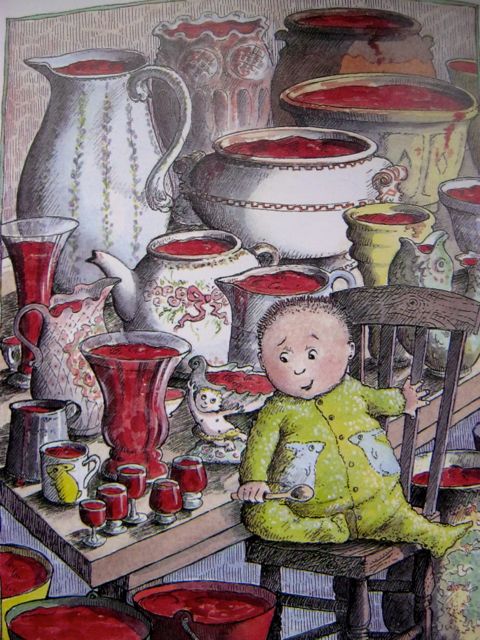
Anyway I just needed to add a little postscript to my challenge. When browsing the wiki page of Helen Oxenbury I came across a link to Margaret Mahy and was astounded that I had completely forgotten her and how much we loved 'The Man Whose Mother Was a Pirate'. However the one I had to write about is 'Jam' (illustrated by Helen Craig) (and had to pop to Amazon to find a second hand copy, I am not sure we ever owned this but had it from the library regularly.)
The story goes that Mr Castle takes over the running of the family home when Mrs Castle goes off to be a scientist. Of course he has to be an uber-house-husband and gets all the jobs done in super efficient style, but we'll let that pass because the rest of the tale is so good. In searching for more domestic chores to fill his day he discovers the plum tree in the garden just loaded with fruit and sets about making some jam.
However, he begins to take it all a little too far. Determined not to waste any of the precious plums he makes more and more jam, filling every possible container in the house, including the flower vases and the sherry glasses. Then the family has to eat all the jam. At first it is wonderful and they enjoy all the cakes and puddings, but after a while they begin to tire of it (not to mention worrying about their expanding waistlines.)
They dare not say anything to Mr Castle for fear of hurting his feelings but eventually the jam haunts their dreams and they come to long for something, anything, to eat that is not jam. At last the final jar of jam is consumed and they plan a new exciting menu, only to discover that a whole year has passed and the plums on the tree are ripe once again. A cautionary tale about home preserves I think.
(You can visit other A to Z Reflections posts here)
Subscribe to:
Posts (Atom)