Monday, 21 February 2022

1419, Billy Summers and all that

It has taken me a couple of months but I have been listening to Lord of the Rings on audiobook over on Youtube. I started off with a multi voiced dramatisation which vanished after a few chapters (as things are wont to do there) then I found Rikash Doekhi and Paul Skinner who provided the remainder (though I was irritated the way Paul pronounced Gandalf, not enough to spoil it and his reading voice is excellent). I reviewed the book back in 2015 after Monkey and I shared the reading of it, and enjoyed it just as much this time around. I was reminded of the ending, which is missing from the films, where the Hobbits return and must fight again to reclaim their Shire from the forces that have invaded it. In some ways it feels a vitally important part of the tale, of how much they are transformed by their experiences, and how nobody rescues them, they do it together, without help from their fellowship. 

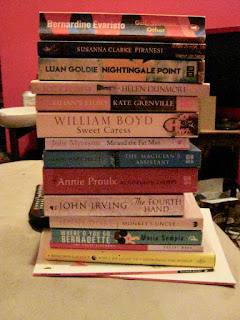
We had a very successful charity shop trawl last week, including copies of 'Girl, Woman, Other' and 'Piranesi'. Certainly enough to keep me going for quite a while. I tend to pick out authors that I have read before so I can be quite sure I have some good reading in my near future.


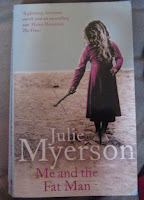
I picked out 'Me and the Fat Man' by Julie Myerson as a quick read (I have reviewed her before, here and here). In it Amy is drifting through life, not knowing who she is, having lost her mother very young and been raised by disinterested foster parents. She meets Harris, who claims to have known her mother, and through him, the fat man, Gary. But things are not at all as they seem, and events rush on, overtaking her, until a tragedy forces her to face up to things. It is a weird little story, about how a person flounders without roots. 
"It had seemed like chance that Gary and I should meet in the pub that night and had felt like choice when I fell for his big body and his gentle, unlikely ways.
But Harris had special skills. He had the skill of making you feel you were choosing, making you believe that anything could happen - that fate was just messing around. They were good times, the ones that followed - though then I was too blinded by the newness to see it. Just when I thought I understood a fact, another, stranger one appeared. Like the dolls you get that you open and there's another inside - each one eating up the next, so as the whole thing can continue. " (p.85)


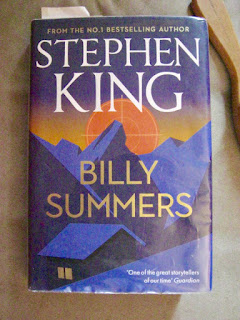
Previous to this however I had finally managed to get hold of 'Billy Summers' by Stephen King. (Shocked to discover it is a decade since I read 11/22/63, it feels like only a couple of years ago.) I really enjoyed this book, he knows how to keep the story moving, with plenty of twists and turns, and how to make you like people, even when they are bad people; which I guess means he writes them as people not clichés, with strengths and weaknesses like the rest of us. 
Billy is a contract killer. But he only kills 'bad people', at least that's how he justifies to himself how he makes his living. He is sucked in to doing a final job by the promise of a big payout. But as he waits around preparing to make the hit he becomes more suspicious of the set-up, and makes his own plans to extricate himself from the situation. As is so often the case (they are criminals after all) people have not been straight with him and he digs a little deeper to find there are some even badder bad people behind the arrangement. Acting on instinct (and proving he is not such a bad bad person) he rescues a young woman and their relationship leads to other bad shit. All the while he is writing his own life story, which we read, and he reflects on how things have come to be this way. While I have no desire to dip into the horror genre I have enjoyed Stephen King, he tells a great story.

"Half way back to his office, he had a nasty thought. There were a few moments on his way here when he lost focus, his mind on Shan's drawing instead of staying where it belonged, on this morning's preparations. Has he dropped the Dalton Smith phone into the sewer instead of one of the others? The idea is so terrible that in that moment he's positive that's just what he did, when when he reaches in his pocket he'll find the Billy-phone, or the Dave-phone, or that useless burner. If so, he can replace it, his Dalton Smith credit cards are all good, but what if Don or Beverley Jensen should call on the day or two before FedEx can deliver a new one to 658  Pearson? They'll wonder why he's out of touch. It might not matter, but it might. Good neighbours, grateful neighbours, might even call the police and ask them to check his basement apartment to make sure he's okay.
He grabs the phone, and for a moment just holds it, feeling like a roulette player afraid to look at the wheel and see which color the little ball has landed on. the worst thing - worse than the inconvenience, even worse than the potential danger - is knowing he was careless. He let his thoughts slip to the life that's now behind him.
He brings the phone out of his pocket and breathes a sigh of relief. It's the one that belongs to Dalton. He's gotten away with one potential mistake. He can't make another. The fates are unforgiving." (p.144-5)

Stay safe. Be kind. Turquoise or Tangerine for the new sofa covers?

Saturday, 5 February 2022

crazy old ladies

Strangely Lewis and Rachel invited a crazy bus lady to lunch and let her cuddle their baby ... and then posted the most unflattering photo on the family photo album so all the other grannies can feel normal. I had a lovely afternoon with Jacob and Aisla; it was like a blast from the past, first wandering round the toy shop (where to be honest she picked something really fast compared to my lot) then getting to know Aisla while Jake chatted for ages to the guys in Games Workshop. Then I spent a lovely 24 hours cuddling the babe. I was worried that she would not like strange new people but she smiled up at me and we got along like a house on fire.

I had a very long trek home, but not because of the weather. The snow cancelled the trains going on to Edinburgh but ours going south was stymied by a broken down train between Northallerton and York. So I read my book in a cold waiting room for an hour and a half, then on a very slow train to York that missed the connection for Manchester. About a dozen of us were ferried by taxi and I finally got home about 1am. I was so buzzed I just sat up and finished it.

'Drive Your Plow Over The Bones of the Dead' by Nobel laureate Olga Tokarczuk (linking to wiki as her website is in Polish) is translated by Antonia Lloyd-Jones. I knew I was going to love it straight away. It tells the story of Janina Duszejko (who hates the name Janina) and her grumpy neighbour Oddball, Good News who runs the local second hand shop, a former student Dizzy and wandering entomologist Boros. (People's names in the story are mostly invented by Janina, allocated according to her impression of them). It begins with the death of Big Foot (their only other near neighbour), and progresses though the deaths of several other local men, which Janina is convinced are being masterminded as revenge by the local wildlife. She and Oddball don't actually have much to do with each other prior to the murders but circumstances conspire to force them to get to know each other better.

I liked her here, because although she is a crotchety old woman and avoids her two neighbours as much as possible, she has moments of just ordinary humanity and being a decent human being:
"As I looked at Big Foot's poor, twisted body I found it hard to believe that only yesterday I'd been afraid of this Person. I disliked him. To say I disliked him might be putting it too mildly. Instead I should say that I found him repulsive, horrible. In fact I didn't even regard him as a human Being. Now he was lying on the stained floor in his dirty underwear, small and skinny, limp and harmless. Just a piece of matter, which some unimaginable process had reduced to a fragile object, separated from everything else. It made me feel sad, horrified, for even someone as foul as he did not deserve death. Who on earth does? The same fact awaits me too, and Oddball, and the Deer outside; one day we shall all be nothing more than corpses." (p.18)

Liked this description of his house, and how much Janina admires it:
"Oddball's fondness for order is plain to see in his small front yard: the firewood for the winter lies piled in ingenious cords arranged in a spiral. The result is a neat stack of golden proportions. These cords of his could be regarded as a local work of art. I find it hard to resist their beautiful spiral order. whenever I pass that way, I always stop and admire the constructive cooperation of hands and mind, which in such a trivial thing as firewood expresses the most perfect motion of the universe.
The path in front of Oddball's house is so very neatly gravelled that it looks like a special kind of gravel, a collection of identical pebbles, hand-picked in a rocky underground factory run by hobgoblins. Every fold of the clean curtains hanging in the windows is exactly the same width; he must use a special device for that. And the flowers in his garden are neat and tidy, standing straight and slender, as if they'd been to the gym." (p.34)

As the story progresses you get a glimpse of her feelings about the natural world, and her growing anger at people who defile it:
"Then, if I went beyond our bounds, the landscape changed. Here and there exclamation marks stuck out of the ground, sharp needles piercing the scenery. Whenever my gaze caught them, my eyelids began to quiver; the eye cut itself on those wooden structures erected in the fields, on their boundaries, or at the edge of the forest. In total there were eight of them in the Plateau, I knew the exact figure, for I'd had dealings with them in the past, like Don Quixote with the windmills. They were knocked together out of wooden beams, set crosswise; they consisted entirely of crosses. These grotesque figures had four legs and a cabin with embrasures on top. Pulpits for hunting. This name has always amazed and angered me. For what on earth was taught from that sort of pulpit? What sort of gospel was preached? Isn't it the height of arrogance, isn't it a diabolical idea to call a place from which one kills a pulpit?" (p.64)

She is a weird mixture of ideas. She is obsessed with astrology, and has a theory about astrological charts predicting the death of the individual, and also the means of death, and she regularly writes to the police with this theory as the murders multiply. She is an engineer by trade, but her 'Ailments' (random capital letters are applied to important words) caused her retirement and she now teaches English in the local school and cares for several holiday homes during the off-season. But she is curious and scientific too. Here she is conducting a experiment:
"I was working in my garden patch, testing one of my Theories. I think I can find proof for the fact that we inherit phenotypes, which flies in the face of modern genetics. I had noticed that certain acquired features make irregular appearances in subsequent generations. So three years ago I set about repeating Mendel's experiment with sweet peas. I am now in the middle of it. I notched the petals of the flowers, through five generations in a row (two a year), and then checked to see if the seeds would produce flowers with damaged petals. I must say that the results of this experiment were looking very encouraging." (p.171-2)

So the story was excellent, the characters were excellent and the atmosphere of the place. I was going to give you a long quote with another astrological theory but I need to just give you a little touch of her writing that had moments like this (and all credit to the translator who captured the writing so well):
"The Samurai's windows were coated with hoar frost, still young, very fine and delicate, like a cosmic mycelium." (p.229)

It is a spoiler to say she did it. I am not sure how much I suspected her, but it was not a surprise. The back story emerges gradually, explaining all. And with the help of her trusty band of friends she escapes across the border to the sunny Czech Republic. And I cheered. 

Stay safe. Be kind. Ponder some morally ambiguous summary justice.

Wednesday, 26 January 2022

Daughters and Mothers

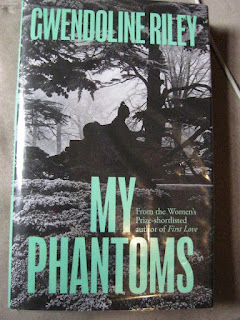
Back in 2013 I enjoyed 'Sick Notes' by Manchester author Gwendoline Riley and so pounced when I read a review of 'My Phantoms'. In it a young woman negotiates a somewhat fraught and distant relationship with her mother. Bridget can manage with their annual birthday dinner but as her mother gets older and unwell she seems to want them to be closer. It's not even that she dislikes her, it's more ambivalent; that the mother, Hen, is just needy, has unspoken expectations of her daughter and seems to look in all the wrong places for companionship. It is a portrait of two people just not getting on, with Bridget caught between what she ought to feel and do as a dutiful daughter and what she does feel and want to do. And then there's the father in the background, and you begin to wonder how the two girls are functioning adults. It's funny (funny weird, not funny ha ha) how often I read books that just make me and my family seem so normal, and make me feel grateful. Sorry, it had to go back to the library last week so no further thoughts, but very much worth the read. Quote, as the two girls are getting ready for a weekend visit with their dad:

 "'There's no point in provoking him, is there?' she used to say - to repeat - chivvying Michelle and me to find our coats and shoes; to be ready ten minutes before our father was due. Even back then I knew that she was talking to herself, really; whisking herself through the task in hand. My mother had her sayings, but she did not give real advice, ever, about anything.

Here, 'there's no point in provoking him, is there?' seemed to mean, 'There's no reason for me to behave in a sane and civilised way when he doesn't (is there?), not when there's a golden opportunity here for me to join in and be mad too.' And she didn't even mean 'provoking', did she? She meant an omission, not an action. She meant: You mustn't fail to anticipate something he could plausibly decide to be affronted by. Which rather left one with nowhere to go. Michelle and I had never been cheeky or disruptive. We'd been mild and quiet from the start when he was around, and it made no difference. Anything could set him off, or not set him off. All depending on how he wanted to feel; on what kind of satisfaction he wanted to extract. Not provoking him could provoke him. It often did provoke him. She knew that. Why did she like to pretend otherwise? For excitement's sake, perhaps? Or because she didn't want to feel left out? I've an image of a dog trying to join in with a football match, but that's possibly too wretched. I think her mental sleight was more akin to the way Michelle and I, after our swimming lessons, used to hit the buttons of the arcade games in the snack bar: we hadn't put any money in, but nonetheless persuaded ourselves that we were affecting the progress of the yellow lights, which flashed in steps, then slowly cascaded. In fact, there were a lot of children who liked to do that, as I remember. It must be a thing children like to pretend. If someone else had got there first, I used to wait my turn, not too close to the machines, but not too far away either." (p.26-7)
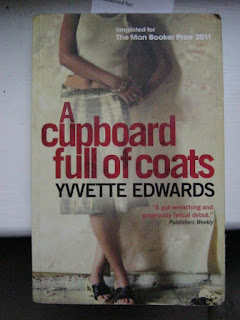

'A cupboard full of coats' by Yvvette Edwards is the story of Jinx, and her mother. But her mother is dead, and the how and the why form that basis for a long weekend of soul searching by Jinx and Lemon. Neither of them killed her but they have both felt responsible. I find it hard to get my head around volatile, abusive relationships, and why people stay in them, but it does make for emotionally fraught story telling. So we watch Jinx, watching her mother, falling for this charming man, this man who invades their lives and then their space, who gets his feet under the table and has no intention of moving. Jinx sees, and she knows, but there is no one to tell, and as her mother lurches from joy to misery and back again she can only watch from the sidelines, powerless to stop it. 

But her guilt and sense of responsibility has over the years translated itself into feeling unable to bond with her own child, a son who now lives with his father, and conversely to the situation in My Phantoms, comes over to visit her. And unlike Bridget's father who ignores or lords it over his daughters, Jinx's feelings of inadequacy drown her every interaction with her son. Here she watches, jealously, as Ben chats animatedly with Lemon:

"I listened as he told Lemon about Max in his class whose tooth came out when he bit an apple in his packed lunch. There were anecdotes about his Power Ranger toys, Thomas the Tank Engine, and Shaggy's exploits in Scooby-Doo. He talked about his new teacher, Mrs Smith, and how impressed she was with his reading. Lemon gave him piece of paper and a pen and Ben proved once and for all that he could write his name himself without any help from anyone.
I was in shock. I had never heard my son like this before. I had simply thought he was a morose child, because morose was how he always was when he was with me. I had never seen this side of him, this laughing chattiness, the non-stop outpouring of everything going on in his life, the pleasure he took in his accomplishments, such as they were. And I felt hurt. Really hurt. Wounded to the core just listening to how natural and happy he could be with a virtual stranger, when I had been trying for nearly five years to have a relationship with him and had come up against brick after brick after brick.
He made me feel how he had made me feel when he was a baby. Like no matter what I did or how much time I put in or how hard i tried, anyone could walk into his life and they were immediately more important than I was. Like I did not matter. My existence meant nothing. And all the while, as I sat on the periphery of their conversation, I could feel myself getting angrier and angrier, and though I tried to rationalize my way out of it, I just couldn't stop myself." (p.38-9)

She is a very unhappy young woman, with so much hurt and grief bottled up, thrust into premature adulthood by the loss of her mother, and so good at covering it all up. So Lemon stays, and cooks for her, and in caring for her and making her vulnerable they each share their story of what happened, and the unfolding of the story, the build up of the violence, and the silence, is very skilfully handled. Here Jinx watches Lemon bring Berris and try to make peace after the first beating:

"I'd hated that man so bad for weeks, wanted nothing else in that time but that he pack up and get out of our home, yet he looked more wretched than any man, woman or child I'd ever seen in my life. Like he knew he'd done the worst thing a person could ever do and was truly, to the heart, sick and remorseful and sorry. He couldn't lookout her and he couldn't stop himself from bawling like a baby. It was the most pathetic thing I'd ever seen.
In that moment, because I knew what he'd done, how he'd smashed in my mother's face in temper, because the memory of him polishing off his dinner and the look of pure satisfaction in his eyes was still fresh and vivid in my mind, my feelings shocked me. I looked at the man who had caused our family so much hurt, so much upset, and there was no denying it; I felt sorry for him.
I felt sorry for him." (p116)

And much of the book I liked Lemon, he cared about music and food, and loved Jinx's mother from the sidelines. But then he tells his side of the events, and I rethink. And then he meets up with Berris after he is released from prison and he says this:

"'You know, after what he done, I thought for a long time he was the hardest-hearted man alive, the coldest, the evilest. But after I spoke to him last time, watching him, listening, not how I done most of my life but kind of fair-like, not squeezing him into the way I wanted to think of him, but looking hard to see who he really was, what he was, after all that I come to the conclusion he was just sensitive. Oversensitive. Even small things that wasn't meant to be no slight hurt him. I tried to imagine how it felt to be in his shoes, and they was small and tight and uncomfortable ...' " (p.247)

and reading it made me feel sick, because she captures here so succinctly how men justify violence against women, as if it was all ok, and he was forgiven, because he was sensitive and her going out dancing and having a nice time without him is behaviour deserving of death.

Sometimes it feels hard to take stuff in, because stories like this repeat down the years, in real life as well as fiction. But Tish and I enjoyed this article about Grace Tame who steadfastly refused to politely smile on camera with the Australian prime minister, and people go ape-shit about it. Women don't owe the world a smile.

Stay safe. Be kind. Don't smile if you don't want to.
Friday, 14 January 2022

January colour

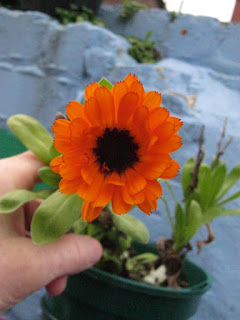
While most of the garden is looking brown and wizened it was lovely to look out this morning and notice that some little plant in a wall pot had put forth a bright orange flower:
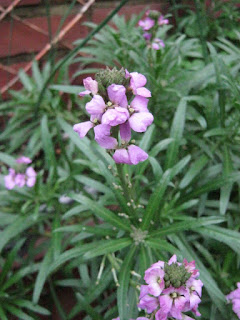
When I went out to take a photo I found that the wallflowers were still blooming, having done so continuously since mum sent them:
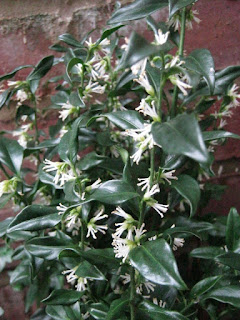
 And the Sarcococca confusa that I planted back in July has not grown much but it is doing what it promised and blooming with tiny white flowers:

Stay safe. Be kind. Enjoy the winter blooms.

Tuesday, 11 January 2022

Summerwater

'Summerwater' by Sarah Moss was sent to me by the library. When I just searched her name I found the review of 'The Fell' that I read in the Guardian, and I am pretty sure that that was the book I reserved, and that the library just sent me another random book by her instead (another random book by her also reviewed here). It is not a novel as such, they are more like vignettes of family life, of a group of families staying in loch-side cabins during a dreary, rainy summer. They live both, claustrophobically, inside their little huts, but also watch each other's comings and goings, while pretending not to, making crass judgements and feeling irritated by the rain. Some 'foreigners' occupy one of the cabins, and there is a growing resentment at their loud intrusive nighttime music. I felt disappointed that there was limited story development or relationships between the characters, each of the chapters focussed on one person, then moved to someone else, with the human beings in the story only coming together for the denouement. It made me feel lonely, because all the people were quite lonely, self-contained, living inside their own heads even alongside their families. 

I liked the first chapter best, an intense description of a woman running:

"It's more than a wingbeat this time, as she splashes through the brown puddle that now covers the whole width of the path. More, she thinks, grinning at the menagerie now imagined in her ribcage, at the entire damn food chain gathered in the chambers of her heart, more like a small mammal, something with hurrying feet. Smaller than a hare. A vole, doctor there's a vole in my upper ventricle. One of these days, she thinks, one of these days, girl, and she pulls off her wet vest, balls it in her hand, picks up the pace, races bare-bellied in the rain past the tent and through the trees and around the barriers at the top of the holiday park, part the bicycles and the blue gas cylinders and the limp laundry and the old man sitting again at his open French windows with a cup of tea. Safety first, the consultant said, there in an overheated pink room with the machines resting between patients, we must think of your kids, they need their mum, don't they, I'm afraid I must say there's to be no more running. And if you really won't take my advice at the very least don't go far, don't push yourself, don't ever run alone.

But what's another person supposed to do, if her heart stops? How would it help, to have a witness?" (p.22-23)

We are finally back at the gym this week, after a month away. I was too tired during Christmas pressure and then we had to isolate, so we are all feeling a but sluggish after a fortnight on the sofa. I did not make new year resolutions, though will continue to not beat myself up about stuff. I joked to the girls about doing a Tough Mudder as a way of giving us something to work towards ... but who am I kidding.

Stay safe. Be kind. Push yourself.

Saturday, 8 January 2022

Coincidences


I love coincidences. They are a kind of magic. I encounter them regularly at work in a low key way that amuses me. Someone will come in to collect a parcel, and then the next person comes in, and their parcel is the one right next to the previous one (out of about 1500 in stock). Or a person comes in, and the next person has the same surname. Or a person comes in, from a little road with a dozen houses, and the next person who comes in is one of their neighbours. Ok, so yesterday I had the freakiest coincidence. A lady comes in with a message to say her parcel is available to collect. When I search the tracking number we do not have it. I put the number in the tracking system and strangely, even though it has an M14 postcode, it is booked in at Hastings delivery office (see above image). I apologise and explain to the lady that they probably have an Ealing Avenue and it has been missorted. I suggest (apologising again) that she phone customer services. Anyway, she collects another parcel that we did have and leaves. The next person at the counter ... their surname is Hastings.
A while later I remember the DOBI, and find an email address for Hastings delivery office and send them a message about the package. They email right back and say they will send it on. Job done. Then this morning, just out of curiosity I look to see if there is an Ealing Avenue in Hastings, and strangely there is not, which leaves me wondering how it came to be booked in on their SPS. But curiously ... there is a Hastings Road in Ealing.

Stay safe. Be kind. Enjoy the magic.

Wednesday, 5 January 2022

Bewildered

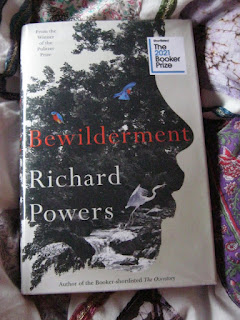
'Bewilderment' by Richard Powers is definitely a book worthy of inclusion on the Booker shortlist. In it Theo and Robin struggle with life without Aly, but that is not their only struggle. As Robin decides to continue his mother's fight to save the planet's wildlife Theo must battle the authorities for the soul of his son; Robin's increasingly erratic behaviour is causing concern that may lead to 'medication'. Theo's job involves the search for life on other planets, and he creates a game with his son where they imagine that they are exploring alternate realities, possible lifeforms across the galaxy that manage to exist in the most unlikely of circumstances. Robin continues to have problems controlling his anger and frustration so Theo turns to Martin Currier, a former colleague (and lover) of Aly who does brain research, and the boy takes part in a study involving mapping brain patterns of emotional states. The technique helps him enormously, and he in return contributes to the research. In attempting to balance protecting Robin from the pressures of a system that does not wish to accommodate him with the need to be a professor they discover the joys of home schooling; they jump through the curriculum hoops that the state requires and leave Robin free to pursue his passion for endangered animals.  When Martin asks to use Robin's experience in his research to help with his funding Theo reluctantly agrees, and that's when things get a bit out of control, with consequences that might have been anticipated. 

A beautiful book, intense and emotionally fraught. Lots of obscure science stuff, that may or may not have any basis in reality, but you can imagine that it does. It feels like the fate of the planet is in the hands of this boy, he takes the weight of the world on himself, and it squashes him. I liked that he was bright and precocious, but also a child, with the way that children can experience things so intensely, and feel so intensely their smallness and weakness in the face of the powers that control. And his father supported him in what he was trying to do, in spite of his smallness and weakness, he made him believe it was worth trying. And then hopes are crushed all round and the reality of the world come crashing in and I cried.

The trials of being a parent loom large in the book, and that is what really sucked me in:
"But it turns out children have a tolerance for mistakes that I never imagined. Who's have believed a four-year-old could pull a grill full of hot charcoal down onto himself and walk away with no lasting harm beyond a brand like a shiny pink oyster on his lower back.
On the other hand, the ways of going wrong never fail to stun me. I once read my six-year-old The Velveteen Rabbit and only learned from my eight-year-old about the months of nightmares it had given him. Two years of night terrors he's been too ashamed to tell me about: that was Robin. God only knows what the eleven-year-old might confess to me about the things I was right now doing wrong. But he'd survived his mother's death. I figured he'd survive my best intentions.
I lay in our tent that night, thinking how Robbie had spent two days worrying over the silence of the galaxy that ought to be crawling with civilizations. How could anyone protect a boy like that from his own imagination, let alone from a few carnivorous third-graders flinging shit at him? Alyssa would've propelled the three of us forward on her own bottomless forgiveness and bulldozer will. Without her, I was flailing.
I twitched in my sleeping bag, trying not to wake Robin. A chorus of invertebrates swelled and ebbed. Two barred owls traded their call-and-response: Who cooks for you? Who cooks for you-all? Who would ever cook for this boy, aside from me? I couldn't imagine Robin toughening up enough to survive this Ponzi scheme of a planet. Maybe I didn't want him to. I liked him otherworldly. I liked having a son so ingenuous that it rattled his smug classmates. I enjoyed being the father of a kid whose favourite animal for three straight years had been a nudibranch. Nudibranchs are deeply underappreciated.
Late-night anxieties of an astrobiologist. I smelled the trees respiring and heard the river where Alyssa and I first swam together, polishing its boulders even in darkness. A noise came from the bag next to me. Robin was pleading in his sleep. Stop! Please stop! Please!" (p29-30)

Stay safe. Be kind. Get tested. (We finally had covid here last week, it can strike even the fully vaccinated.)